When a public EV charger isn’t working in Elgin, treat it as a low-range problem, not a kiosk puzzle. Try a second stall and a clean app start. If the session still won’t begin, stay put. If your building never had a home plug, call for a mobile boost.
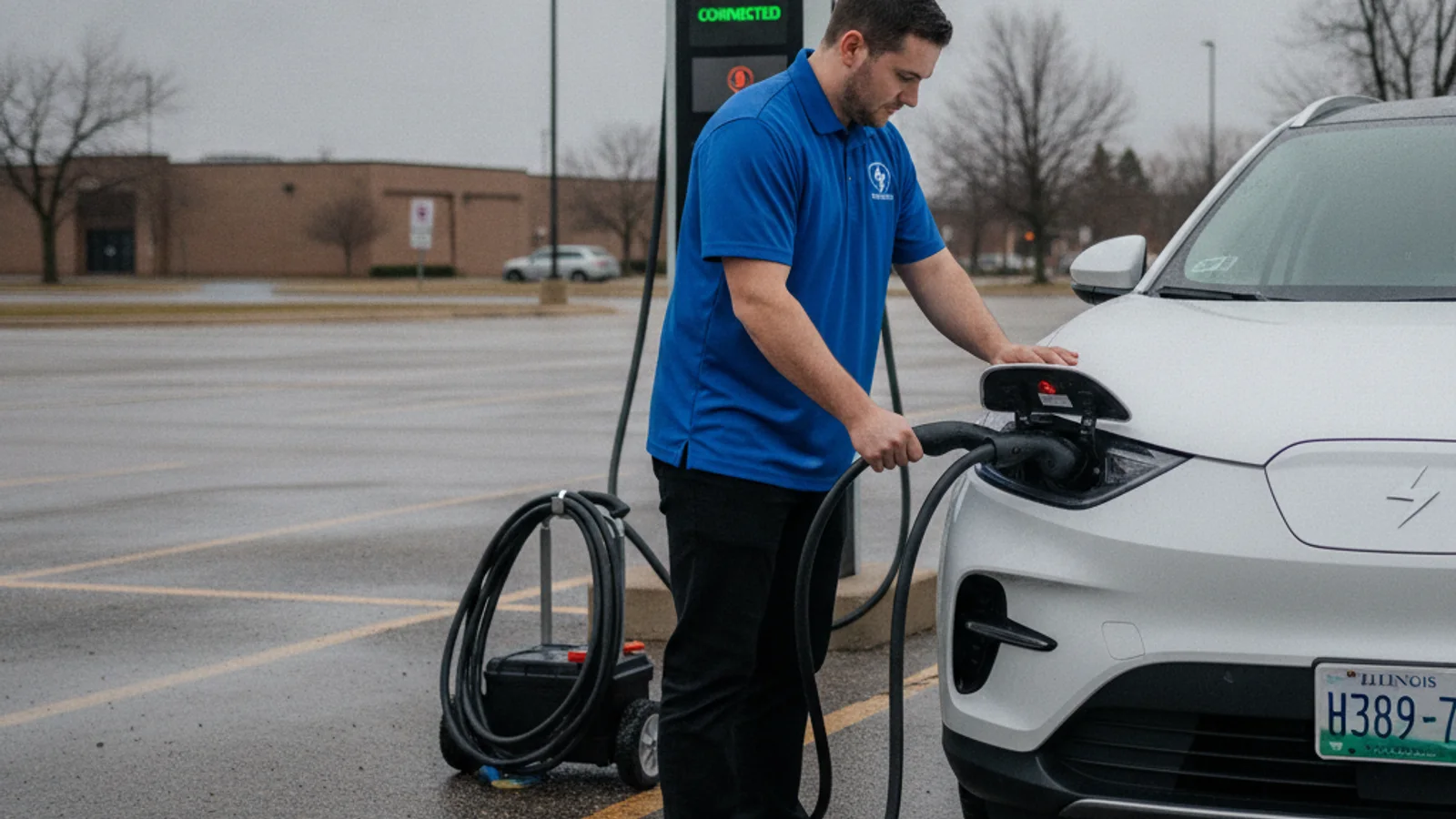
Downtown Elgin doesn’t give you a garage fallback
Elgin is a large Fox Valley city in Kane County. Census figures put the population a little over 114,000. About 41.5% of the housing stock went up before 1980. A lot of that older stock sits in the downtown core. More of it lines the Fox River riverfront. You’ll see the same era around the Hemmens Cultural Center.
Those buildings were wired for lights and window units, not a 240-volt wall box. Plenty of drivers here park on the street or in a shared lot. They lean on public stalls because home never got a charger. When that public session fails, there isn’t a driveway to limp back to.
The west side feels like a different town inside the same limits. Newer growth along Randall Road means more driveways and more off-street parking. If you live out that way, a dead stall is often just a delay. You can finish the trip at home. If you live downtown, the same dead stall is the whole problem. Students at Elgin Community College without a plug are in that bind too.
St. Charles sits just south along the Fox River. Its housing skews newer than Elgin’s older core. A failed public session lands harder here than a few miles downriver.
Weekdays look different from casino nights. Student cars stack around Elgin Community College. Retail traffic piles onto Randall Road after work. Downtown street parking turns over slower on event nights at the Hemmens. The failed stall is the same. The clock on your range is not.
The Grand Victoria Casino makes this worse on long-dwell days. You leave the car for hours. You come back ready to roll. The kiosk throws an error, and the pack is already lower than you wanted. The same pattern shows up after a show at the Hemmens. A late class on campus can leave you there too. The casino district and downtown share that long-park-then-error pattern.
ComEd serves Elgin, so home-charger questions belong with that utility. Confirm any rebate or install rule with them before you spend money. This page couldn’t verify current ComEd EV program figures from materials we could cite. The utility sets those programs, not Charge Pro CHI.
Start with the phone, not the handle
A stalled session often isn’t a fried cabinet. It’s a handshake that never finished.
Force-close the network app. Open it again. Start the session from the phone, not the screen. ChargePoint, EVgo, and Electrify America all bill through that app path. Tapping the kiosk over and over doesn’t retry the same thing.
If the stall already shows unavailable, believe it. Check the network’s own status in the app. Then open a driver-report map before you unplug and wander. Our guide to charging apps to open before a strand walks through that order.
Try a second payment method next. An expired card or a lapsed plan can look like a dead charger. Swap to another card in the app. Use the RFID fob if you carry one. Don’t assume hardware failed until payment clears.
If the app says connected and nothing flows, that’s a different fault. Public charger connected but not charging covers that path in more detail.
Then treat the cable like the suspect
Unplug all the way. Look at the connector before you push it back in. Grit, ice film, or a bent pin will kill a start. Seat it firmly until it latches.
Move one stall over if you can. Fast sites often share a power cabinet across two or more posts. One screen in error doesn’t mean the whole bank is dark. A quiet neighbor stall is a better test than a drive across town.
Give that loop a few minutes, not a long wait. You’re not repairing the site. You’re ruling out a loose plug and a stuck app. After two stalls and a fresh login, stop. Standing in the lot while range ticks down turns a nuisance into a stall.
Cold weather makes the same checks slower. Connectors feel sticky. Gloves hide a bad seat. Take the extra second to look, then click it home. If the port door is icy, don’t force it. A bent latch turns a failed session into a shop visit.
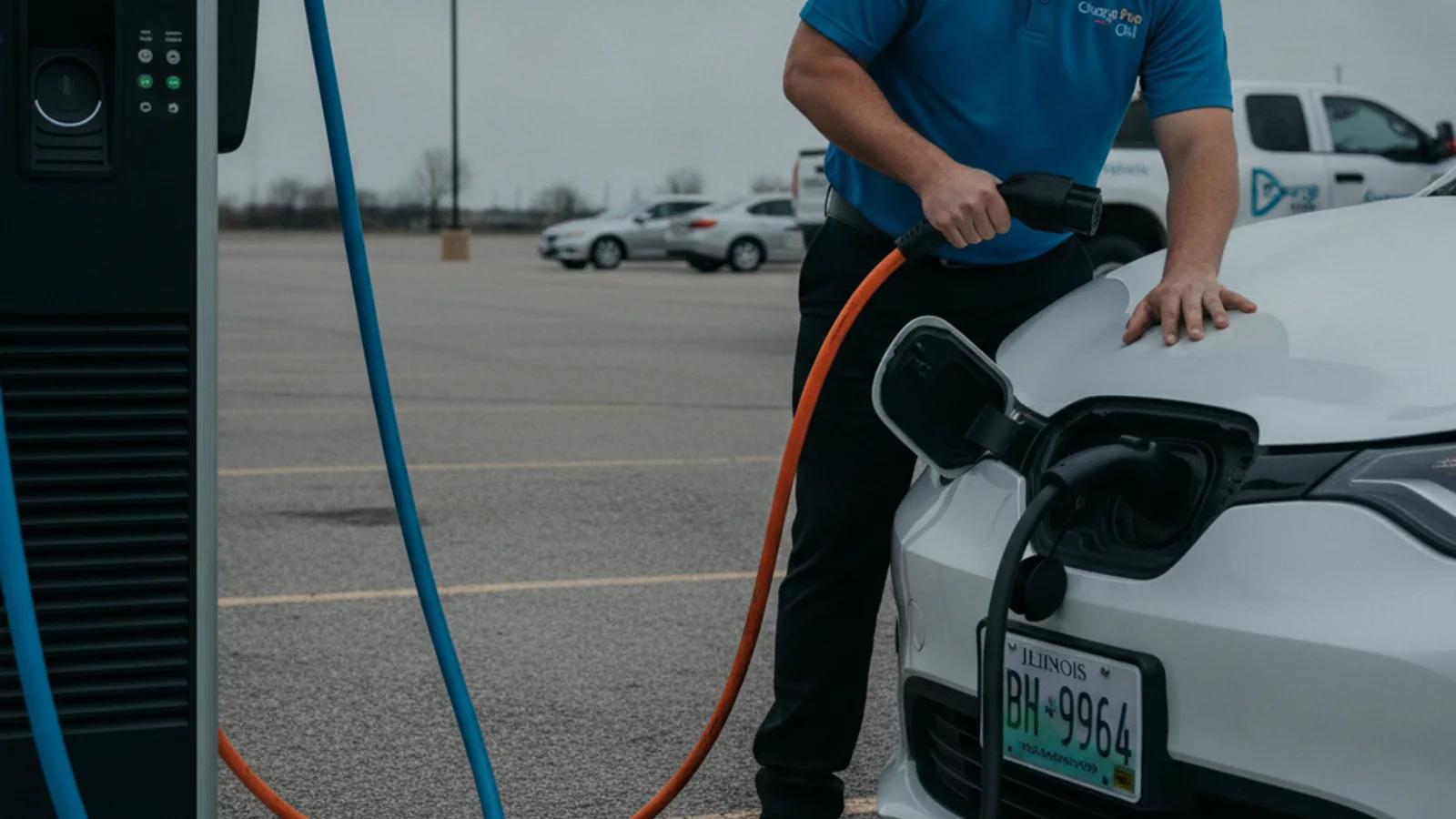
Split upkeep is why a stall can sit broken
Tesla Superchargers are a closed loop. Tesla builds the hardware, owns it, and services it. That doesn’t make every Supercharger perfect. It does mean one company is on the hook.
ChargePoint, EVgo, and Electrify America often sit on a split. A property owner buys the cabinet. The network runs software and billing. When a cable fails, those two parties have to agree who fixes it. You can’t see that queue from the parking stall.
Public cables also take more abuse than a home plug. Dozens of drivers a day yank the same handle. The connector hits pavement. Someone forces the wrong inlet. None of that is your fault. It also isn’t something you can fix with another reboot.
There’s a software disguise too. A DC fast stall has to reach a billing server before it will energize. If that link drops, a mechanically fine charger still refuses to start. That’s why the app restart belongs early, not last.
This page does not have a verified count of down stalls in Elgin. Networks change status by the hour. Trust live app reports, not a remembered map pin. Don’t drive on a guess that a site is usually fine.
Don’t spend the last miles proving a theory
Randall Road is one of the busiest retail corridors in the region. The far west corridor is built for errands, not for a dying pack. US-20 and State Route 31 feed that same loop. So do State Route 25 and Big Timber Road. You’ll find lots of short-trip parking if you already arrived low.
I-90, the Jane Addams Tollway, is how people leave town. If the pack is already thin, don’t roll toward the tollway on a hope. Out of charge on I-90 is a worse night than a quiet lot downtown.
Out of charge on Randall Road is the same trap in retail traffic. Apps will paint a green icon. They will not hold a stall for you. Confirm the next site from a parked seat. Only then move the car.
A rough cutoff helps. If you still have a healthy cushion, a short hop can make sense. If you’re already under about 10%, hunting becomes a gamble. Heat, cold, and stop-and-go all eat the estimate your dash is selling. Stretch what’s left from a parked, safe spot.
South Elgin, Bartlett, Streamwood, Carpentersville, and St. Charles sit next door. Nearby only helps if a live report says a stall is working. You still have to reach it without drama.
Stay in the lot. Put the car in park. Do the research sitting still. Chasing a rumor of a working plug is how a broken kiosk becomes a shoulder call.
When staying put is the smart call
Call for a mobile boost instead of another drive in these cases.
You’re under a thin reserve and can’t confirm a stall you can reach. You’ve already tried two stalls or two networks in the same lot. You’re at the casino, on campus, or downtown without a home plug tonight. You’ve got a shift or a pickup, and you can’t wait on the site. You’re alone, it’s late, and you don’t want to tour unfamiliar lots.
Charge Pro CHI is a referral line for Chicagoland. We don’t own trucks, and we don’t run the charging networks. We match you with an independent local operator. The pros we connect you with are licensed and insured. That operator quotes you before any work starts, then bills you directly.
Ask for mobile EV charging if you want the charge brought to the car. The pro comes to you, not the other way around. You can stay at the dead kiosk or in a casino lot.
For more local context, see mobile EV rescue when you stall in Elgin and the Elgin charging city page.
What shows up, and what it can do
The operators in this network bring a 240-volt Level 2 source to the car. Teslas take a native NACS plug. Other EVs use a CCS or J1772 adapter. That typically adds 10 to 20 miles in 15 to 30 minutes of charging. That’s plug-in time, not a promise of when someone arrives.
Ten to twenty miles is usually enough to reach a working site. It can also get you home if the west side has a plug. It isn’t a full charge. You shouldn’t expect the pack to fill in a parking lot.
If the dash is dark or the locks act weird, think 12-volt first. A charge port that won’t open is often the same battery. That isn’t an empty pack. Public kiosks can’t jump that. The same operators can jump or replace a dead 12-volt battery on site. They handle Tesla and every major EV brand.
Describe what the car is doing. Let the operator say whether you need pack energy or a 12-volt wake-up.
Make the call before the pack hits zero
A dead public stall isn’t a personal failure. In Elgin’s older core, you can’t always sleep it off in the driveway. If two stalls and a fresh app still won’t start a session, stop spending range.
Call (858) 925-5546 to get matched with a local operator. Stay with the car if you can do it safely. Keep the network app open so you can show what you already tried.
Frequently asked questions
Why won’t the public charger start a session?
Most no-starts are a loose connector or a failed app handshake. A payment reject or one bad stall can look the same. Reseat the cable. Restart the app, not just the kiosk. Try the next stall. If that’s clean and the screen still errors, treat the stall as down.
Should I keep driving around Elgin to find another stall?
Only if you have a real cushion and a live report. Under about 10%, stay parked. Downtown drivers without a home plug have less room to gamble. Confirm the next stall from the lot. Then move once, or call for a boost instead.
Can an operator charge a non-Tesla at a broken public stall?
Yes. The independent operators we connect you with bring CCS and J1772 adapters. Tesla uses native NACS. They charge the car where it sits. You don’t need that public kiosk to recover. They quote before they start, and they bill you directly.