A charging app is useful while you still have miles to spend. It does little after a Naperville commute ends low. Schaumburg parking can leave you in the same spot. That’s the split this page is about. Use apps for EV charging while you can still choose a stop. Call for a mobile boost when you’re done driving. The car needs power where it sits.
Apps plot a station. They don’t charge the car.
A map on your phone shows hardware someone else installed. It doesn’t roll up with a 240-volt Level 2 source. It doesn’t jump a 12-volt battery. Those are separate jobs. If you blur them, you lose time.
A low high-voltage pack is a range problem. A car that won’t start, with odd lights or a charge port that won’t open, is often a 12-volt problem. Apps for EV charging won’t sort that for you. They only list public plugs.
Charge Pro CHI is a referral line. We match stranded EV drivers with independent local operators. We don’t own trucks, yards, or chargers. We don’t employ technicians. We don’t set the price. The operator quotes you before starting, then bills you directly.
A Chicagoland day isn’t one kind of parking
Chicago’s 2024 population estimate is 2,721,308. Census figures put 68.6% of its housing as built before 1980. Oak Park is at 78.6% pre-1980 stock. Cicero is 90.2%. Berwyn is 90.0%. That older pattern is a verified housing fact. It’s not a statement about public chargers on any given street. It does help explain why some owners still live on public sessions and the vehicle app, even on a normal weekday.
Newer suburbs read differently in the same tables. Naperville’s 2024 estimate is 153,124, with 11.7% of housing from before 1980. Plainfield is 6.7% pre-1980. Huntley is 3.8%. Gurnee is 9.5%. That stock is much newer than Cicero or Oak Park. A long sit in a lot can still send you home with less range than you budgeted.
Schaumburg’s 2024 estimate is 77,099. Arlington Heights is 75,596. Those are large Cook County suburbs. A workday can end with the car still sitting. Nobody opens an app until the commute is already over.
Aurora’s 2024 estimate is 180,710. Joliet’s is 151,837. Elgin’s is 114,701. Waukegan’s is 88,570. Those Kane, Will, and Lake County cities are real end points. A lot of Chicagoland days actually stop there. The parking looks calm. The pack percentage may not.
An app that was perfect at 8 a.m. is only a listing at 6 p.m. It still has to be reachable, free, and working. The phone can’t promise the last two. That’s when an app either still has a reachable listing, or it doesn’t. If it doesn’t, you need a different kind of help.
Open tools in an order that matches the car
Start with the vehicle app
Use the app your automaker built for that EV. It can read the pack you actually have. A generic map usually sees stations, not your battery. Open it while the number is still comfortable. Don’t wait until you’ve parked empty.
We won’t name a brand’s app or walk through its menus. Those screens change with software updates. We can’t verify what’s true on every model this week. Check the owner’s manual, the car’s display, or the maker’s site. A dealer service desk can tell you whether your car has a companion app at all.
Treat its route as a draft. It can aim you at a stop. It can’t promise a free, working plug when you get there. Verify before you spend the last easy miles on that pin.
Then open the network that owns the cabinet
Public charging companies run their own apps and sites. That feed is often the newest view of their own hardware. If you’re aiming at one company’s station, that company’s tool is the second check.
It only knows its own gear. If your week cuts across more than one network, check more than one app. The icon you already have on the home screen isn’t a full inventory.
We’re not ranking those apps. Coverage and features move. For what a network currently shows, use that network’s site. Don’t trust a blog to stay current.
The U.S. Department of Energy’s Alternative Fuels Data Center station locator is a government inventory of reported stations. It’s not a live availability feed. Use it to see what’s been reported in Cook, DuPage, Lake, Kane, Will, or McHenry County. Then confirm with the network and with your car.
For metro context, use our Chicagoland EV charging hub next to those tools. A national default map doesn’t know this region’s housing and parking. Use both. Don’t pick a winner.
Treat aggregator maps as a third view
Aggregator apps pull many networks onto one screen. Some add notes from the last driver who plugged in. That can surface a station a single network app never showed you.
A pin is still a listing. The cabinet can be occupied, down, or gone after the last refresh. A comment from three weeks ago is one session. It’s not a live status. That isn’t a flaw unique to one app. It’s how any directory works when someone else owns the plug.
If you’re already watching the percentage fall, stop collecting maps. What to do when an EV is running low is the decision guide for that moment, before you’re fully stuck.
A dead listing isn’t a reason to keep rolling
Apps answer where a charger is listed. They don’t start a session that refuses to begin. If you arrive and nothing happens, you’re in a hardware or account problem. It’s not a mapping problem. When a public charger says connected but isn’t charging, run the short checks first. Then ask whether another listing is actually in range. You could spend the rest of the pack proving the app wrong.
Don’t keep driving on a shrinking number because the next pin looks close on glass. Close on a screen isn’t the same as reachable in the car you have. If the listings have failed, park somewhere safe and switch plans.
When the commute already ended, you need power here
This is the part app roundups skip. You’re in Naperville after a long day. You’re in Schaumburg after hours in a lot. You’re in Wheaton, Arlington Heights, or Aurora, and you’re not chasing another pin tonight. Hunting a rapid charger still assumes you can drive to it. Whether to hunt a rapid charger or call for a boost is the real fork.
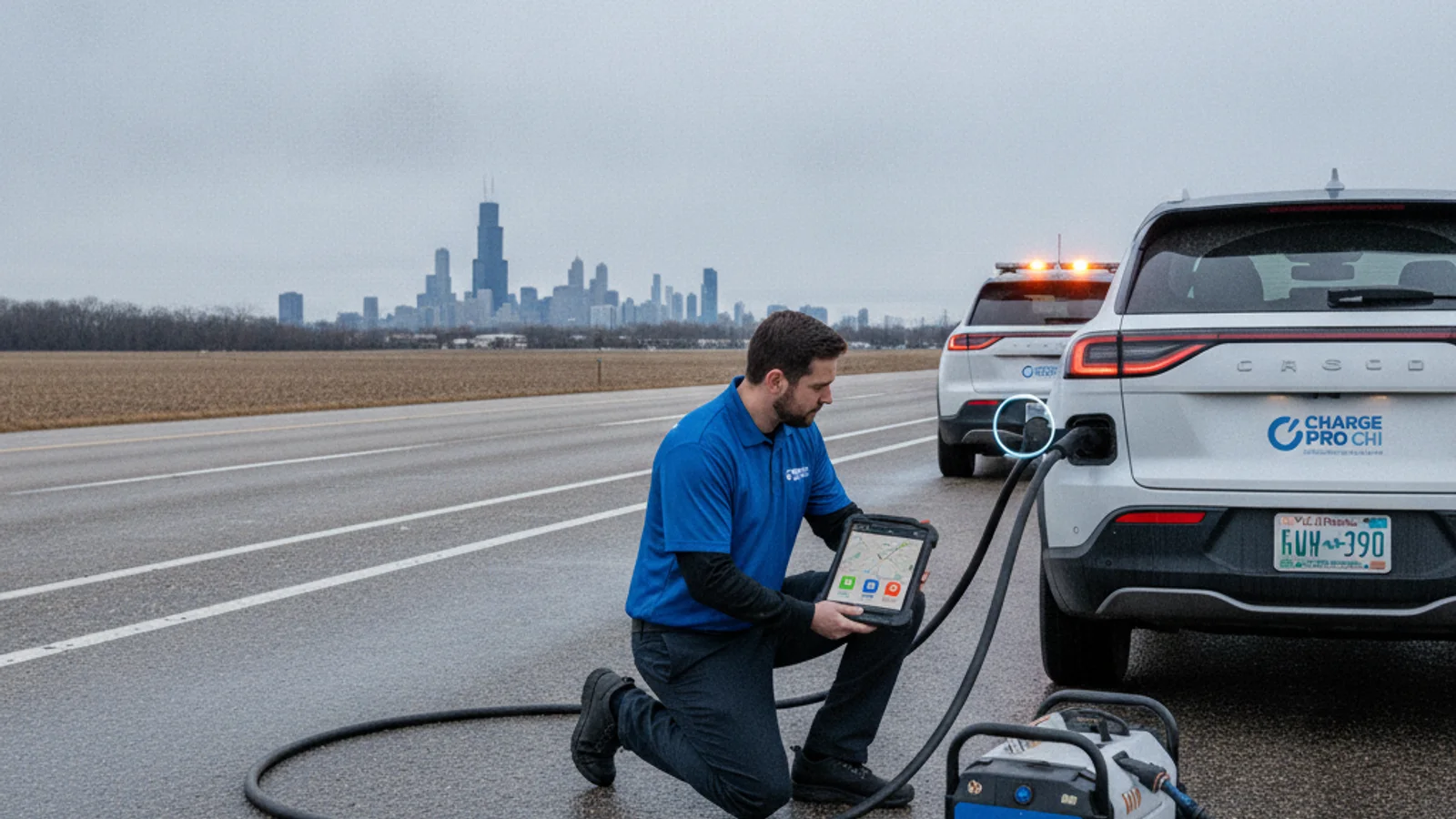
Mobile EV charging brings an independent operator to the car. That only fits if you’re parked safely. It also fits if you’re too low to trust the next listing. The truck uses a 240-volt Level 2 source. Teslas take a native NACS plug. Other EVs use a CCS or J1772 adapter. A typical session adds 10 to 20 miles of range. That takes 15 to 30 minutes of charging time. That’s time on the plug. It’s not an arrival time. We don’t publish arrival windows. We don’t quote the job. The operator does, before any work starts.
If the pack is already at zero, ask about out-of-charge recovery. Ask about it if the spot isn’t practical for charging in place. The operator looks at the vehicle and the location, then tells you which path fits. For the same stall after a Naperville day, this suburb walkthrough stays on that commute ending low.
Operators in the network cover Tesla and the other major EV brands. They can jump or replace a dead 12-volt battery on site when that’s the fault. Your charging app won’t make that call for you. You’ll just have a car that won’t wake.
Save a backup that isn’t another pin
Keep a plan that still works if every listing is wrong. Note a second station on routes you drive often, if you want. Also save a way to reach a mobile operator. You’ll want it when the first and second pins both fail. Charge Pro CHI serves Chicagoland. That includes Chicago, Naperville, Schaumburg, Aurora, Joliet, Elgin, Waukegan, Evanston, and Oak Park. It also includes the other cities on our local pages. We connect you with local pros. The operators we send are licensed and insured. We don’t hold the trade license, and we don’t do the work.
If the apps have no reachable, working option left, stop spending range. Call (858) 925-5546 and we’ll connect you with an independent mobile rescue operator. Hear the quote before anything starts.