If your EV can still reach a confirmed rapid charger, use that stop. If remaining range won’t cover a verified route, stop hunting. Apartment drivers in older Cook County housing often can’t wait out a stall search. Park somewhere legal and ask for a mobile boost instead.
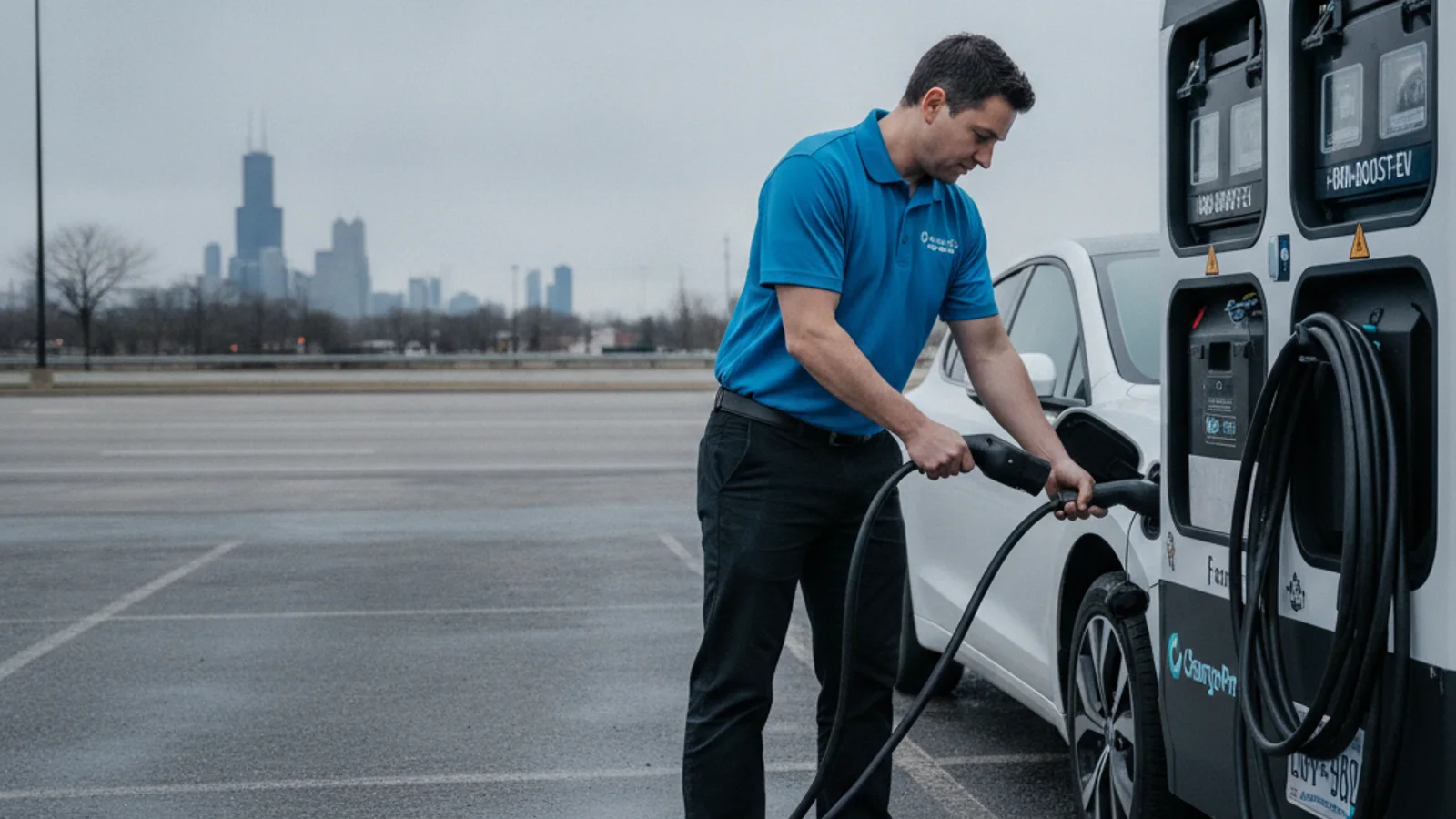
Older buildings are why a stall hunt runs out of time
An “ev rapid charger near me” pin is a lead. It isn’t a hold on a stall. You still need a plug that fits. You also need a lot you can enter. And you need enough energy to arrive.
That squeeze hits renters first. Chicago’s 2019-2023 ACS count puts 68.6% of housing in buildings from before 1980. Cicero sits at 90.2%. Berwyn is 90.0%. Oak Park is 78.6%. Evanston is 71.2%. Skokie is 72.0%. Those blocks weren’t laid out around a home wall box.
Newer suburbs look different. Naperville has 11.7% pre-1980 housing. Gurnee has 9.5%. Huntley has 3.8%. A driveway there can wait. A rented garage in Cicero usually can’t. Neither can a Chicago apartment stall.
So the live question isn’t whether a map shows a rapid charger. It’s whether you can sit through a second hunt. In older inner-Cook parking, you often can’t. That’s when a boost from an independent operator beats another pin.
If the building itself can’t take a home charger, start with home EV charging in Cicero when the house cannot.
Confirm the stall before you spend the last miles
Addresses, access rules, and operating status change. Confirm them before you burn remaining range. Open the station operator’s own app or website. Then check the car’s navigation. An aggregated map can help you scan options. Don’t treat an old listing as proof the cabinet works tonight.
Work this list before you roll. The connector has to match the car. The operator should show the stall as open. You need a legal way onto the property. Skip stalls limited to customers, residents, or employees. Your car has to predict enough energy for the full approach. Include the garage entrance in that estimate. Read the live session price in the operator’s tools before you plug in.
The U.S. Department of Energy’s charging station guide lists CCS, CHAdeMO, and J3400. Those are DC fast connector types. Your vehicle may not accept every one. An adapter doesn’t make every cabinet compatible. Follow the manufacturer’s guidance for your model.
Live status is a signal, not a promise. Another driver can take the stall before you arrive. A cabinet can show online while the screen is dead.
If you’re planning ahead, save more than one compatible stop. Use the charging apps to open before a strand. That gives you a second verified option.
A posted rate can change by hour and by network. Confirm the current figure with the operator before you pay. This research didn’t turn up a verifiable public rate we can print.
Inner Cook, the North Shore, and the far suburbs aren’t one route
A pin’s straight line doesn’t tell you if you can arrive. Cook, Lake, DuPage, Kane, Will, and McHenry each change the last mile.
In Chicago, Cicero, and Berwyn, the charger may sit inside a garage. Confirm the entrance, the gate, and whether you can park there. A stall on your phone can still sit behind a resident fob. Oak Park’s housing is 78.6% pre-1980.
Evanston, Skokie, and Wilmette mix older homes with tighter streets. Wilmette’s pre-1980 share is 74.3%. Highland Park in Lake County is 60.6%. Waukegan is a different Lake County town. The 2024 estimate is 88,570 people. Hispanic share is 57.0%. Pre-1980 housing is 54.0%. Don’t treat one Lake County pin like the next.
Northwest Cook office towns look simple on a map. Schaumburg’s housing is only 15.9% pre-1980. Arlington Heights is 42.0%. Elk Grove Village is 38.6%. Lots can still close after business hours. Employee-only posts still lock visitors out. Read the access line in the operator listing.
West and south, the same hunt stretches over longer arterials. Aurora, Joliet, Elgin, and Naperville spread the last mile out. A charger across town can still mean a missed exit. Use turn-by-turn for the way in.
If the pack is already very low, choose the stall you can actually enter. Skip the one that only looks fastest on the label.
Stop hunting when the car can’t finish the trip
Treat the dashboard range as an estimate. Add the exit, local turns, the garage ramp, and the last stretch. If that path leaves no buffer, don’t keep driving. You can turn a low-charge warning into a stopped vehicle.
Check whether the EV is behaving normally. Look for a charging-system fault, a locked port, or a reduced-power alert. A public rapid charger may not help those. Read the exact message. Then open the owner’s manual.
Next, verify at least one compatible station from the operator’s own network. If you can, mark a second option that’s also in range. Don’t hop from one uncertain cabinet to another on thin energy.
When you arrive and the stall does nothing, write down the screen text. Note where the session stops. Try another compatible stall only if you can do it safely. A public charger that says connected but isn’t charging is next if the cabinet fails.
If no verified, compatible stall remains in range, stop searching. Don’t spend the last miles on a pin that only looks close. Move to a legal, safe spot if the car can still roll. If it can’t, don’t push it. That’s when you switch from a hunt to help. Out of charge in Chicago covers the empty-pack case in the city.
When a mobile boost beats another map pin
A mobile boost fits when the car is parked safely. The traction pack is too low to reach a confirmed stall. The usual goal is enough range to reach a fixed charger.
Charge Pro CHI is a referral line. We match stranded EV drivers with independent local mobile rescue operators. We don’t perform the work. We don’t own trucks. We don’t set prices. We don’t promise an arrival time. The operator quotes you before starting and bills you directly.
What those operators typically bring is a 240V Level 2 source. Teslas take a native NACS plug. Other EVs use a CCS or J1772 adapter. That’s charging time, never an arrival time. It typically adds 10 to 20 miles in 15 to 30 minutes. They can also jump or replace a dead 12V battery on site. They handle Tesla and every major EV brand.
Before you request mobile EV charging, collect what the operator needs:
- Year, make, and model
- The exact dashboard message
- Current battery percent, if it’s still displayed
- The connector or charge port you can see
- Your precise location and parking position
- Height, gate, garage, or property-access limits
- Whether the vehicle can shift, steer, and unlock
Chicago isn’t precise inside a downtown garage. Schaumburg doesn’t name the office lot. On an expressway, give the route, direction, and nearest exit.
A boost may not fit if the car won’t accept power. It also may not fit if the port is damaged. A dead 12V can lock you out of the car. Describe the symptoms. Don’t guess the failed part. The independent operator confirms whether a charge is the right job. What’s on a mobile EV charging truck walks through the equipment in plain language.
When recovery is the better path
Vehicle transport fits when charging won’t fix the immediate problem. That includes a car that can’t accept a charge. It includes a port that won’t open. It includes a serious fault on the dash. It’s also safer when the EV has stopped in a dangerous spot.
A depleted pack and a dead 12V can look the same from the seat. A dark screen doesn’t prove the big battery needs charging. Share the exact symptoms. Don’t request equipment based on a guess.
Recovery also makes more sense when every verified compatible charger sits beyond remaining range. Use the actual route and the estimate on the dash.
Our out-of-charge recovery service can connect you with an independent local operator. Charge Pro CHI doesn’t tow vehicles or set operator pricing. It doesn’t provide a service warranty. Confirm the proposed service, current price, equipment, and destination before you agree. If transport is the plan, follow the vehicle manufacturer’s towing instructions. Tell the operator if the car can enter transport mode.
When to call
Call when the EV can’t safely reach a confirmed rapid charger. We’ll connect you with an independent local operator. The pros we connect you with are licensed and insured.
Call (858) 925-5546 and we’ll connect you with a local EV rescue operator.