The pack hits zero on I-80 as the south suburbs open up. You’re on the shoulder with semis rolling past your mirror. The next ramp isn’t a walk from here. This Will County stretch is a long logistics run. Housing and warehouses spread as the metro thins. A dead EV on this pavement is a shoulder problem. It isn’t a quiet lot where you can browse a map.
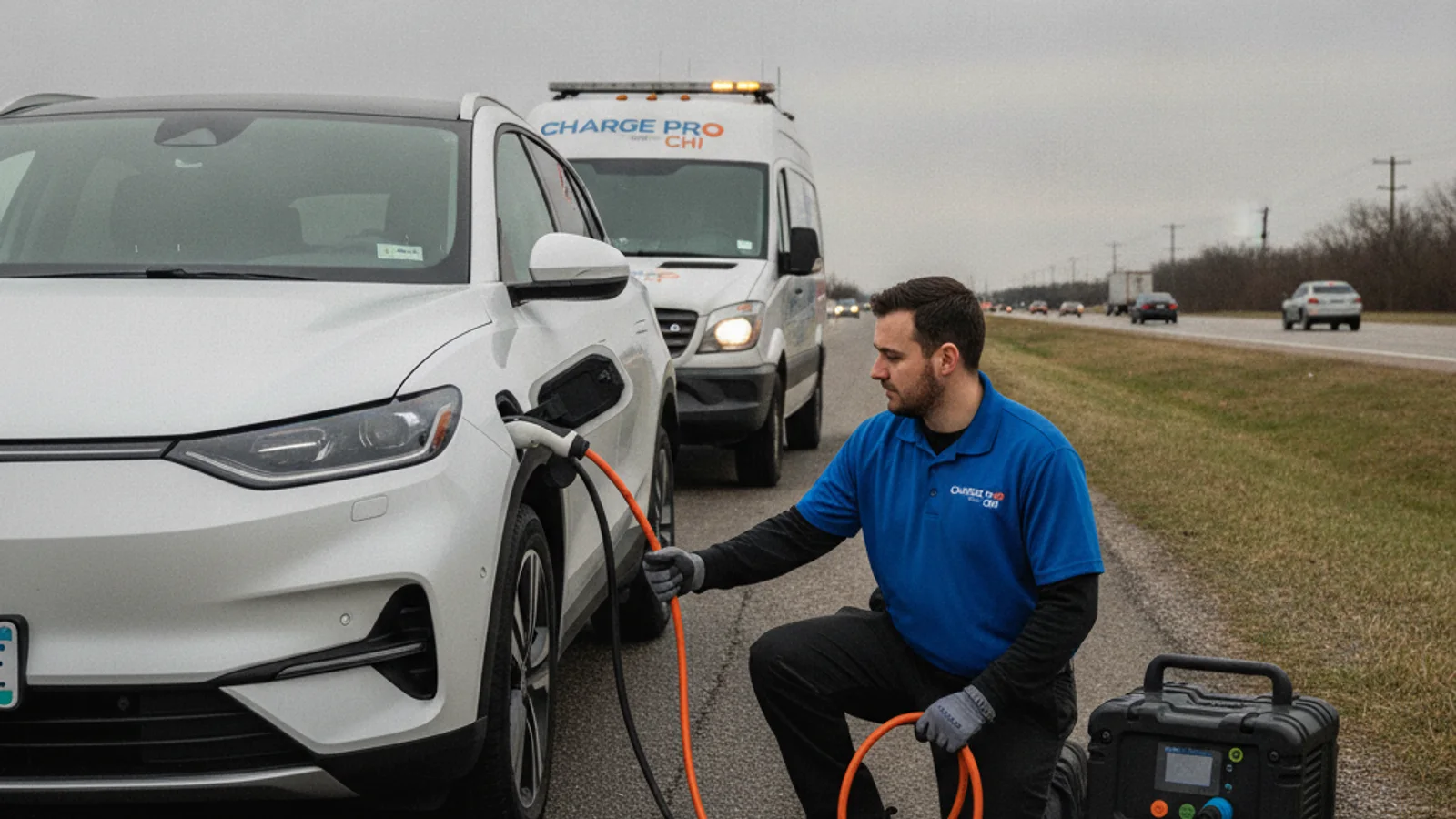
I-80 through Will County is a freight corridor first
I-80 is the east-west truck spine of the southwest suburbs. It doesn’t feel like a side street in Joliet. It doesn’t feel like a mall lot either. You share the lanes with through freight and warehouse traffic. Commuters tying Cook County to Will County towns are in the mix too.
Joliet is the large city on this line. The 2024 estimate puts it at 151,837 people. New Lenox, Plainfield, Romeoville, and Bolingbrook sit in the same county. Only 6.7% of Plainfield’s housing is pre-1980. New Lenox sits at 7.9% on that same measure. That usually means longer arterials and more space between clusters. When the car dies on I-80, you’re not in a tight grid. You’re on a high-speed shoulder with trucks.
Romeoville’s Hispanic share is 35.7%, and Joliet’s is 34.7%. Bolingbrook sits at 28.2% on the same census tables. This is a working corridor, not a scenic pull-off. Shift changes and trailer traffic keep it busy even when your dash is dark.
The stall that catches people is ordinary. You left a lot in Tinley Park, Oak Lawn, or the city already low. You used more than the range guess promised. Cabin heat in winter eats miles, and so does crawling behind trucks. A long westbound pull does the same. Then turtle mode hits between exits.
Empty pack versus a 12V that just died
Not every dark EV on I-80 has an empty traction pack. Plenty of no-starts are the 12-volt battery. That small battery runs computers, contactors, and latches. When it fails, the car looks fully dead. You may still have range you can’t see.
A true empty pack usually warns you first. The range number drops and speed gets limited. You still rolled onto the shoulder under some power. A 12V failure can happen in a lot or at an on-ramp. It can also happen after the car sat. Lights act strange and the screen never wakes. Doors may not release the way you expect.
Tell the operator which one you think it is. They bring a 240V Level 2 source for an empty pack. They can also jump or replace a dead 12V on site. Tesla and every major EV brand are in the mix. Native NACS for Teslas, and an adapter for CCS or J1772 cars.
If you’re not sure, say so. Don’t send the wrong setup on a guess. The operator still quotes you before any work starts.
You can do a few checks from the seat. Try the 12V accessory points your manual names. See if the center screen boots at all. Note whether you had a low-voltage warning before the stall. Note whether range hit zero with the car still in drive. Those four facts save a wasted dispatch.
What a boost on this interstate actually does
Charge Pro CHI is a referral line. It matches you with an independent local operator. It doesn’t own trucks, and it doesn’t employ technicians. It doesn’t set prices, and the operator bills you directly.
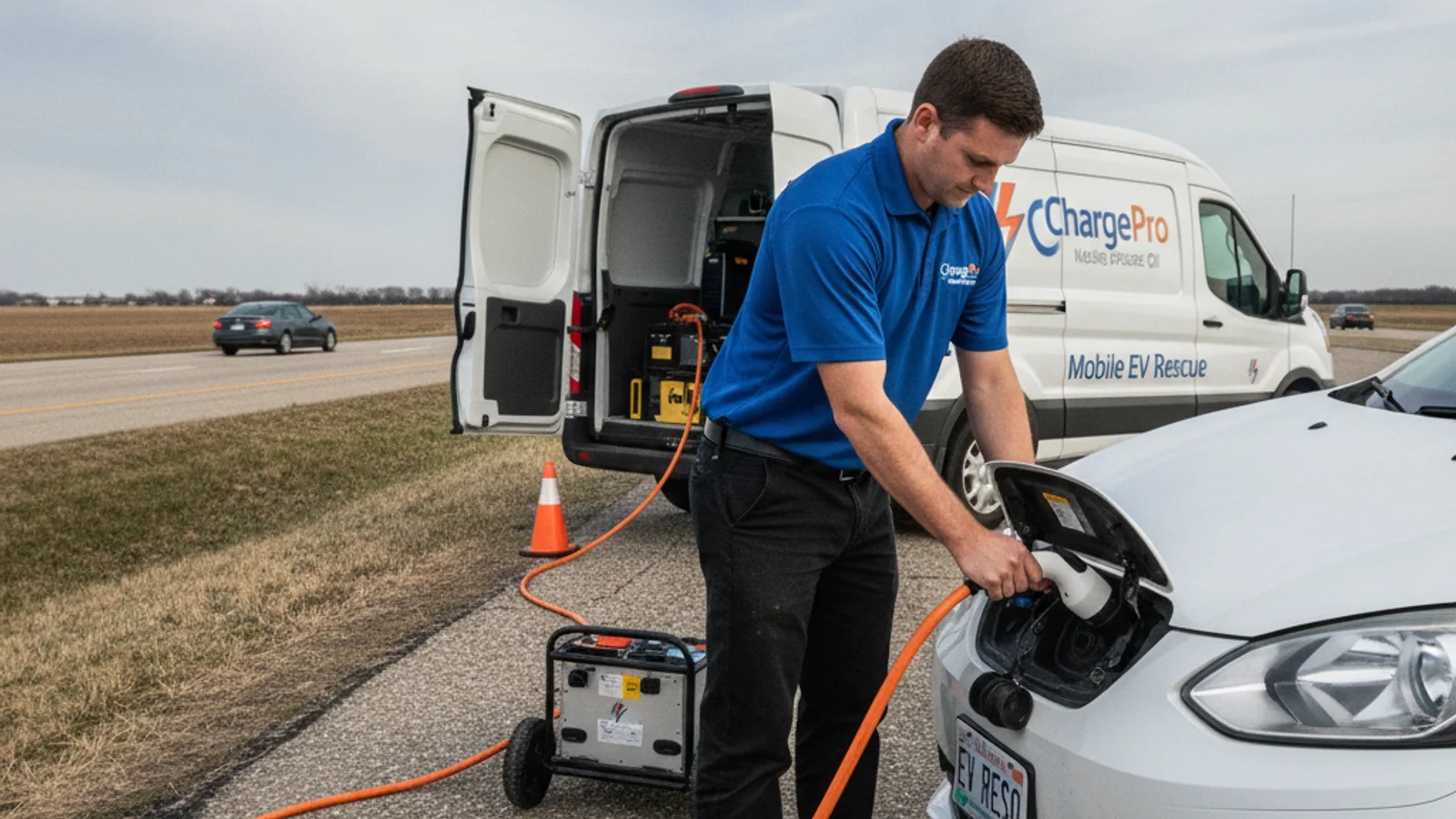
The job on I-80 is simple. Add enough range to get you off the shoulder. Typical charging time is 15 to 30 minutes. That window is time on the plug. It isn’t a promise of when someone arrives. Most boosts add about 10 to 20 miles. That’s usually enough to reach a charger you pick. It can also cover a lot you know. A home stall in Joliet, New Lenox, or Plainfield counts too.
Read how a mobile EV charging truck works if you want the equipment picture. The short version is parking legally and plugging in. You stay out of the travel lanes. You don’t stand between the car and passing trucks.
A Level 2 boost isn’t a Supercharger session. You’re not filling the pack on the shoulder. You’re adding miles to leave a bad place. That distinction matters when you describe the job on the phone.
Towns this stretch actually ties together
Westbound I-80 pulls you out of denser south Cook and into Will County. Eastbound I-80 does the reverse into denser south Cook.
Joliet is the big node. It’s a full city with neighborhoods, yards, and industrial edges. If you live there, a boost that gets you home may be the whole fix. Tesla owners in that city already compare OEM roadside with a local backup.
New Lenox and Plainfield are commuter towns with newer housing. Oak Lawn’s stock is 58.4% pre-1980. Plainfield’s is 6.7%. Romeoville and Bolingbrook sit on the same Will County pattern. Tinley Park and Orland Park sit closer to the Cook County side. Oak Lawn sits in that Cook County belt too. If your day started there and died on I-80, say so. Origin and destination help the operator plan the plug time.
Don’t walk this interstate to reach an exit. Stay with the car unless you’re in immediate danger. Keep hazard lights on, seat belt on, and call from inside.
Confirm the last exit you passed. Note eastbound or westbound. Say whether you’re past Joliet or still on the Cook County side. That pin accuracy beats a range screenshot.
What actually moves the quote
Nobody here publishes a fee menu. A number recited before your pin is a guess. The operator who takes the job quotes you before starting.
Three things tend to move that quote.
The first factor is distance. I-80 through Will County is a long run as the metro thins. An operator coming from a denser inner suburb has more pavement to cover. One already near Joliet has less. A pin on the westbound shoulder isn’t a driveway stall in New Lenox.
The second factor is time of day. Overnight, peak freight, and weekend traffic change how the operator stages. Weather changes the job too. A winter night on this corridor is a different scene than a dry afternoon. The quote reflects that work.
The third factor is how much range you need. Ten miles to a charger you already chose is one job. A longer plug to reach a specific garage is another. Say the destination out loud. Don’t ask for a full pack on the shoulder. That isn’t what this service is for.
Out-of-charge recovery is the empty-pack version of this call. If the 12V is the real problem, say that too. Mixing those jobs wastes time.
Get enough range to leave, then leave
Once the operator is on site, keep the goal small. You want a safe roll-off. You want enough miles to reach a place you can sit. You don’t need to finish a long trip from the shoulder.
If the car still won’t take a charge, stop forcing it. A failed handshake or a locked port is a different problem. So is a pack that won’t wake. That’s when a flatbed becomes the cleaner path. Compare a mobile charge and a tow before you wave the truck off. Towing a dead EV has rules. Wheels, dollies, and transport mode matter. Guessing that part is how you cause a second repair.
Tesla drivers sometimes start with the in-app roadside line. That’s fine, and it doesn’t always send a charger. Local operators still handle the boost when the OEM path is a tow. Non-Tesla drivers shouldn’t wait on a Tesla-only stall. CCS and J1772 cars need the adapter the operator already carries.
Winter on this corridor is hard on both batteries. Cabin heat draws from the pack. A weak 12V hates cold mornings after a sit. Summer A/C draws from the pack too. None of that is a reason to sit in a live lane. It’s a reason to treat the range number as a guess.
If you still have a sliver of range, use it. Get off I-80 into a lot you can sit in. A Romeoville surface street is a better plug site than this shoulder. So is a lot off a New Lenox exit. Only stay on the interstate if you can’t make the next ramp.
When you should skip the boost
A boost is the right call when the pack is empty. The car still has to accept a plug. It’s the wrong call when you can’t get fully onto the shoulder. Get the vehicle out of traffic first. Then you talk charging.
Skip the boost if you already know the car has a mechanical fault. A burning smell, a crash, or a do-not-drive warning isn’t a range problem. Don’t ask a charging truck to cover that.
If you stalled after a long dwell in a south-suburban lot, say so. A car that sat for hours can be a 12V job, not an empty pack. The operator needs that detail.
Call, get a quote, then decide
Charge Pro CHI connects you with a local operator for this corridor. Call (858) 925-5546. Tell them you’re on I-80 in Will County. Give eastbound or westbound and the last exit. Say whether the pack is empty or the 12V is dead. The operator quotes you before starting. You’re not hiring the brand to do the work. You’re hiring the independent pro they match you with.
Keep the ask honest. You need enough range to get off this logistics stretch. That’s the whole job.