Your Joliet Tesla can still take a Level 2 boost on site. That holds when you cannot confirm the next Supercharger. Independent operators we connect you with bring a 240-volt source to the car. That’s Tesla roadside assistance Joliet drivers call on the I-55 belt. I-80, Larkin Avenue, and downtown lots get the same on-site option.
Start with Tesla’s current Supercharger listing
Don’t trust a screenshot, a saved pin, or a search snippet. Tesla’s app and in-car nav are the live record. Station access, status, and Tesla’s published rates can change. Charge Pro CHI doesn’t run Superchargers.
Check the stop before you keep driving. Confirm the site still appears in Tesla’s current tools. Read any access notes Tesla shows for that location. Check that the listing matches your Tesla. Compare the full route with the range on your screen. Choose a second currently listed site you can actually evaluate.
A map pin is not an entrance. Read the full listing Tesla presents. We can’t publish Tesla’s rates, stall counts, or hours here. Those details belong in Tesla’s current tools. Confirm them there before you roll.
If you can’t confirm a usable destination, don’t make that pin your only plan. The Joliet city charging page is the local hub for that backup conversation.
Joliet is a two-interstate city, not one map dot
Joliet is the Will County seat. Census figures put 149,785 residents in the ACS 2019-2023 count. A stall at CenterPoint is not a stall by the Rialto Square Theatre.
The Stevenson, I-55, carries Tesla traffic toward Chicago and the southwest suburbs. I-80 cuts the city east to west. Jefferson Street is US-30 through town. Route 59 and US-52 add the surface grid. Larkin Avenue is another corridor people actually stop on.
Downtown, the west side, and the east side don’t share the same access. The Cathedral area doesn’t either. Harrah’s and Hollywood casinos create long-dwell parking. Old Joliet Prison is a landmark you can name for a pin. It is not a Supercharger listing. Chicagoland Speedway and Route 66 Raceway sit nearby.
South of town, the CenterPoint intermodal terminals sit on the freight map. Joliet is one of the biggest intermodal freight hubs in North America. Delivery vans and trucks run those yards down toward empty. Tesla drivers share those I-80 and I-55 ramps after a long shift.
Crest Hill, Shorewood, Rockdale, New Lenox, and Plainfield sit on this same Will County pattern.
Write your direction of travel and the nearest mapped exit. Add a cross street or a dropped pin. “I’m in Joliet” isn’t enough for someone heading to you. On I-55, say northbound or southbound. On I-80, say eastbound or westbound. In a casino deck or a downtown lot, name the property you can see.
ComEd is the electric utility here. We could not confirm a current ComEd EV rate for this page.
Set a stop point before the pack gets thinner
Don’t hop to the next pin because it looks closer on the map. Work from the energy your Tesla actually shows.
- Pick the Supercharger Tesla currently lists as your best option.
- Name a second currently verified site on a route you can judge.
- Decide when you’ll stop driving and ask for roadside help.
Set that third step early. If you’re alone, park legally, then pick up the phone. If traffic is an immediate danger, call emergency services first. A mobile boost is not a crash response.
Shoulder stops on I-55 need a direction and an exit. Lot stops need a visible property name. Those details separate a Stevenson problem from an I-80 decision. Our I-55 out-of-charge guide covers that belt when you’re already at zero.
When the Supercharger in front of you won’t start
A listing can look fine and still fail on the ground. You might see a blocked entrance or a damaged handle. You might get an error, or a session that never begins. Describe only what you can see.
Keep the Tesla parked. Read the message on the car, the cabinet, or Tesla’s tool. Save the exact wording. Don’t translate it into your own diagnosis. Confirm you reached the site Tesla sent you to. Match the property, the entrance, and the equipment. A nearby plug isn’t automatically the stall navigation chose.
If another stall is open, follow the instructions on that cabinet. Don’t force a connector. Don’t handle damaged gear. Use Tesla’s support path when Tesla’s tool points you there.
Tesla’s own roadside program is a separate channel from a local boost. Read what Tesla roadside assistance covers here before you assume Tesla will send energy. Tesla’s published terms change. Confirm them in Tesla’s current materials, not from an old screenshot.
Stop hunting destinations you can’t confirm as reachable. An operator can review what you describe. Charge Pro CHI connects you with licensed, independent local operators. We don’t run the Supercharger. We don’t perform the roadside work.
Decide whether the next Supercharger is actually reachable
Another listing is not automatically a safe backup. Compare Tesla’s route distance with the energy on your display. Then add every turn, entrance, and likely detour. A thin margin is not certainty. If a wrong ramp would put you at zero, stay put. Request help instead of rolling the last miles as a search.
If the exact site isn’t confirmed in Tesla’s current tool, stay put. If you can’t name the property entrance, stay put. If the Tesla doesn’t show enough energy for the full drive, stay put. Keep a backup if that site isn’t usable.
If one of those is still unclear, roadside help may be the better next step. A local operator can discuss a mobile 240-volt boost. Start with mobile EV charging when the car is safely accessible and needs energy.
Some situations need transport instead of a charge where you sit. The operator should make that call after reviewing the car and the access. Out-of-charge recovery is the referral option when an on-site boost isn’t right.
Don’t treat a typical range add as a promise. Operators typically add 10 to 20 miles of range. That takes 15 to 30 minutes of charging. That window is charging time. It is never an arrival time. The operator still quotes you before starting. Confirm the service, the price, and the destination with that operator before you agree.
What a Level 2 boost on the I-55 belt actually does
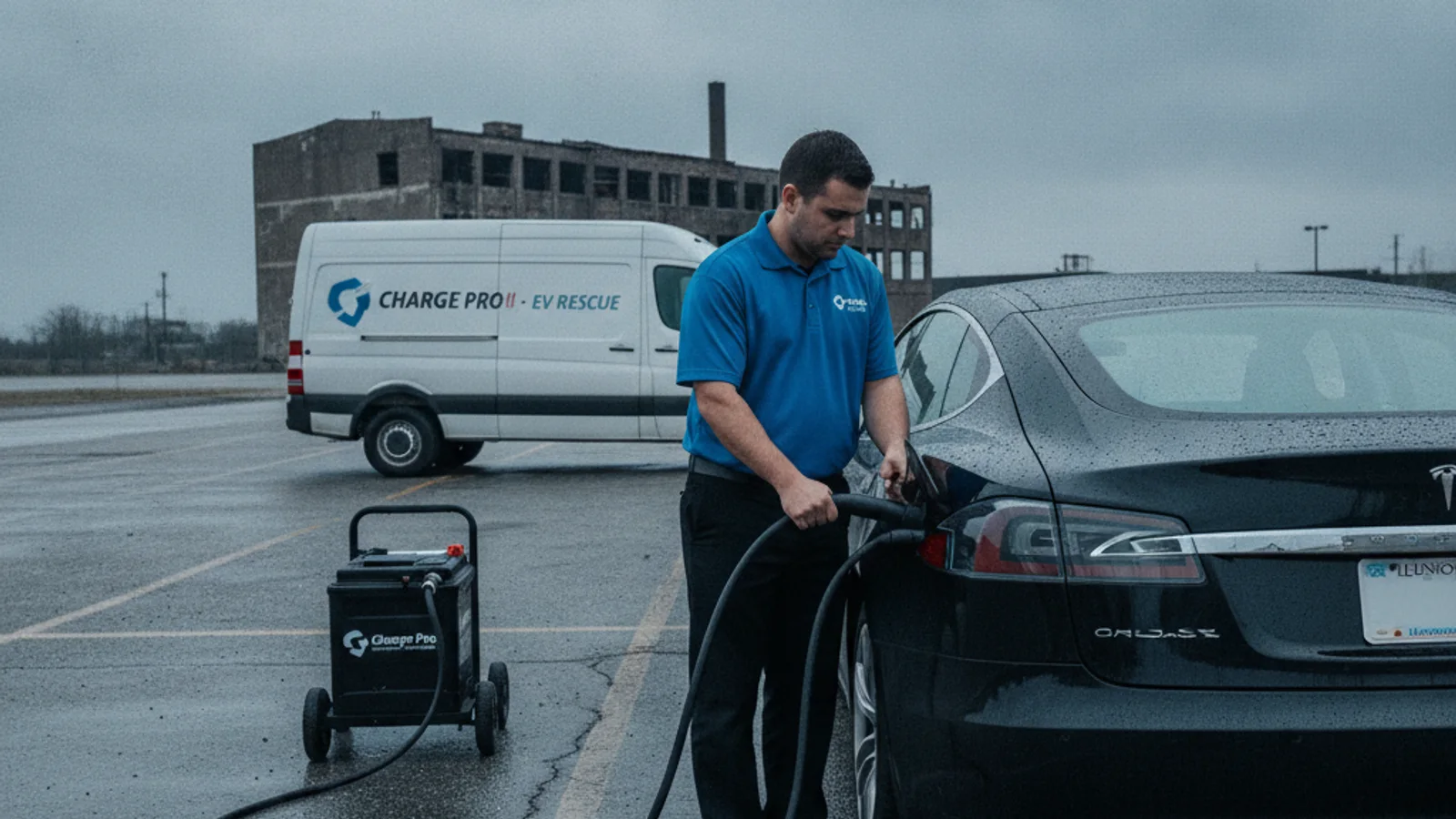
Tesla Superchargers are DC fast charging. A mobile rescue is a different tool. The operator brings a 240-volt Level 2 source to the Tesla. Owners get a native NACS plug. Non-Tesla EVs on the same street use CCS or J1772 adapters. The goal is enough range to reach a Supercharger you’ve already verified.
If the car is a Tesla, Tesla roadside rescue is the matching service page. For a broader city stall, see our Joliet roadside help post. The operator quotes before any cable goes in. The operator bills you directly. Charge Pro CHI doesn’t set that price and doesn’t collect it.
Empty pack or a 12-volt that won’t wake the car
A dead pack and a dead 12-volt can look the same from the curb. If the screens are dark or the car won’t wake, say that. The operator may jump or replace the 12-volt on site. Don’t open high-voltage covers.
What to tell the operator so the quote matches the stop
Start with where the Tesla actually sits. A dropped pin beats a Supercharger address you never reached. Share the model if you know it, the remaining percentage, and the exact warning text. Say whether the car powers on, shifts, and opens the charge port. Mention the Supercharger you were trying to reach.
Mention gates or tight drive lanes you can see. Casino decks, the Rialto block, and CenterPoint yards don’t share the same access. Say what you see.
Send a photo if the operator asks. Show the full warning. Don’t touch damaged charging gear to make a better shot. Don’t promise the next site will work. Share Tesla’s current listing and let the operator review it.
Charge Pro CHI is a referral line. We match stranded EV drivers with independent local mobile rescue operators. We hold no license, own no trucks, and employ no technicians. The pros we connect you with are licensed and insured. You contract with the operator. You pay the operator directly. Confirm price, scope, and access before they start.
When to call us
Call when your Tesla can’t reach a Supercharger you’ve verified as usable. Call when a Joliet site won’t start a session and more driving isn’t sound. Call when I-55 or I-80 leaves too little energy for a wrong exit.
Call (858) 925-5546 and we’ll connect you with a local EV rescue operator. We don’t promise an arrival window. The operator quotes the work after they hear where you are.