The dash is dark in a downtown Chicago garage. The traction pack still shows miles. The car won’t wake, lock, or roll. That’s an EV rescue vs repair split, and it’s not close. A dead 12-volt battery leaves the car in the stall. A shop lift can’t help until the car can leave. You’re reading this from a concrete deck at night. You need the car to move, not a morning advisor with a loaner clipboard.
A dark car in a downtown stall is rescue
Chicago’s housing is old. ACS 2019-2023 figures put 68.6 percent of Chicago homes in buildings finished before 1980. Oak Park sits at 78.6 percent. Cicero sits at 90.2 percent. Berwyn sits at 90.0 percent. Those older buildings mean tight ramps and gated decks. Cars sit for hours after a downtown workday. The 12-volt battery keeps computers, locks, and contactors alive. When it dies, the car looks finished even with a healthy pack.
A repair bay wants the car driven in, and you can’t drive this one. The right call is on-site help. That can be a jump or a 12-volt replacement. Use a short mobile EV charging boost if the pack itself is empty. What you see when an EV 12-volt dies walks through that 12-volt pattern.
Rescue and repair are not the same trade
People search “EV service” and get a mixed list. Dealerships, independent shops, and roadside numbers all appear. They don’t do the same job.
A shop visit is scheduled in advance. A technician puts the car on a lift. They chase a warning lamp, a noisy hub, or a failed onboard charger. They also flash dealer software the car won’t take in a garage aisle. That work needs a bay, a parts counter, and a diagnostic laptop.
Rescue happens where the car died. Charge Pro CHI is a referral line. It matches stranded EV drivers with independent local operators. The brand doesn’t own trucks or run a warehouse. It doesn’t hold a shop license or employ technicians. The operator quotes you before starting and bills you directly. The pros we connect you with are licensed and insured.
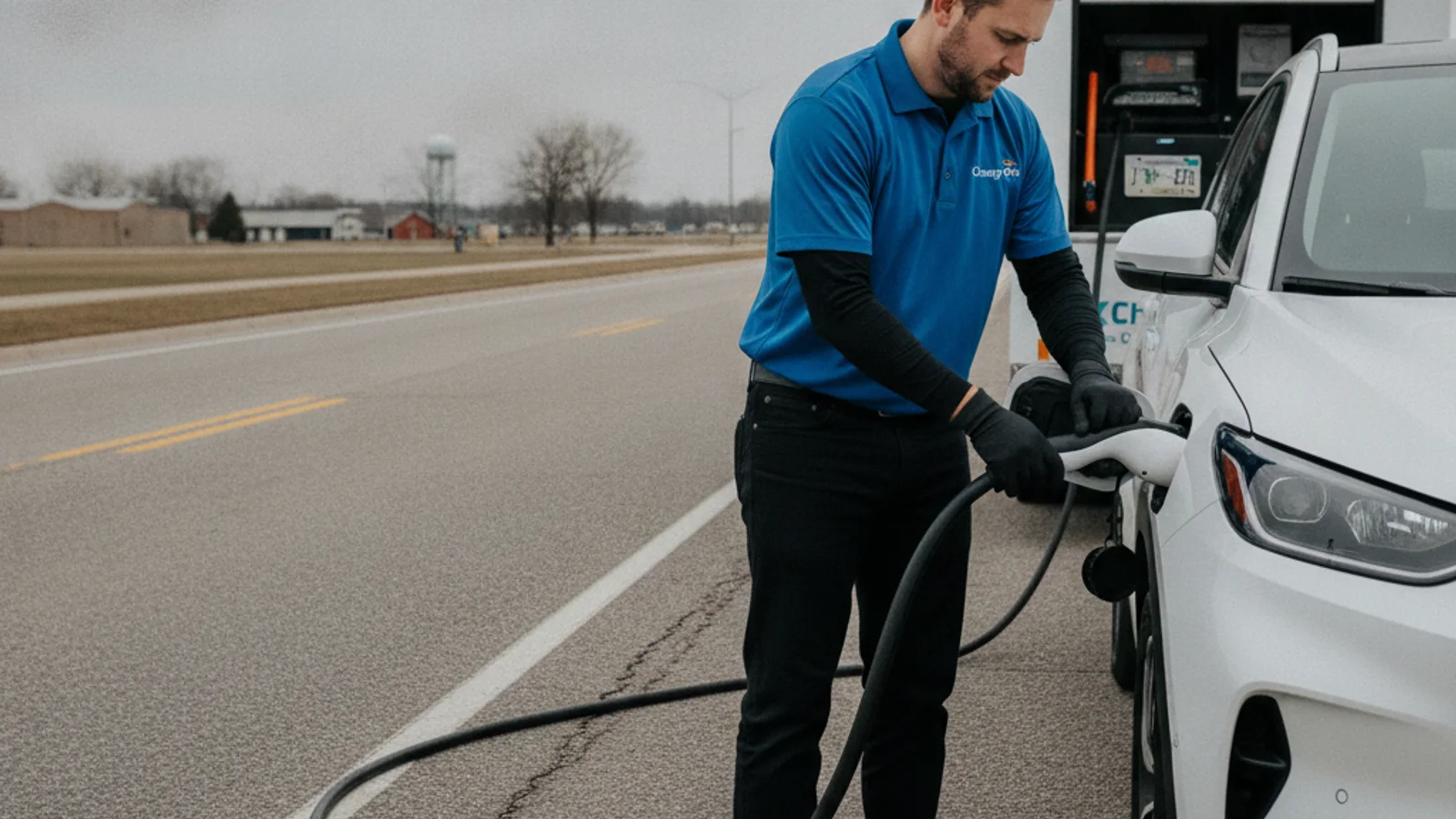
Operators we connect you with bring a 240-volt Level 2 source. Tesla owners get a native NACS plug. Other brands use a CCS or J1772 adapter. A typical session adds 10 to 20 miles of range. That takes 15 to 30 minutes of charging. That’s charging time, not an arrival window.
They also jump or replace a Tesla 12-volt battery on site. They handle Tesla and every major EV brand. That’s the work that belongs in a stall or on a curb.
Book a shop when the car can still move
Go to a dealer or an EV-capable independent if the car still drives. Range that keeps falling with a normal state of charge is a shop problem. So is a grind from a wheel after a pothole. Heat that never comes belongs on a lift too. An onboard charger that never talks to a wall unit isn’t a roadside job.
Cabin filters, brake fluid, and tires still matter. Fewer moving parts doesn’t mean zero service. Warranty and recall work lives at the dealer. If the car can get there under its own power, take it there.
Don’t call a rescue operator for a rattle from last week. They’ll send you to a bay.
Three checks that sort the call
Stand next to the car and sort it fast.
Dark screens with range still showing
Dark screens and silent locks with range still showing usually mean the 12-volt. That’s the downtown-garage pattern. It shows up after a long sit in Oak Park and across older Cook County streets. Evanston’s housing is 71.2 percent pre-1980. Wilmette is 74.3 percent. Cars in those towns often live in older buildings. The 12-volt still dies the same way. EV roadside assistance is the call when the car won’t wake in the stall.
A pack that’s actually at zero
A true zero or a turtle icon is an out-of-charge stall. A shop can’t energize the port in the lane. Out of charge in Chicago covers that empty-pack path. Don’t confuse it with a 12-volt death. The pack gauge is the tell.
Damage a roadside kit can’t touch
A bent knuckle or a high-voltage isolation warning isn’t a short boost. You may still need a flatbed after the operator confirms it. Rescue isn’t collision repair, and it isn’t a pack replacement in a parking stall. Start with charge, jump, or tow if you need that fork spelled out.
The stall looks different across the metro
A downtown Chicago stall isn’t a Naperville driveway. Naperville’s 2024 population estimate is 153,124. Only 11.7 percent of its housing predates 1980. Schaumburg is 15.9 percent. Plainfield is 6.7 percent. Newer suburbs often mean attached garages and easier van access.
Chicago’s 2024 estimate is 2,721,308 people, and most of the housing predates 1980. The car may sit several levels down, behind a gate. There may be a height bar on the ramp. Tell the operator that before they quote. The quote is for work they can actually reach.
Gurnee is only 9.5 percent pre-1980. A stall there is more often a surface lot. The rescue versus repair test doesn’t change. DuPage looks newer than the inner Cook streets. Wheaton is 35.2 percent pre-1980. Aurora, in Kane County, is 33.1 percent pre-1980. Evergreen Park is 87.7 percent pre-1980. South Cook stalls often sit in older housing too. The cut is simple: the car moves, or it sits.
Why a shop appointment fails this stall
You can book the dealer from the garage, and that doesn’t move the car. The 12-volt battery is small. It isn’t the pack under the floor. Tesla, Rivian, Ford, Hyundai, and Chevy still use a 12-volt battery to close contactors. When that battery is down, the big pack is locked out. That’s why the car looks bricked with miles on the display. Owners mix the two batteries all the time. A shop can replace a tired 12-volt later if it keeps dying. The stall still needs a rescue first.
What operators won’t do
The pros we connect you with don’t swap a high-voltage pack in a garage. They don’t flash dealer software. They don’t rebuild a drive unit. They don’t process warranty claims. They don’t stock a parts department.
They work the problem in front of them when the car won’t move. A 12-volt jump or replacement. A Level 2 boost can get you to a charger or a shop. Tesla and every major EV brand.
If the high-voltage pack has gone offline, that’s a tow to a dealer. A boost won’t wake a pack that’s failed. Sort that fork before you spend the evening in the garage.
Use this path tonight
If the car still drives, even poorly, go to a shop. A jumper pack won’t fix a motor fault.
Dark car, pack still has range. Treat it as a 12-volt death. That’s the downtown garage case. Call for on-site help. Don’t book a morning advisor slot while the car blocks a neighbor.
If the pack is at zero, you need energy at the port. Walking away from a locked garage doesn’t move the car. A mobile boost is built for that.
You can still book a local operator after Tesla, AAA, or your insurer. Charge Pro CHI doesn’t replace those programs. It’s another path for a 240-volt boost or a 12-volt jump on site.
What to tell the operator
Give the city, the garage level if you know it, and the symptom. Say whether screens are dead or the pack is at zero. Say the brand, and say if you need a CCS or J1772 adapter. The operator quotes before starting, and you pay them directly.
Charge Pro CHI serves Chicagoland. That includes Chicago and the rest of the mapped cities, from Waukegan to Joliet. Service-area coverage is the match, and the brand isn’t the crew.
Call rescue when the car can’t leave
A warning light you can drive with belongs at the dealer. A car that won’t leave a downtown Chicago garage belongs with a mobile operator. That’s the EV rescue vs repair split.
Call (858) 925-5546 when the car is stranded. Ask for a local operator quoted on site. Confirm the work with the operator before they start. The shop can have the car after it can roll.