Des Plaines EV roadside assistance means a charge at the car, not a tow. Airport lots, Rivers Casino dwells, and Jane Addams miles are how packs hit empty. The operators we connect you with bring 240V to the pin.
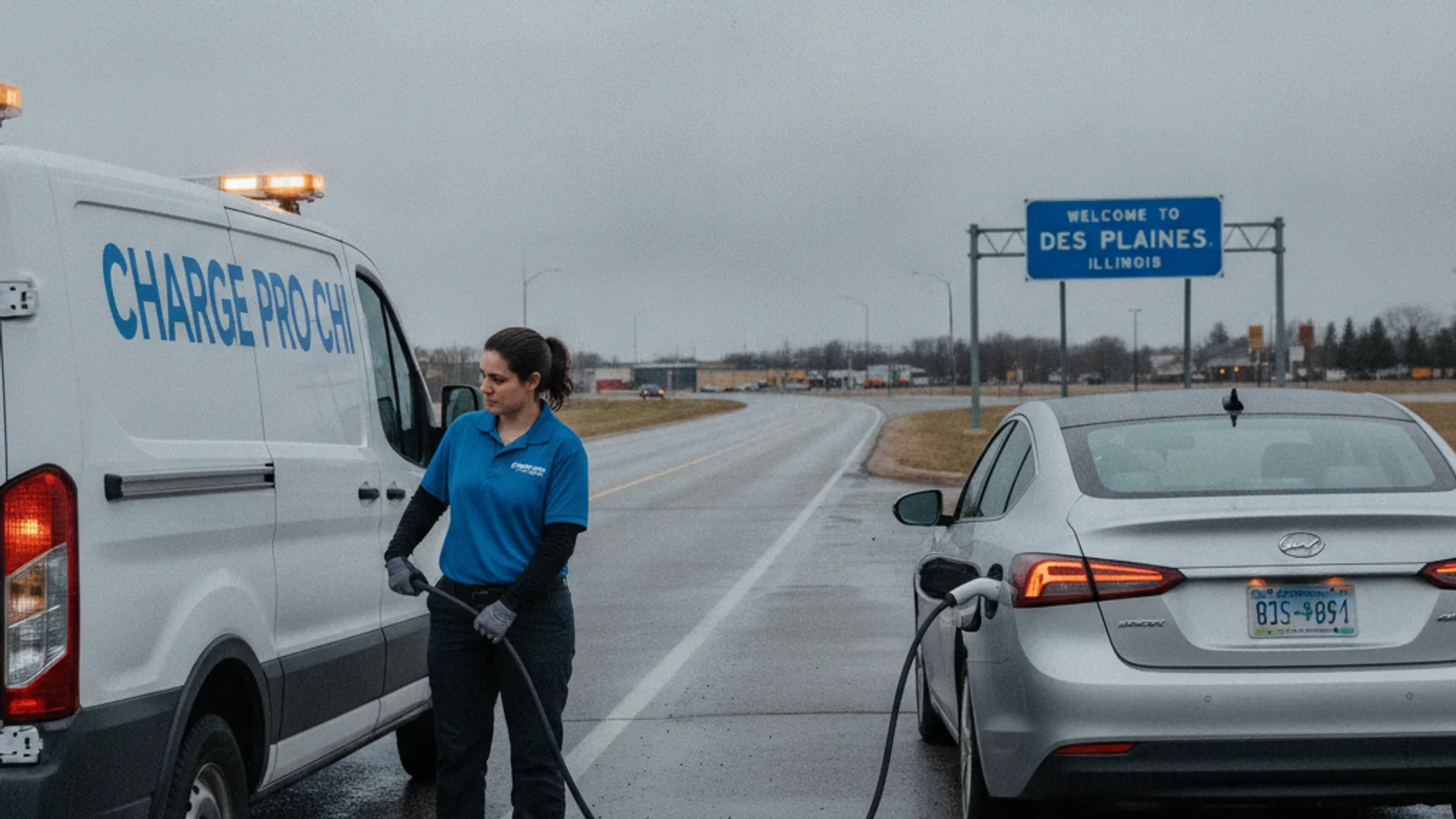
Why Des Plaines stalls happen on the airport edge
Des Plaines sits in Cook County on O’Hare’s northwest corner. I-90 and I-294 both cross here. US-12 and US-45 run as Mannheim Road and River Road. Rand Road, Golf Road, and Oakton Street cut across town. Airport parking, tollway miles, and long errands all pull on the pack.
The city covers about 14 square miles. The 2024 Census estimate is 58,832 people. The ACS 2019-2023 count was 59,408. Nearly six in ten homes were built before 1980. Many of those houses never got a 240V circuit. Apartment and condo drivers often have no overnight plug. ComEd is the electric utility here. A utility account doesn’t install a wall box. If you can’t charge at home, an O’Hare day starts on leftover range.
Downtown Des Plaines, south Des Plaines, and the O’Hare-adjacent blocks share one pattern. You leave with a percentage that looked fine. Then the car sits for hours. Cabin heat, a dead 12V, or extra dwell time finishes the job.
The original McDonald’s museum site and Rivers Casino help when you share a pin. Operators work from that pin, not from a shop address.
For a city-level overview, see our Des Plaines EV charging page.
Jane Addams, Tri-State, and Mannheim Road stalls
I-90 on this side of town is the Jane Addams. Closer in toward Chicago, people still call it the Kennedy. Drivers off a flight often treat this stretch as short and flat. It isn’t a mountain grade. It is stop-and-go, winter cabin load, and a merge onto I-294. That combination burns more energy than a lot of nav screens show.
If you stall here, stay in the car when it’s safe. Put the hazards on, then call for help. Our post on running out of charge on I-90 covers the shoulder decision.
I-294, the Tri-State, is the other heavy strand line. Airport traffic often stacks on the Tri-State through this city. Low charge plus a crawl toward Park Ridge is a common bind. Don’t try to limp across several interchanges on a warning light. A Tri-State EV rescue write-up is for that exact mess.
Mannheim Road and River Road sit between the tollways, the airport edge, and local trips. Golf Road and Rand Road feed errands and commute hops. Oakton Street ties downtown to the rest of the grid. You don’t need a steep hill to empty a pack. Cold air, a heater, and a long light cycle will do it.
Park Ridge, Mount Prospect, and Elk Grove Village are short hops on a healthy battery. They’re a problem when you’re already at a warning. If you live one town over and died here, say so when you call. The operator quotes you before any work starts, then bills you directly.
Rivers Casino, downtown lots, and O’Hare parking
Rivers Casino is a long-dwell destination where cars sit for hours. Climate control and a 12V drain add up while you’re inside. You come out ready to drive home. The car won’t wake, or it wakes with too little range to leave. That’s a mobile charge or a 12V job on the spot.
O’Hare-adjacent parking is the other Des Plaines stall drivers hit. You park for a flight and return to a cold, sitting car. The lots sit on the airport’s northwest edge, toward Rosemont. The high-voltage pack may still have miles. Tesla, Ford, Chevy, and Rivian cars can look dead on a failed 12V. The operators we send jump or replace that 12V on site. They handle Tesla and every major EV brand when the pack itself is empty.
Downtown Des Plaines lots are shorter dwells that still go wrong. You left at a percentage that looked fine at noon. Evening traffic on Oakton Street or River Road wasn’t in the plan. South Des Plaines has the same sitting-car problem after work.
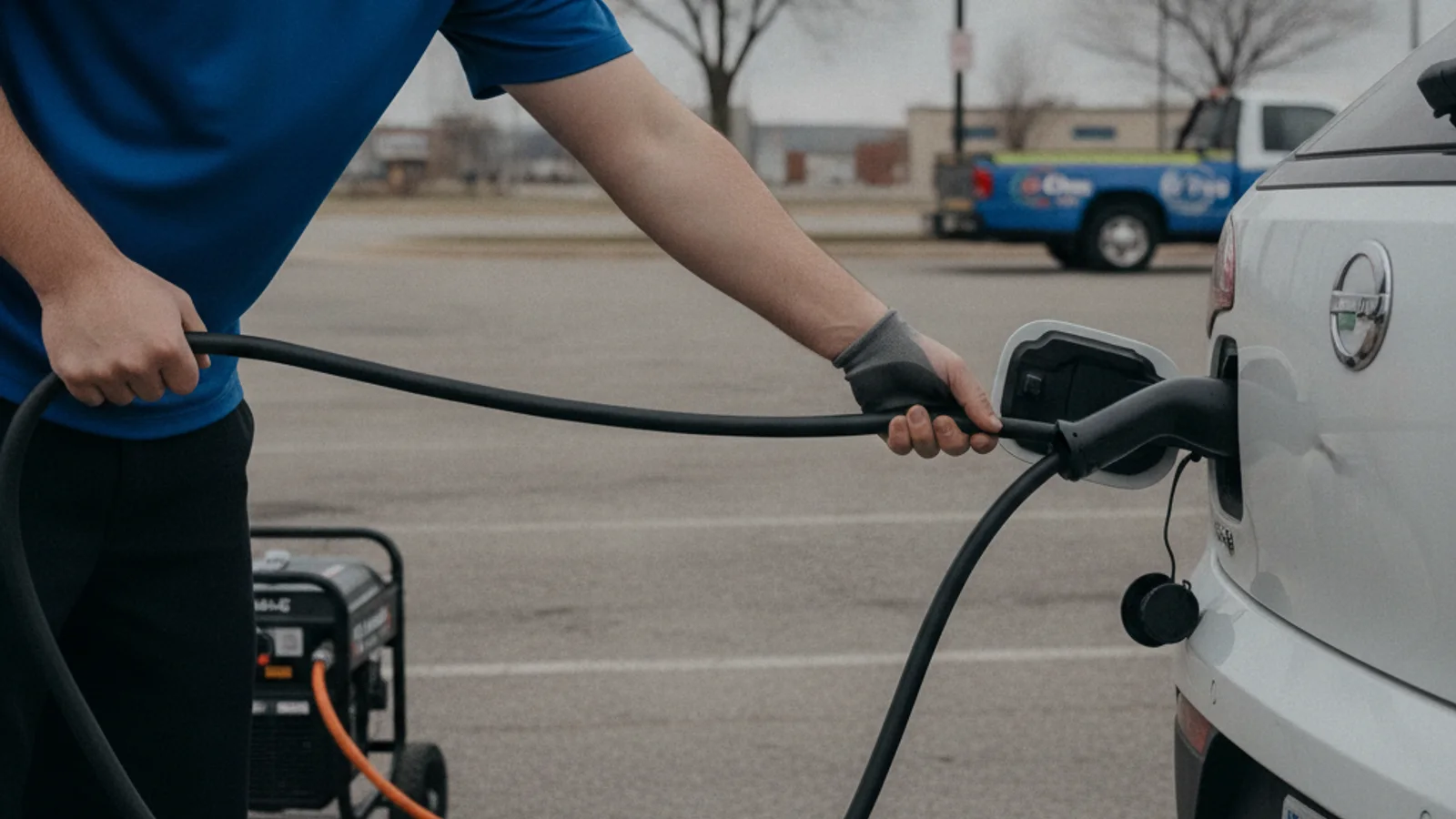
What the operator actually brings to the car
Charge Pro CHI is a referral line. We match stranded EV drivers with independent local mobile rescue operators. We don’t hold a trade license, own trucks, or employ technicians. We don’t set prices or promise an arrival time. The operator quotes you before starting and bills you directly.
They bring a 240V Level 2 source to the car. Teslas get a native NACS plug. Non-Tesla EVs get a CCS or J1772 adapter. Typical charging time is 15 to 30 minutes for about 10 to 20 miles. That window is charging time, not an arrival promise. They also jump or replace a dead 12V battery on site.
Arrival depends on the operator, I-90 or I-294 traffic, and your pin. We don’t publish a window because we can’t.
A Level 2 boost can get you off the shoulder. It isn’t a full fill. Read mobile charging versus a tow if you’re choosing between those two. For the hardware that shows up, see how a mobile EV charging truck works.
If the car won’t accept charge, the operator should say so on site. A pack fault or stuck charge port is a shop problem. A boost that can’t land isn’t a rescue. Ask them to confirm acceptance before they keep going.
Empty pack versus a dead 12V
These two failures look alike from the driver’s seat. The screens are dark, and the doors may not unlatch on the first try. The app may have lost the car.
An empty high-voltage pack usually follows a trip you already knew was tight. Jane Addams miles or a casino stay with a low start will do it. The car may still show a tiny percentage. It may have hit a limp mode. Our mobile EV charging page is the pack-side version of this call.
A dead 12V is sneakier, and the pack can be half full. The car still won’t ready. Lights, locks, and computers run off that small battery. Cold sits in O’Hare-area lots make this more likely. Older housing without overnight charging means more cars sit at a low pack. That extra sit can stress the 12V over a week.
Tell the operator which symptoms you have. Won’t unlock, won’t charge, or showed zero miles. That changes what they roll with to the pin.
Charge on site, or wait on a flatbed
A flatbed has a place. Tow it for structural damage, a charge-system fault, or a shop-level error. For an empty, healthy pack, a mobile Level 2 session is the simpler path. You stay with the car. You don’t need a second ride back from a charger.
We don’t publish tow rates, boost rates, or wait times. Those aren’t ours to set. The operator’s quote is the number that matters. If a figure isn’t on that quote, treat it as unconfirmed. Confirm it before you agree to pay.
Illinois cold makes the choice sharper. Cabin heat on I-90 eats range. A January sit at Rivers Casino may need a 12V wake-up plus a boost. The operator should check the small battery first when the car is dark.
Don’t crawl toward Mount Prospect or Elk Grove Village on a guess. Don’t sit in a live lane to save a few miles. Get to a legal spot if you can, then call.
When to call Charge Pro CHI
Call when the pack is empty or the 12V has killed the start. Call if range is falling on the Jane Addams or the Tri-State. Those are rescue calls, not repair-shop visits.
Give the operator a pin, the make, and whether the car will unlock. Mention downtown, the casino area, south Des Plaines, or the O’Hare edge. Stay out of traffic, and keep hazards on if you’re on a shoulder.
Call (858) 925-5546 and we’ll connect you with a local operator.