Oak Park EV roadside assistance is a mobile boost when you stall. Many cars here never get a charge at home. Pre-1980 houses and street parking are the usual reason. You leave a curb on Lake Street or Madison already thin. Then the pack dies before you reach a plug. Charge Pro CHI connects you with a local operator. That pro brings a 240V Level 2 source to the car. They can also jump a dead 12V on site.
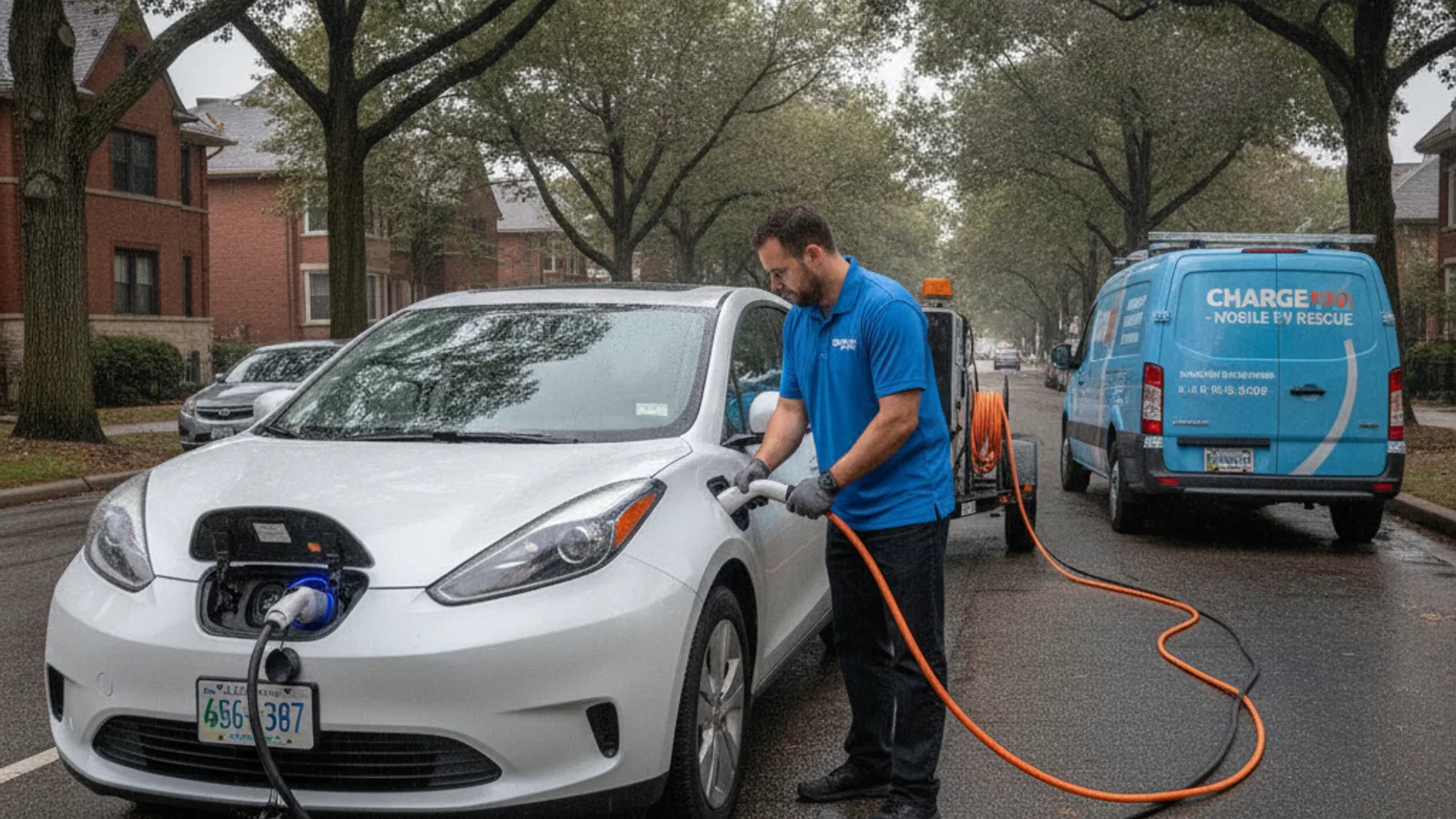
Why Oak Park EVs so often skip a wall box
Oak Park sits in Cook County, just west of Chicago. The land area here is 4.7 square miles. About 53,315 people lived here in the 2019-2023 ACS count. The 2024 census estimate sits at 52,947. That’s a lot of households on a small map.
Census housing data is the part that matters for EVs. About 78.6 percent of homes were built before 1980. Naperville, by the same table, sits at 11.7 percent. Schaumburg’s pre-1980 share is only 15.9 percent. Oak Park’s stock is older, tighter, and harder to rewire. A garage Level 2 setup needs panel space an older building may not have.
A large share of residents rent or park on the street. Research for this page doesn’t publish an exact rental rate. You can see the curb pattern on any block near downtown. Cars sit bumper to bumper along those blocks. There’s no cord to run from a porch. There’s no reserved garage stall with a wall box.
Oak Park is transit-rich, and many households stay car-light. The CTA Green and Blue lines cut through town. Many daily trips here never need a car. The cars that remain still commute, still visit, still sit overnight at the curb. They start the day without a home charge. That’s the usual stranding pattern in Oak Park.
ComEd is the electric utility that serves Oak Park. Whether your building can add a charger is a ComEd and electrician question. Charge Pro CHI doesn’t install home charging gear. We don’t own a yard or a parts warehouse. We’re a referral line, not a shop. We match stranded drivers with independent mobile operators.
Cicero next door has the same older housing. Home charging when Cicero housing cannot spells out that pattern.
Lake Street, Harlem, and the Eisenhower edge
Downtown and the Wright district
Downtown Oak Park gathers on Lake Street. Green Line riders mix with shoppers and through traffic. A stop at the Frank Lloyd Wright Home and Studio uses range. You may have meant to keep that buffer. Unity Temple sits in the same walkable core. The Wright district streets are narrow, and parking is on the street. If the warning comes on in a space, you’re stuck. You can’t roll into a driveway charger you don’t have.
ZIP codes here are 60301, 60302, and 60304. Tell the operator the ZIP and the nearest cross street. That beats a vague pin that says downtown.
Harlem, Madison, and I-290
Harlem Avenue, Illinois Route 43, is the north-south spine. North Avenue, Madison Street, and Austin Boulevard complete the grid. Lights and stop-and-go nibble the pack on short trips. That’s ordinary city driving, not a mountain grade. You still run out if you started the day low.
South Oak Park meets I-290, the Eisenhower. The freeway runs along the southern edge of town. A Loop commute, or a run in from Chicago, can end on that shoulder. If you’re in a live lane, call 911 first. Move to a legal spot when you can. Then book EV roadside assistance from a safe pull-off. An operator can work from that pull-off.
The Austin border is a few blocks from Chicago. Traffic, lights, and a thin morning charge add up there. Give the operator your direction of travel if you’re on the Eisenhower. If police are on scene, follow their direction.
We serve every part of Oak Park, including side streets. The Oak Park charging hub keeps the local page in one place.
Empty pack versus a silent 12V
From the sidewalk, both failures look like a dead car. They’re different jobs, and they need different gear.
An empty high-voltage pack is a range problem. You drove until the estimate hit zero, or close. The car may still unlock from the fob. Interior lights may still work as usual. You need energy at the charge port. That’s a mobile EV charge at the curb.
A dead 12V is an electrical problem, not a range one. The 12V runs the computers, locks, and contactors. When it fails, the car can look fully bricked. You might be locked out of the cabin. The center screen stays black the whole time. Miles can still sit in the pack. A jump or an on-site 12V swap is the fix, not a range fill.
Cold weather makes 12V faults more common in EVs. That’s a general EV fact, not an Oak Park-only rule. A car that sat on a curb all night still has to wake. Cabin heat and computers both draw from that small battery. If nothing wakes, treat it as a 12V until someone tests it.
Operators in this network handle Tesla and every major EV brand. They bring a native NACS plug for Tesla. Non-Tesla cars use a CCS or J1772 adapter. Typical charging time adds about 10 to 20 miles in 15 to 30 minutes. That’s time on the plug, not a clock for arrival.
If you’re weighing a boost against a flatbed, start here. Read charge, jump, or tow when the electric car died. A tow fits crash damage and some drivetrain faults. An empty pack still needs electrons after the truck drops you.
What the operator does on a parked-up block
Oak Park blocks are short, and cars line both sides. A flatbed wants a gap that often isn’t there. A mobile charging van can work from a legal curb space. The curb spot has to be legal and safe.
You call Charge Pro CHI for a match. We match you with an independent local operator. That operator quotes you before any work starts. They bill you directly for the work. We don’t set prices on that quote. We don’t own the truck they drive. We don’t employ the technician who shows up.
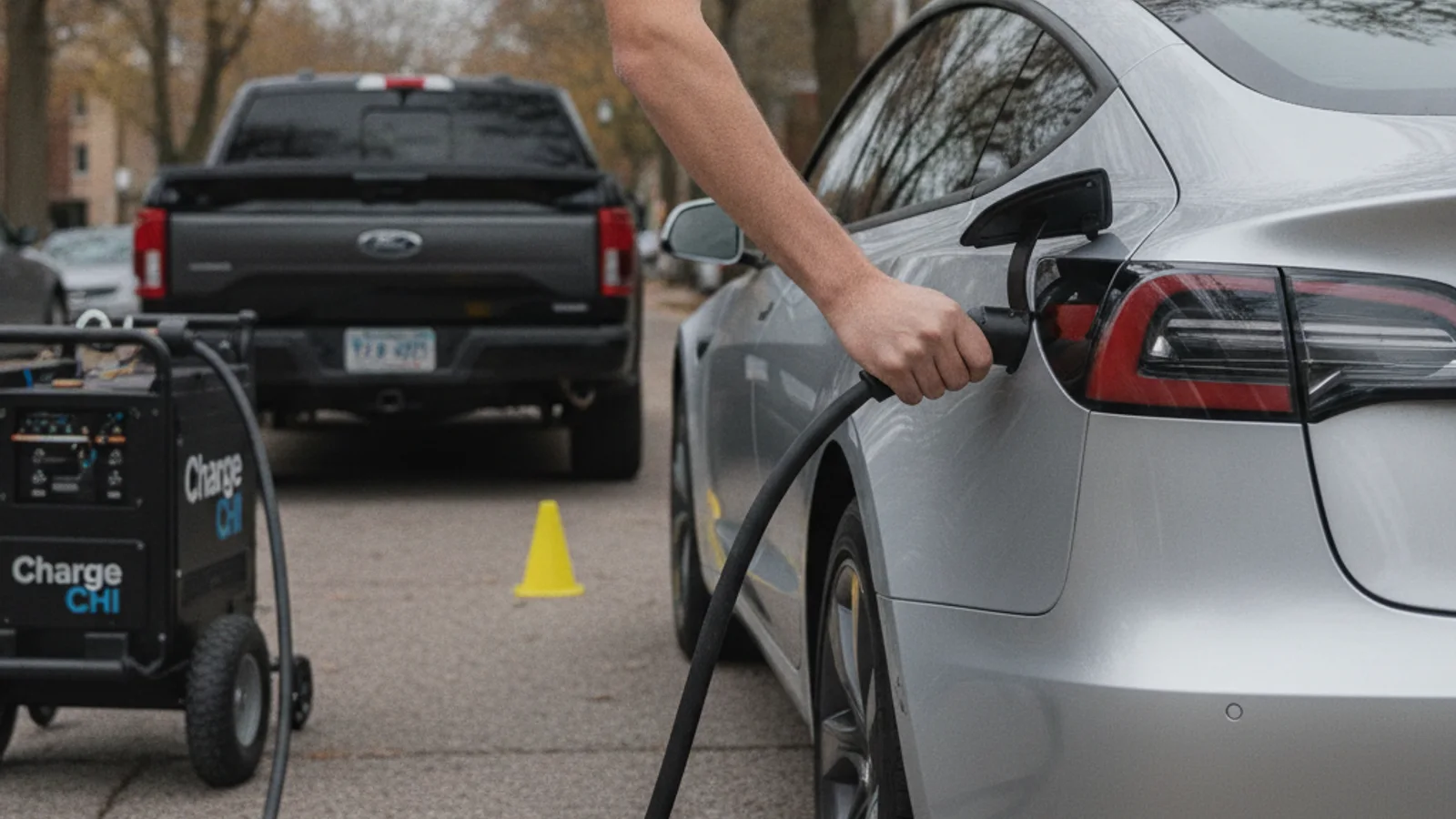
The operator confirms the make, the plug, and the failure type. Then they add enough range to reach a charger you pick. Or they wake the 12V so the car can drive. How a mobile EV charging truck works shows the gear in plain terms.
We don’t publish arrival clocks for Oak Park. Eisenhower traffic, a blocked curb, and a Green Line crossing all change the math. The operator gives their own window on the call. Treat that window as theirs, not ours.
Stay with the car if it’s safe. Keep the hazard lights on while you wait. Don’t stand in the street to flag anyone.
After a boost, pick the next plug yourself. The U.S. Department of Energy AFDC locator maps public stations. We won’t guess which station is open. Confirm in an app before you roll. Don’t assume a lot is empty when you arrive. Don’t assume it’s full either until you check.
Berwyn, Cicero, and the Austin line
Oak Park doesn’t sit in a vacuum. Berwyn and Cicero lie south and southeast of here. River Forest sits to the west of town. Chicago is the east wall at Austin Boulevard.
A Harlem stall can become a Berwyn stall two lights later. If you cross that line, use the Berwyn EV roadside guide. Cicero’s housing is older still on the Census table: 90.2 percent pre-1980. Berwyn’s pre-1980 share sits at 90.0 percent. The same no-wall-box-at-home pattern shows up on those blocks.
Evergreen Park, farther south, is 87.7 percent pre-1980. Glenview, on the North Shore, is 40.3 percent. Housing age is what shapes this kind of stall. Oak Park is a first-ring problem, not a far-suburb one.
Charge Pro CHI covers these Cook County streets in the Chicagoland service area. The brand refers, and independent operators do the work. They quote, they plug in, and they bill you.
How to call Charge Pro CHI
Call when the car is already stuck. That’s an empty pack on an Oak Park curb. That’s a 12V that won’t wake the car. That’s a Wright district visit that spent your buffer for the next plug.
Don’t call us for a home install. Don’t wait on a published arrival clock from us. Do expect a quote before work starts. Then they do a 240V boost or a 12V jump on site.
If you’re still rolling and the estimate looks ugly, slow down. Open your charging app while you still can. Aim for a station you can actually reach. When you’re already stopped, call (858) 925-5546. We’ll connect you with a local operator.