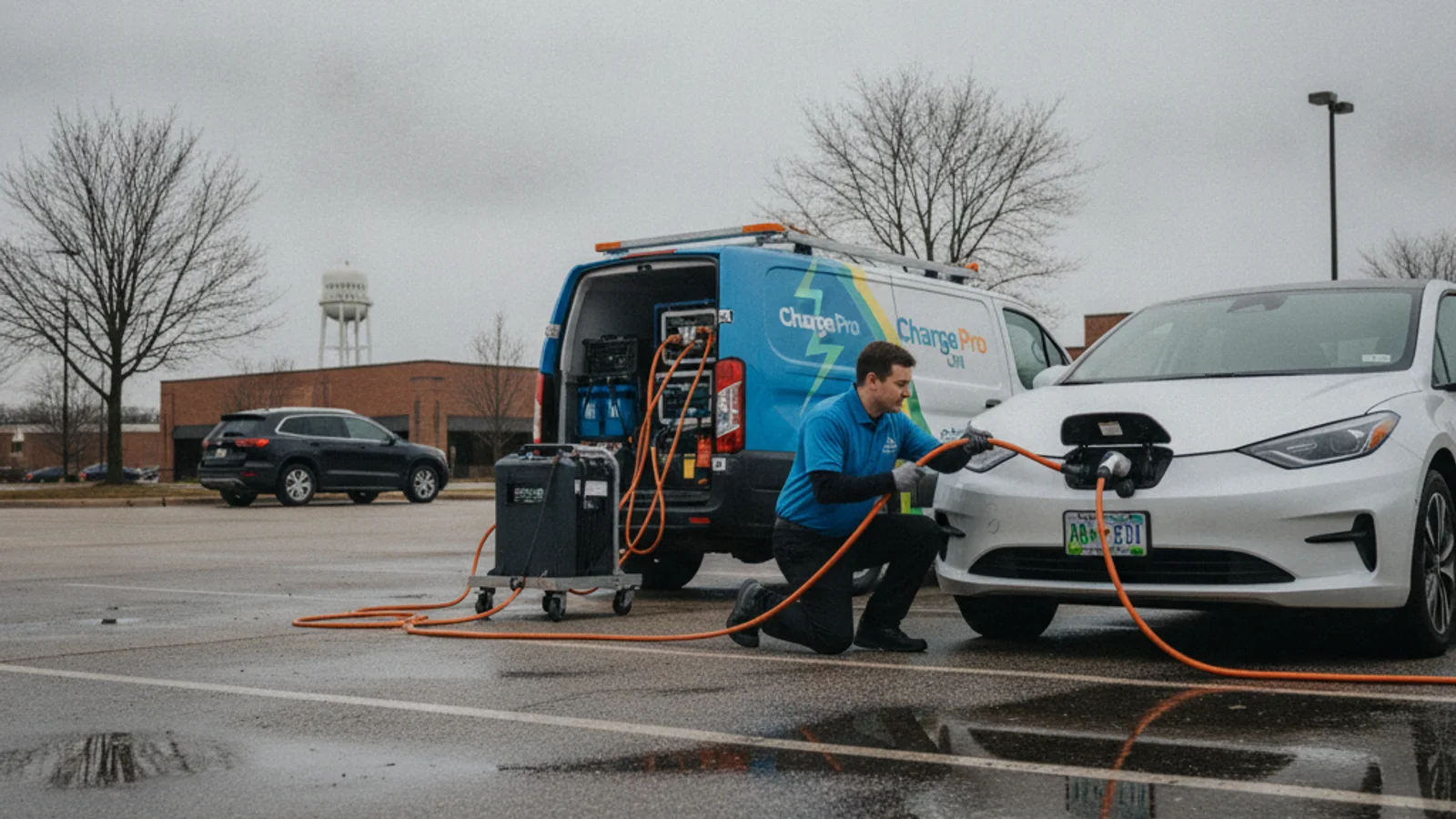
The pack hits zero in a Tinley Park lot after a long sit. It happens after a concert at the amphitheater. A mall afternoon or the last miles of an I-80 commute can do the same. EV roadside assistance in Tinley Park is a mobile charge or a 12V jump on the spot. It isn’t a tow by default. Charge Pro CHI matches you with a local operator. That operator comes to the car, quotes before any work starts, and bills you directly.
Why Tinley Park EVs stall after a normal day
Tinley Park sits in southwest Cook County. ACS figures put the village at 55,007 residents. A lot of the housing is newer. Only 17.2% of homes went up before 1980. Overnight charging in the garage is common here. Drivers leave in the morning with a full pack. Range isn’t on their mind until it is.
That habit breaks on three local patterns.
The first is a night at the Tinley Park Amphitheater. You park for a summer show and sit for hours. You come back after dark to a car that won’t wake. Cabin climate, lights, and heat soak can drain more than you planned. The traction pack may also be too low to leave the lot. For that long-dwell pattern, see dead EV after Tinley Park parking.
The second is long-dwell parking at retail and around Odyssey Fun World. You meant to stay an hour. You stayed four. The car sat in a hot lot. Then you asked it for the drive home on 183rd Street or Oak Park Avenue.
The third is the commute itself. Metra’s Rock Island and SouthWest Service lines make this a rail town. Plenty of drivers still take I-80, US-45 (LaGrange Road), and SR-43 (Harlem Avenue). A day that started with enough range can end short. Errands stacked up. The cabin heat ran hard.
None of those need a shop if the only problem is energy. They need power at the bumper.
Summer heat and winter cold change which failure you get. A July show at the amphitheater is more likely an empty pack. Cabin climate and a hot lot do that. A January Metra lot is more likely a 12V that won’t wake the car. Both are Tinley Park calls. They aren’t the same fix.
Empty pack or a 12V that won’t wake the car
Two failures look the same from the driver’s seat. They aren’t the same job.
If the car drove until the range number hit zero, the high-voltage pack is empty. Doors still work. Screens still talk. You just can’t go. That’s an out-of-charge recovery call. The operator brings a 240V Level 2 source to the car. A native NACS plug covers Tesla. CCS or J1772 adapters cover most other EVs. Typical charging time puts about 10 to 20 miles back in 15 to 30 minutes. That window is charging time. It isn’t an arrival time.
If the car is dark or locked out, start with the 12V. Same if the screen won’t come up. Teslas still use a small 12V battery for computers, locks, and contactors. So do Hyundai Ioniq models, Kia EVs, Chevy Bolts, and most other EVs. The big pack can be fine. The little battery isn’t. A Tesla 12V battery jump on site is the usual first step. If the 12V won’t hold, the operator can quote a replacement there. That still isn’t a tow.
Tell dispatch what the car is doing. Give the make and model. Say whether the screen is alive. That’s enough to send the right connector.
Where Tinley Park stalls actually happen
Downtown Tinley Park and the Oak Park Avenue corridor are easy meet spots. So are the lots around the amphitheater. An operator would rather plug in a parking space than work a live lane. You should too, if you can still roll a few feet.
I-80 along the south edge is a different kind of call. You were headed toward Joliet or New Lenox. Or you were pointed back toward the city. Then the estimate went red. Interstate shoulders aren’t a place to wait without hazards on. Stay in the car if traffic is moving fast. Give dispatch the nearest mile marker or exit. Don’t give a vague “near Tinley.”
LaGrange Road and Harlem Avenue produce the in-town stalls. Drivers misread the last errand. Then they stop in a plaza rather than risk the next light. 183rd Street and south Tinley Park see the same pattern after a late retail run.
Metra lots on the Rock Island and SouthWest Service are evening and overnight calls. The car sat through a workday. You get off the train, and it won’t start. That’s often the 12V, especially after a cold snap. It can also be a pack you meant to charge at home and never did.
Odyssey Fun World and the amphitheater area cluster on weekends. Long dwell, a full family day, and a car that sat. Orland Park next door has the same mall-and-lot pattern. Oak Forest, Mokena, and Country Club Hills share the I-80 and LaGrange Road commute.
Give the nearest named road. Harlem, LaGrange, 183rd, Oak Park Avenue, or I-80 is enough. Downtown versus the amphitheater area is enough local detail for dispatch.
What a mobile EV charge actually is
Charge Pro CHI is a referral line. It doesn’t own trucks. It doesn’t employ technicians. It doesn’t set prices. It matches stranded drivers with independent local operators. The operator quotes before starting. The operator bills you directly.
The rig isn’t a tow truck. It’s a 240V Level 2 source on wheels. Operators handle Tesla and every major EV brand sold here. You don’t need to know NACS versus CCS. You need to say what you drive.
Fifteen to thirty minutes of charging is usually enough to reach home. It’s also enough to reach a public charger you already use. The operator isn’t filling the pack to 100%. The job is enough range to leave the lot, the shoulder, or the Metra deck.
A flat, a frozen charge port, or a drivetrain fault won’t take a charge. Charging won’t fix those. Say what you see. A boost is for an empty pack or a dead 12V. A shop is for broken hardware.
EV roadside assistance is that matching call. You describe the stall. Dispatch confirms the connector. A local operator heads to the location you share.
A boost on the lot versus a tow off I-80
First-time callers often ask for a tow. That’s what gas cars taught them. An empty EV isn’t a broken EV. If the pack is at zero, the car isn’t broken. A mobile charge keeps it where it is. You wait through the charge. Then you drive it yourself.
A tow still makes sense when the car can’t take a charge. It makes sense when the 12V won’t hold. It makes sense when you’re in a lane you can’t sit in. It also makes sense when something besides energy failed. Compare the two paths in mobile EV charging or a tow before you approve either quote.
Don’t guess what either job costs. The operator on the phone gives you the number for that job. Charge Pro CHI doesn’t publish rates.
I-80 calls have one extra constraint. If you’re already stopped on the interstate, safety comes first. Hazards on. Stay off the travel lanes. Tell dispatch you’re on I-80, not only “near town.” That’s how they pick the right operator. For the highway-specific sequence, start with out of charge on I-80.
Home charging is common. Roadside is the backup
ComEd serves Tinley Park. Most of the housing stock is post-1980. Many owners already charge in the garage overnight. That’s why a stall here often feels like a surprise. You didn’t think of yourself as someone who runs out.
A wall box at home doesn’t cover a concert lot. It doesn’t cover a Metra deck. It doesn’t cover an I-80 delay that ate the last bar. It also doesn’t cover a 12V that dies in the driveway on Oak Park Avenue. Roadside help and home charging answer different days.
If you’re weighing a Level 2 install, a licensed electrician has to read your panel. Census housing age isn’t a panel inspection. Confirm it on site. Overnight charging at home still cuts how often you need a mobile boost. It doesn’t erase the amphitheater night or the mall dwell.
Newer houses around downtown and south Tinley Park don’t make the car immune. The usual plan is still plug in at home, then use the pack for the day.
When to call
Call when the car won’t leave the lot, the shoulder, or the driveway. Empty pack, dark screen, or a 12V warning: that’s the list. You don’t need a full story. Location, make, model, and what the car is doing is enough.
If the car still rolls, ease it into a plaza space and shut it down. Don’t keep cycling the start button. Don’t let someone jump the high-voltage pack from a gas car. Put the hazards on if you’re near moving traffic.
Coverage for the village is on the Tinley Park EV charging page. That includes the amphitheater area and the Oak Park Avenue corridor. Charge Pro CHI matches you with a local operator. The operator quotes before any cable goes on. Call (858) 925-5546 when you’re already stuck.
Frequently asked questions
Does a mobile charge work after a Tinley Park Amphitheater show?
Yes, if the problem is an empty pack or a 12V that won’t wake the car. Long dwell in a concert lot is a common local stall. The operator charges where the car sits. You drive out when there’s enough range. A tow is the wrong first move unless the car can’t accept a charge.
My Tesla won’t start in a Metra lot. Is that the main battery?
Usually it’s the 12V. A dark screen, odd door behavior, or a car that won’t wake points to the small battery. The traction pack can still have range. A jump on site gets most Teslas moving. If it dies again, ask for a replacement quote instead of another jump.
Do operators cover non-Tesla EVs in Tinley Park?
Yes. The operator brings a native NACS plug plus CCS or J1772 adapters. That covers Rivian, Ford F-150 Lightning, Mustang Mach-E, Hyundai Ioniq 5 and 6, Kia EV6 and EV9, Chevy Bolt and Equinox EV, Polestar, Nissan Leaf, and most other EVs sold in the US. Say the make and model when you call.