A Ford F-150 Lightning that won’t start is usually a dead 12V. The traction pack can still show a full charge. The truck stays dark anyway, because the small battery has to wake it. Without that wake-up, locks, screens, and latches all stay dead. Delivery Lightnings in Will County sit a lot between short hops. That sit time is a classic way the 12V goes flat.
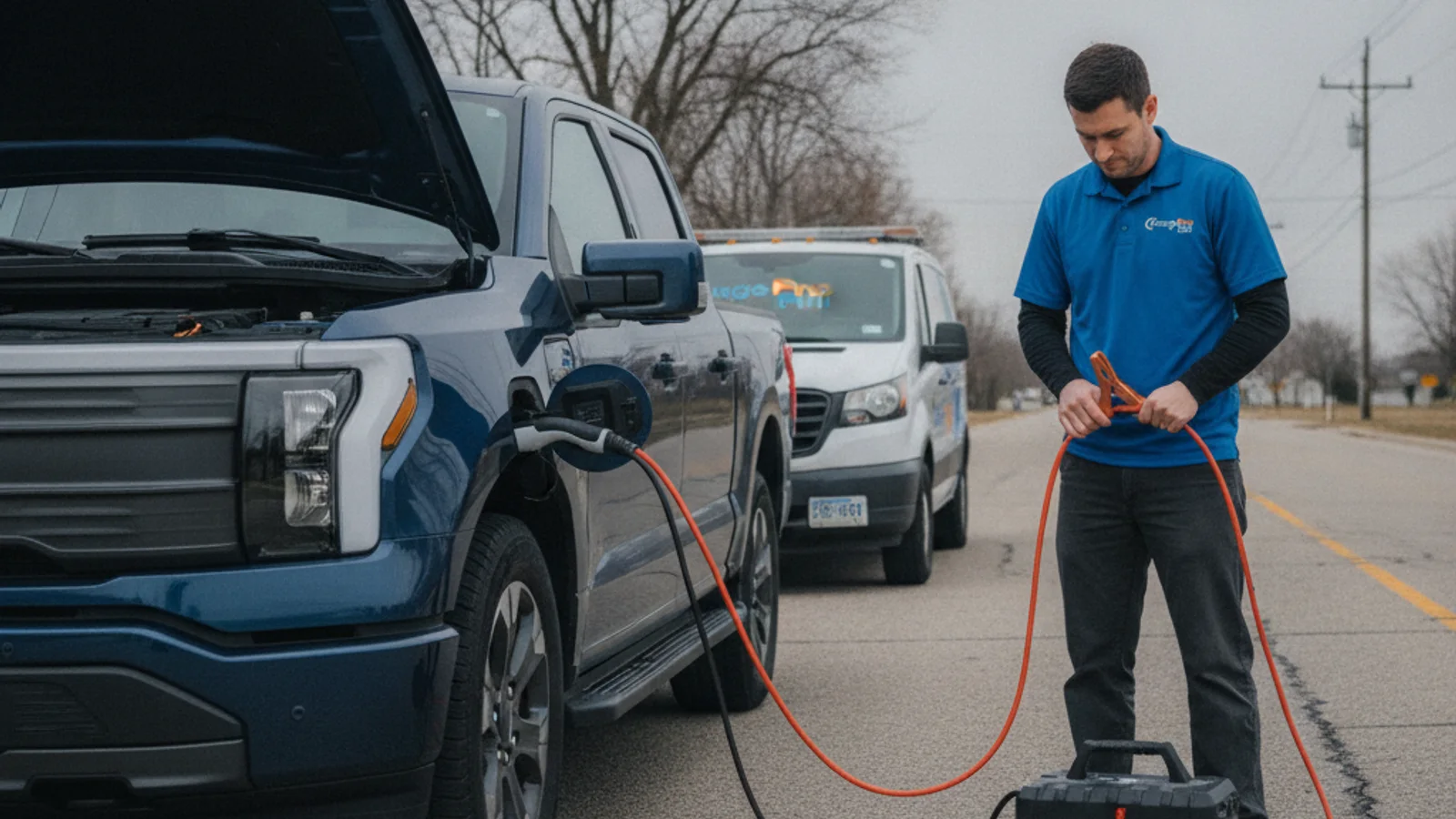
A dark truck is not an empty pack
The key fob does nothing, and the phone app won’t wake the truck. The center screen stays black, or it flickers once and dies. Cabin lights look weak, then they quit. You might hear a relay click, then silence. The mega power frunk stays shut, because the electric latch needs 12V. A charge cable can be locked in, and charging still never starts. The truck can’t initialize the session without that small battery.
A pack problem looks different from a dead 12V. The dash usually still lights, and the truck still talks to you. You’d see a low-range warning, reduced power, or a refusal to shift. Range would be the complaint, not a silent brick. If everything is dark, start with the 12V. Our guide on what you see when an EV 12-volt battery dies separates those two failures.
The 12V is the gate for the big pack
The Lightning uses two batteries that don’t share a job. The traction pack is the large high-voltage battery under the body. It stores the miles and actually moves the truck. The 12V is a small lead-acid battery, like a gas F-150 starter battery. It powers computers, screens, door locks, lights, and the pack contactors.
The truck needs the 12V alive before it can close those contactors. Only then can it pull energy from the traction pack. If the 12V is dead, the DC-DC converter never starts. The converter is what normally keeps the 12V topped off. So a dead 12V can’t recharge itself from a full pack. You sit there with unused range and a truck that won’t wake.
The drain is usually ordinary, not a mystery electrical event. A door left ajar overnight will do it. So will cabin modules, aftermarket lights, or a fridge in the bed. Pro Power Onboard can feed tools while the truck is parked. Short delivery loops may never give the converter a long rest. An aging 12V just holds less, then it fails on a cold morning. If the truck sat after a shift, check the 12V first.
Delivery days in the Will County belt
A delivery Lightning around Joliet, Romeoville, or Bolingbrook spends a lot of time parked. It hops between stops and rarely gets a long rest charge in between. Accessories stay live, so the 12V may not have enough left to wake the truck.
Joliet is Will County’s largest city, with a 2024 Census estimate of 151,837. About 34.7% of Joliet residents are Hispanic or Latino. Roughly 39.0% of its housing predates 1980. That’s an older mix than the newer towns next door.
Romeoville’s 2024 Census estimate is 41,177 people in Will County. Hispanic or Latino share there is 35.7%. Only about 20.6% of housing is pre-1980. That’s newer stock than Joliet’s older core.
Bolingbrook, also in Will County, has a 2024 estimate of 74,756. Hispanic or Latino share is 28.2%. Pre-1980 housing is only 12.3%. Plainfield’s 2024 Census estimate is 48,881, still in Will County. Only 6.7% of housing there predates 1980. Hispanic or Latino share is 10.0%. New Lenox is smaller, with a 2024 estimate of 28,480. Pre-1980 housing is 7.9%, and Hispanic or Latino share is 5.3%.
Those Census figures come from ACS tables and 2024 estimates. We read them from Census Bureau files on 18 Sep 2026. They don’t set a charger map. They don’t tell you a fee. They do show that Will County isn’t one housing type. Joliet’s older blocks aren’t Plainfield’s newer subdivisions. A Lightning can start a route in one town and sit dead in another. The 12V doesn’t care which city line you crossed. It cares that the truck sat, or that a load kept drawing.
If the pack is what died on the interstate, that’s another call. Out of charge on I-80 in Will County is written for an empty traction pack. A silent Lightning in a lot after a shift is usually the 12V. The Joliet EV charging page is the local hub if you’re in that city.
A lot stall after a shift is a 12V problem until the screens prove otherwise. Don’t assume you need a flatbed because the truck looks dead. Don’t assume the traction pack is empty because the dash is black.
Open the frunk when the latch has no power
Ford hid the 12V and the jump points in the frunk. That layout is fine until the 12V is already dead. The mega power frunk uses an electric latch. No 12V means the latch won’t release on its own.
Ford built a manual release for this exact stall. It’s a mechanical pull, usually a tab or a cable. The location changes by model year, so read your owner’s manual. Don’t pry the lid or yank random trim to guess. Once the frunk is open, look for dedicated jump terminals. You’re not clipping to the battery posts themselves.
If you can’t find the manual release in the book, wait for help. Forcing the lid can break the latch and still leave you stranded.
Jump only the labeled 12V points
The positive post sits under a red cap and is marked +. The negative is a ground point on the body nearby. That’s often a bare metal stud or a bracket. Connect a 12V jump pack, or a donor 12V battery, to those two points. Treat it like jumping a gas truck, because that’s all this circuit is.
You’re reviving the auxiliary system, not charging the traction pack. Stay off the orange high-voltage cables, which aren’t jump points. If the labels aren’t clear, stop and get help. How to jump start an EV in winter covers clamp order and the usual mistakes.
After a clean jump, the truck should wake. Locks answer the fob, and the screen comes back. Give it a few minutes so the converter can feed the 12V from the pack. If it dies the next time you shut down, the battery is done. A second jump is a delay, not a repair. Operators in this network can replace a 12V on site. EV 12V replacement signs and on-site help is the follow-up if it keeps falling.
If the pack is empty, skip the jump
Sometimes the Lightning has actually run the traction pack to zero. A 12V jump won’t put miles back in that battery. You need energy in the pack, enough to roll to a plug.
Use the screens to tell the two failures apart. If the truck wakes, talks, and shows no range, that’s the pack. If it stays fully dark, keep treating it as a 12V until it proves otherwise.
For an empty pack, a mobile operator brings a 240V Level 2 source. On a Lightning they use a CCS adapter, not a native NACS plug. Charging typically adds 10 to 20 miles in 15 to 30 minutes. That’s charging time on the truck, never an arrival window. It’s meant to reach a public charger, a work plug, or home. Out-of-charge recovery is the page for that boost.
No named charging site was confirmed for these Will County towns. We aren’t listing plugs we couldn’t verify. Ask the operator where they want you to head after a boost. Confirm a working plug on your route before you leave the lot.
Charge Pro CHI doesn’t install wall boxes or rewire Pro Power Onboard. It doesn’t hold a trade license, and it doesn’t employ technicians. A home charger or a wiring fault is a licensed electrician’s job. Roadside help here is a 12V jump, a 12V replacement, or a range boost.
How the referral actually works
Charge Pro CHI is a referral line for stranded EV drivers in Chicagoland. It matches you with an independent local operator. The brand owns no trucks, no equipment, and no parts inventory. It sets no prices, and it publishes no business hours. The operator quotes you before starting, then bills you directly.
On a Lightning, that operator can jump the 12V at Ford’s terminals. They can replace a 12V that won’t hold a charge. They can add a Level 2 boost if the traction pack is empty. They handle Tesla and every major EV brand, Ford included. For the non-Tesla path, see non-Tesla EV rescue.
Tell the operator what the truck is doing. Say whether the fob works and whether any screen lights. Say whether the frunk is open. That split decides a 12V jump versus a pack boost. The quote is theirs, and it comes before work starts.
If your Lightning won’t start, call (858) 925-5546. We’ll help sort a dead 12V from an empty pack. Then we connect you with a local operator. The quote comes from that operator, before any work starts.
Frequently asked questions
Why won’t my Ford F-150 Lightning start when the pack is full?
A full charge lives in the traction pack, not in the 12V. The truck still needs a healthy 12V to wake its computers. The Lightning stays dark even with unused range sitting in the pack. A 12V jump at the frunk terminals usually brings it back.
How do I open the frunk on a dead Lightning?
The mega power frunk latch is electric, so it needs 12V to release. When the 12V is dead, the latch won’t pop from the fob. Ford includes a manual frunk release, a mechanical tab or cable. The spot varies by year, so check the owner’s manual for your truck. Once the frunk is open, you can reach the jump terminals.
Can I jump a Ford Lightning like a regular F-150?
Yes, with one hard limit: you only jump the 12V system. Ford gives you labeled jump terminals in the frunk. Use the positive post under the red cap and the nearby ground. Don’t clip onto orange high-voltage cables. If you’re not sure which points are which, stop and call.