A GMC Sierra EV coasted empty on a Chicagoland logistics run. It still needs power at the bumper. The traction pack is out, or the 12V has dropped. The truck won’t take another dock. This page covers GMC Sierra EV emergency charging in that stall. You’ll get the first safety moves. You’ll get what a mobile Level 2 boost can add. Charge Pro CHI also connects you with an independent operator. That operator quotes before they plug in.
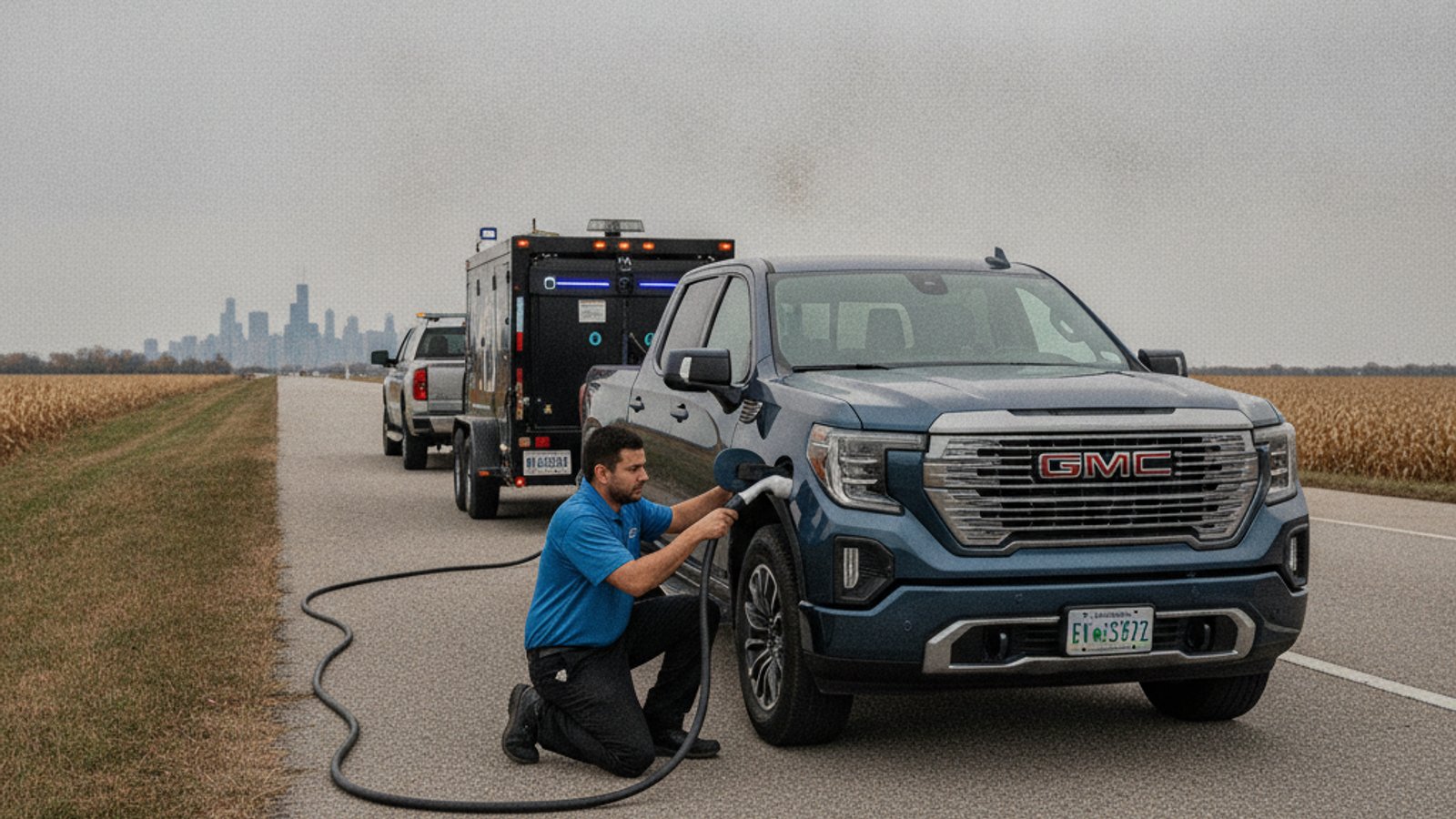
Charge Pro CHI doesn’t own rescue trucks. We don’t employ technicians. We don’t set prices or publish hours. We match stranded EV drivers with local mobile operators. The operator bills you directly. If the truck only needs range, they bring 240V to the charge port. If the truck won’t wake, they can jump or replace a dead 12V on site.
Why a Sierra EV strands on a work day
A Sierra EV is a heavy electric pickup. It spends the day as a tool, not a grocery run. Payload, a trailer, and a long idle at a gate all pull from the same pack. Cabin heat in a Chicagoland winter pulls more. So does cooling a cab that sat in sun at a yard. None of that is a defect. It’s how a work truck uses energy.
The logistics belt around this metro isn’t one neighborhood. Elk Grove Village sits in Cook County near cargo and warehouse work. Joliet anchors Will County with 151,837 residents in the 2024 estimate. Aurora, in Kane County, is larger still at 180,710. Chicago itself holds 2,721,308 people on that same 2024 estimate. Those places don’t drive the same. A Sierra EV leaving a newer Plainfield subdivision has a different day. A truck staging in Cicero has another.
Census housing age tells part of that story. About 90.2% of Cicero’s housing predates 1980. Berwyn sits at 90.0%. Chicago is at 68.6%. Plainfield is at 6.7%. Naperville is at 11.7%. A newer garage can take a 240V box more often. An older bungalow belt often can’t. This page’s research pulled those Census figures. It didn’t turn up a verified utility EV rate. It didn’t turn up a permit rule we can quote. It didn’t turn up a public charger count either. Confirm those with your utility, the city, and the yard you report to.
Empty pack or a dead 12V
Before you call anyone, name the failure. Rescue for a silent 12V isn’t the same job as filling an empty traction pack.
The traction pack hit empty
You’ll usually get warnings first. Power tapers. Climate control may drop. The truck can feel like it’s saving the last bit of energy. Then it stops. Hazard lights and locks may still work for a while. That’s because the 12V is a separate battery. That 12V isn’t extra range. It runs computers, lights, and latches.
If the dash still talks to you, treat it as an empty pack. If it’s calling for charge, you want help at the bumper. Use mobile EV charging. You don’t want a guess about a shop.
The truck won’t wake at all
A Sierra EV can also sit dark. The app may still show range from this morning. Screens stay black. The charge door won’t listen. Door handles feel dead. That pattern often points at the 12V, not the big pack. GM’s other electric trucks fail the same way. A silent cab with energy still in the pack is a 12V job. Treat it that way until someone proves otherwise.
Operators we connect you with can jump or replace a 12V on site. They also handle Tesla and every major EV brand. A mixed fleet at a yard isn’t a special case.
If you can’t tell which battery failed, say that on the call. Describe what the dash does. Describe what the app shows. Tell them it’s a dark truck with range still on the app. A wrong guess slows the fix.
First moves on the shoulder
Low-charge warnings are your cue. Pick a safe box of pavement. Don’t hunt for a perfect lot while the truck is fading.
Turn the hazards on. Get fully out of the travel lane if the truck still rolls. I-55, the Tri-State, and I-80 in Will County have loud, fast shoulders. Stay in the cab unless the spot is unsafe. If you must step out, keep the truck between you and traffic.
Note the mile marker, the ramp name, or the yard gate. Westbound I-55 near a warehouse beats “somewhere south.” If you’re in a stall inside a site, name the business and the door. Operators can’t see a dock number you didn’t give them.
Stay off the travel lanes. Don’t stand behind the truck on a freeway. If the pack died in motion on that I-55 stretch, start with the freeway steps. Then open what to do when you’re out of charge on I-55.
Yard lots have their own mess. Tell security you’re waiting on a mobile charge, not a wrecker, if that’s true. Give the operator the gate code you can share. Move only if a supervisor makes you. Move only if the truck still rolls.
What mobile GMC Sierra EV emergency charging looks like
A mobile Level 2 boost is a 240V source on a vehicle. It comes to your bumper. It isn’t a Supercharger. It isn’t a full fill. The point is enough range to roll to a plug you already trust. Or back to a yard that can hold the truck overnight.
Charge Pro CHI matches you with that operator. We don’t roll the truck. The operator quotes you before they start. They bill you directly. There’s no rate on this page because we don’t set one. No public figure was confirmed in the research.
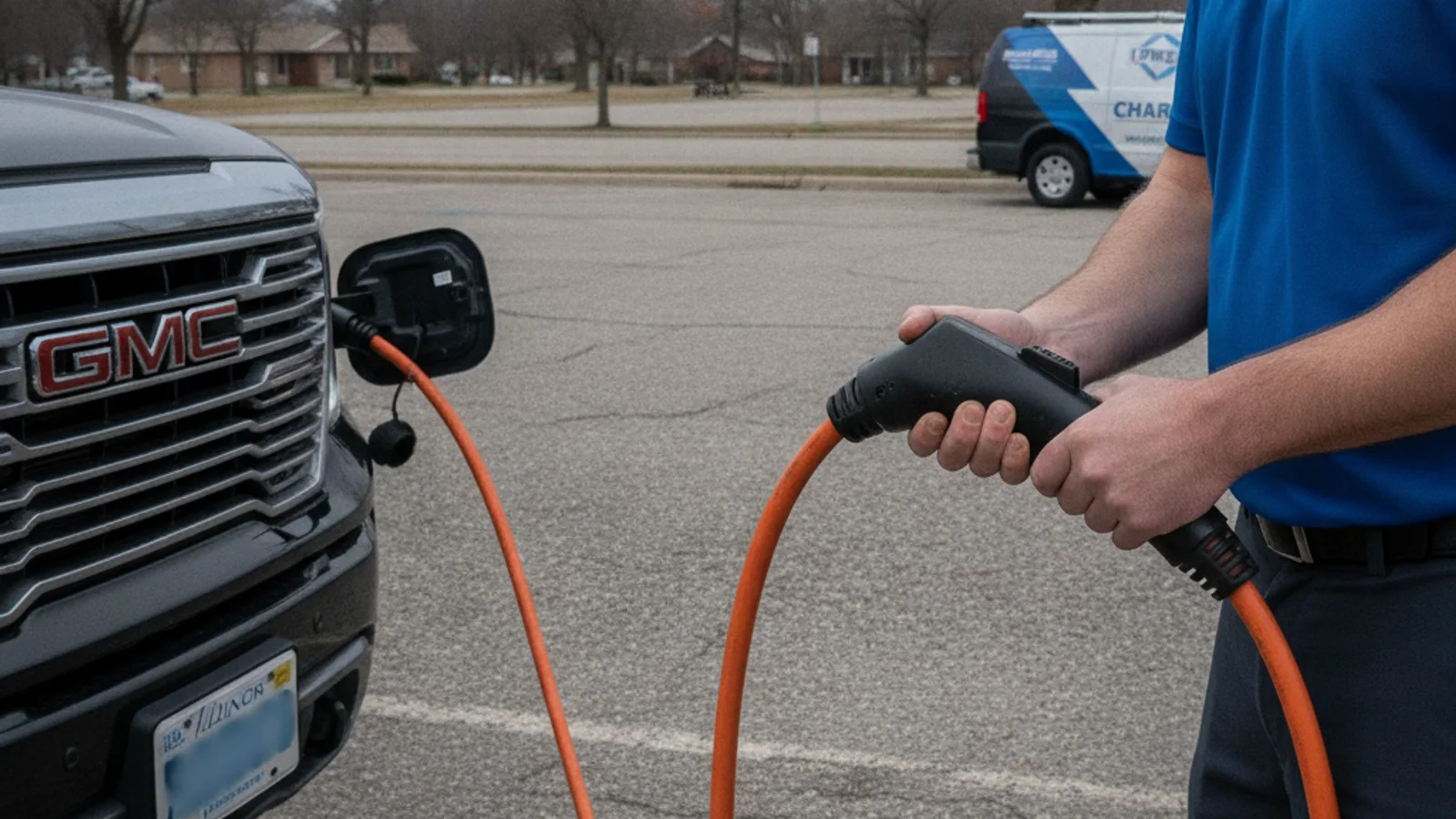
What they typically bring matches the rest of this network. A 240V Level 2 source. A native NACS plug. CCS or J1772 adapters for non-Tesla EVs, which includes a Sierra EV. Tell them the make, model, and year so the adapter is in hand.
Charging time isn’t arrival time. Once they’re plugged in, operators typically add 10 to 20 miles of range. That happens in 15 to 30 minutes of charging. That window is charging only. This page doesn’t promise when someone shows up. Weather, traffic, and where you sat all change the clock. Those arrival times weren’t verified here.
Ten to twenty miles is enough for many logistics stalls. It’s a buffer to a charger you already had in the app. Or to a home bay. Or to the yard. It isn’t a full workday. Don’t plan a second trailer pickup on that boost alone.
If you want the hardware picture, start here. What’s on a mobile EV charging truck walks through the van and the 240V source.
If the truck can still roll to a plug
If limp mode still gives you a short crawl, use it with care. A CCS or J1772 site already in the nav can be the whole fix. Use the truck’s map. Open a charging app. Confirm the plug type. A Sierra EV isn’t a Tesla. A Supercharger stall that’s Tesla-only won’t help. It only helps if that site is marked open to other brands.
This research didn’t include a verified list of working stations by city. It also didn’t include a count of ports. Don’t trust a remembered lot from last month. Check live status. The DOE Alternative Fuels Data Center is one public place to look up plug types. Your in-truck nav is another. If the app says a stall is down, believe it. Pick a new plan.
Don’t spend the last bar hunting. A rolling search that dies in a turn lane is worse. Stop early and call for a boost instead. If you can’t reach a plug you can confirm, switch plans. Use out-of-charge recovery.
A 120V travel cord isn’t a roadside plan for this truck. Level 1 needs a live household outlet and a lot of hours. A Sierra EV pack is large. A trickle on a shoulder doesn’t return a workday. A portable 240V unit only helps if you’re already next to the right outlet. A freeway shoulder doesn’t have one.
A tow is a different job
Towing a heavy EV pickup is a shop move. It’s the right call when a motor, an axle, or a crash is the problem. It’s a slow way to fill an empty pack. The truck has to be loaded the way the manufacturer allows. A four-down pull can be the wrong method on an EV. This page can’t quote a GMC tow procedure we didn’t verify. Ask the operator. Or read the Sierra EV’s own towing section. Do that before anyone hooks a chain.
A flatbed still leaves you waiting for a charger at the other end. Dealership availability wasn’t confirmed here. Don’t assume a GMC store has an open DC stall the minute you roll in. If the only problem is energy, boost at the bumper. It skips the load, the unload, and the second queue.
If the truck is damaged, say so. Rescue charging can’t straighten a crumpled fender. If the pack is empty and the truck is otherwise sound, say that clearly. That’s when you want a non-Tesla EV rescue.
The logistics belt, city by city
Chicagoland isn’t one charging story. The housing is different. The jobs are different. The roads are different. A Sierra EV used as a logistics truck feels those differences on the same shift.
Elk Grove Village
Elk Grove Village is a Cook County job center. The ACS 2019-2023 count is 32,132 people. The 2024 estimate is 31,802. About 14.6% of residents are Hispanic or Latino. About 38.6% of housing predates 1980. Warehouse docks and cargo loops define a lot of the work here. A Sierra EV that dies at a dock is a work delay. The driver still has a load, a window, and a dark truck.
If that’s your stall, stay put if you can’t confirm a plug. Give the operator the gate, the door, and any security check. A warehouse loop is easier to miss than a house number. The same pattern shows up in a delivery van EV dead in Elk Grove Village.
Schaumburg and Hoffman Estates
Schaumburg’s 2024 estimate is 77,099 people. ACS population was 76,780. Hispanic or Latino share is 11.2%. About 15.9% of housing predates 1980. That’s newer stock than the inner west. Hoffman Estates is next door. ACS population was 51,186. The 2024 estimate is 50,920. Hispanic or Latino share is 19.0%. About 32.1% of housing predates 1980.
These northwest Cook suburbs mix office parks, retail lots, and warehouse edges. A Sierra EV can sit for hours in a lot. Someone is inside on a call. Long dwell is how a winter pack sags. If the truck won’t restart after a long wait, decide pack versus 12V. Do that before you ask for a tow.
Joliet and the I-80 side of Will County
Joliet is a Will County hub. ACS population was 149,785. The 2024 estimate is 151,837. About 34.7% of residents are Hispanic or Latino. About 39.0% of housing predates 1980. I-80 cuts the southwest metro here. A Sierra EV on that freight mix is doing real miles, often with payload.
Joliet is large enough that a stall can be many places. A downtown street. A yard. The interstate. Say which. Don’t give a city name alone and hope. Add the road, the gate, or the cross street.
Bolingbrook, Romeoville, and Plainfield
Bolingbrook’s 2024 estimate is 74,756. ACS population was 73,813. Hispanic or Latino share is 28.2%. Only about 12.3% of housing predates 1980. Romeoville is smaller. ACS population was 40,996. The 2024 estimate is 41,177. Hispanic or Latino share is 35.7%. About 20.6% of housing predates 1980. Plainfield grew faster. ACS population was 45,705. The 2024 estimate is 48,881. Hispanic or Latino share is 10.0%. About 6.7% of housing predates 1980.
That newer housing belt is where a home 240V setup is more common. It doesn’t change a stall on I-55. A Sierra EV that left a Plainfield driveway full can still arrive empty. Towing, heat, and a long wait at a dock in Romeoville will do that. Treat the last reserve as a work tool. It isn’t spare pride.
Chicago and the inner west
Chicago’s ACS population is 2,707,648. The 2024 estimate is 2,721,308. Hispanic or Latino share is 29.6%. About 68.6% of housing predates 1980. Cicero is denser in older stock. ACS population was 83,223. The 2024 estimate is 82,090. Hispanic or Latino share is 88.8%. About 90.2% of housing predates 1980. Berwyn is 55,888 in the ACS count and 55,152 in 2024. Hispanic or Latino share is 60.2%. About 90.0% of housing predates 1980.
A Sierra EV used in the inner west often starts without a home wall box. That’s a housing fact, not a charger map. This research didn’t prove where public plugs sit in those cities. If you can’t plug at home, plan the day around confirmed sites. Keep a bigger buffer. When that plan fails, you want the boost at the curb. You don’t want a scavenger hunt on a one-way.
Lower Wacker, the Kennedy, and the Dan Ryan are the same stall in the core. Tight shoulders. Fast traffic. Little room to wait. Get the hazards on. Stay in the cab. Give the operator the exact level or ramp. A downtown pin isn’t enough.
Aurora, Elgin, and Kane County
Aurora is Kane County’s large city. ACS population was 179,867. The 2024 estimate is 180,710. Hispanic or Latino share is 42.8%. About 33.1% of housing predates 1980. Elgin is 114,106 in the ACS count and 114,701 in 2024. Hispanic or Latino share is 48.4%. About 41.5% of housing predates 1980.
Kane County work includes plants, yards, and long arterial miles. The Reagan Tollway and Randall Road eat range when you add cold and payload. Keep the same rule. Confirm the next plug. If you can’t, stop in a safe lot. Call for a Level 2 source at the bumper.
Cold, payload, and the idle that surprises people
Chicagoland winters are hard on every EV. A Sierra EV has a large cabin and a large pack. Heat that cabin from cold and the miles on the display shrink. A pack that sat overnight outside loses easy power until it warms. This page won’t invent a percent. Your own energy graph is the honest number.
Payload and towing are the other quiet drain. The truck is built to haul. Hauling isn’t free. If the day’s job is a trailer, plan more charging stops than an empty-bed commute. The nav’s remaining miles assume a lighter day than the one you booked.
Idle at a gate is the third drain. A diesel driver understands idle. An EV driver sometimes doesn’t. Climate on, radio on, waiting for a dock, and the pack is working. If you know the wait is long, shut down what you can. Keep enough buffer to leave the site.
Summer heat is real in this metro too. Cooling the cab after a parked bake uses energy. So does keeping a pack in a safe temperature band. Again, no invented percent. Watch the consumption screen on the first hot week you run the truck loaded.
Home charging when the house is old
Overnight 240V is still the simplest way to start a logistics day with a buffer. That’s a habit, not a product pitch. Many inner-west and Chicago addresses sit in pre-1980 housing. Cicero and Berwyn are extreme on that measure. Oak Park is at 78.6% pre-1980. Evergreen Park is at 87.7%. A 240V install may be simple in a 1990s Naperville garage. It can be a fight in a 1920s bungalow. We didn’t confirm permit rules, panel sizes, or utility rebates for any of those cities. Ask an electrician and the utility of record. Charge Pro CHI doesn’t do that work.
Naperville’s pre-1980 share is only 11.7%. Carol Stream is 14.2%. A Sierra EV stored in those garages is more likely to leave full. It’s still empty if the driver skipped the plug. It’s also empty if a wall box tripped and nobody noticed.
If home charging isn’t possible, you’re living on public plugs and yard plugs. Build a bigger reserve. Don’t treat a thin reserve as a game. When the reserve fails, a mobile boost is the roadside version of that 240V outlet.
A 120V garage outlet can maintain a light day. It’s a poor way to recover a Sierra EV that came home near empty. If the truck is already on the road near empty, that garage outlet isn’t in play.
What Charge Pro CHI does, and what it doesn’t
We’re a referral line for Chicagoland. We match you with independent local mobile rescue operators. We don’t perform the work. We own no trucks, no yards, and no parts inventory. We employ no technicians. We publish no hours. We promise no arrival time. The operator quotes you before starting and bills you directly.
What those operators do is narrow and useful. They bring 240V Level 2 to the car. They use a native NACS plug, plus CCS or J1772 adapters for non-Tesla EVs. They typically add 10 to 20 miles in 15 to 30 minutes of charging. They can jump or replace a dead 12V on site. They handle Tesla and every major EV brand, including a GMC Sierra EV.
GMC’s own roadside plan wasn’t a document we could verify for this page. Read the glovebox card and the app that came with the truck. Many factory plans send a tow. A tow may not include a 240V boost. If the factory line can’t charge you on site, a local operator is the other call.
Don’t wait for another EV to save the pack. Some trucks can power tools from onboard outlets. That isn’t the same as filling a Sierra EV traction battery. Can one EV charge another when you’re stranded covers that dead end.
After a boost, go straight to a confirmed plug or a known bay. Don’t squeeze in one more pickup on a thin charge. Watch the first miles. If the truck is still throwing a charge fault, you’re past a simple empty pack. That’s a shop.
If you want a match, call Charge Pro CHI at (858) 925-5546. Have the truck’s location, the make, and whether the screens are alive. The person who shows up is the operator, not a Charge Pro CHI crew. They’ll quote before they clip on.
Frequently asked questions
How much does GMC Sierra EV emergency charging cost?
Charge Pro CHI doesn’t set the price. The independent operator quotes you before they start and bills you directly. No public fee schedule turned up in the research for this page. Ask for the quote while you’re still on the phone. If the number doesn’t work, you can decline before they plug in.
How long does a mobile charge take on a Sierra EV?
Once the cable is on, operators typically add 10 to 20 miles of range. That happens in 15 to 30 minutes of charging. That’s charging time, not a clock for arrival. How far those minutes go depends on cold, payload, and how empty the pack was. The goal is enough range to reach a plug you can confirm. Or a yard that can hold the truck.
Can another EV charge my GMC Sierra EV on the roadside?
Don’t count on it. Pack-to-pack charging isn’t a standard roadside method here. Onboard outlets on a work truck are for tools and jobsite loads. They aren’t a rescue hose for another traction battery. Call for a dedicated 240V source. Or roll to a confirmed public plug if you still can.