Tesla charge time in Chicagoland depends on the plug and the pack. A Supercharger stop to about 80% usually takes 25 to 40 minutes. Overnight Level 2 at home typically needs 6 to 10 hours. A regular 120V outlet can take two to three days. Cold packs and street parking are what change those windows here.
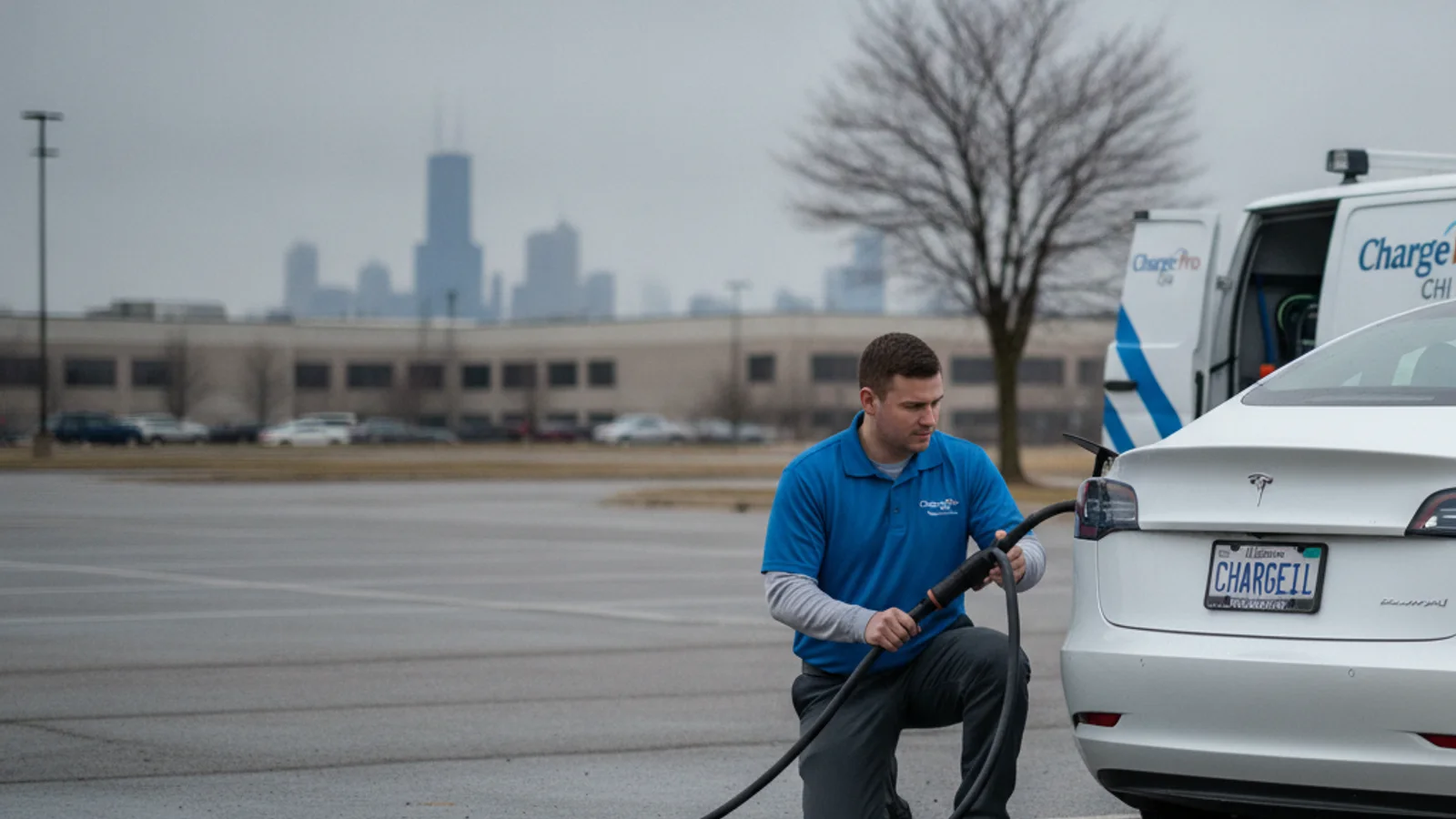
Street parking isn’t a garage circuit
Cicero’s housing stock is 90.2% pre-1980, and Berwyn sits at 90.0%. Oak Park is 78.6%, and Chicago itself is 68.6%. A 240V wall connector isn’t a given in that mix. Plenty of Model 3 owners on those blocks park on the street. Overnight charging there often means a public Level 2 post or a shared lot. It isn’t a private wall connector on a dedicated circuit.
Naperville is different, because only 11.7% of its housing predates 1980. Plainfield is 6.7%, and Gurnee is 9.5%. Newer DuPage, Will, and Lake County housing is more likely to have overnight garage charging. That’s why the same Tesla can wake up full in Wheaton. It can wake up short after a night in older Cook County housing.
Don’t treat every suburb as the same charging story. Highland Park is 60.6% pre-1980, and Waukegan is 54.0%. Gurnee, in the same Lake County, is only 9.5%. Aurora and Elgin bring Kane County housing into the same spread. Joliet and Romeoville do that for Will County. The wait follows the plug you can actually reach.
Start with the fastest plug, then work down
Tesla charging comes in three speeds, and the gap between them is wide. For a stranded-driver walkthrough of those levels, see EV charging levels, explained for stranded Chicagoland drivers.
Superchargers and other DC fast plugs
A Supercharger feeds DC straight into the pack. It skips the car’s onboard charger. On a newer stall, a Model 3 or Model Y climbs fast. Around 10% to 80% takes roughly 25 to 35 minutes. Older Model S and Model X cars, and older stalls, run slower. Third-party CCS fast chargers work the same way once you’ve got the right adapter. Past 80%, every fast charger eases off, and most trip drivers unplug there. Sitting for 100% can eat as much time as the first big jump. Tesla’s nav can precondition the pack when you route to a Supercharger. Set that before you leave. A cold pack accepts DC more slowly until it warms. That’s Tesla’s own charging behavior, not a county rule.
A 240V Level 2 night at home
A 240V Level 2 charger works at home or in a public lot. It adds about 20 to 44 miles of range per hour. The spread depends on the car’s onboard charger and the circuit. From near empty, a full charge typically runs 6 to 10 hours. That’s a night’s sleep, not a short errand. If you can park in a garage in Naperville or Glenview, that overnight window is the default. In Cicero, a house that can’t take a charger changes the night. You’re on street charging and a longer calendar. Home EV charging in Cicero when the house cannot take a charger covers that bind.
The wall outlet you already have
A standard 120V household outlet is the slow lane. It adds roughly 3 to 5 miles of range per hour. From near empty, a Model 3 or Model Y can sit two to three days. It can cover a short local loop if the car stays plugged in. It can’t rebuild a depleted pack before a morning run across Cook County.
Why the last 20% feels stuck
Lithium-ion cells take charge fastest in the middle of the range. They slow hard near full to protect the pack. Ten percent to 80% on a Supercharger might take half an hour. Eighty to 100% on the same stall can take nearly as long again. Plan trips around the 80% mark and skip the tail.
Cold packs change the Supercharger clock
Chicagoland winters soak a pack that sat outside. A Tesla that spent the night on an Evanston or Skokie street soaks cold. One that slept in a garage in newer housing stays warmer. Street spots in Chicago and Oak Park don’t shelter the pack. A cold pack throttles DC fast charging until thermal management catches up. Cold-soaking is the bigger local swing for drivers here. Tesla preconditioning is the tool you already have. Set nav to the Supercharger before you roll. Give the pack time to warm on the way. A cold day also changes how long a charge lasts. Read how long a Tesla charge lasts through a cold Chicagoland day. Don’t wait for a temperature number this page can’t confirm. No verified Chicagoland threshold turned up in the research for this piece. Tesla’s thermal limits are set in the car, not by Cook County or DuPage County. Watch the in-car charge graph, not a weather-app guess.
If the pack hits empty before you can plug in
If the Tesla is too low to reach a charger, don’t sit and wait. Charge Pro CHI is a referral line. We match stranded drivers with independent local mobile rescue operators across Chicagoland. The brand doesn’t own trucks and doesn’t send its own crew. The operator brings a 240V Level 2 source to the car. It uses a native NACS plug, plus CCS or J1772 adapters as needed. That on-site charge typically adds 10 to 20 miles of range in 15 to 30 minutes of charging. That’s charging time, not an arrival time. The operator quotes you before starting and bills you directly. Out-of-charge recovery is the service for an empty pack. What’s an EV charging truck, and how mobile rescue actually works explains what shows up. A dead 12V is a different stall. The car may not wake or unlock even with miles in the pack. Operators can jump or replace that 12V on site. Don’t confuse that with a high-voltage fill. If you’re stranded before you can reach a charger, call (858) 925-5546. We’ll connect you with a local operator. The quote comes from that operator, not from a published menu.
Frequently asked questions
How long does it take to charge a Tesla from empty on a Supercharger?
Roughly 25 to 40 minutes to reach about 80%, depending on the model and the stall. Charging past 80% slows a lot, so most drivers stop there.
How long does a home Tesla charger take overnight?
A 240V Level 2 home charger typically takes 6 to 10 hours from near empty to full. That fits a normal overnight window if you can park on the circuit.
Can I charge a Tesla with a regular wall outlet?
Yes, but it’s slow. A standard 120V outlet adds only 3 to 5 miles of range per hour. A full charge from empty can take two to three days.