A fleet Ford F-150 Lightning on I-55 doesn’t have one charge time. Ford’s published specs put a 15 to 80 percent DC fast charge around 41 minutes. That’s the Extended Range pack under ideal conditions. The Standard Range pack sits close, around 44 minutes on the same window. Plug the truck into a Level 2 charger instead. A full fill commonly takes 8 to 10 hours. Dispatchers on the I-55 belt should plan around both clocks, not a single number.
Two packs change a shift, not just a spec sheet
Ford sells the Lightning with two batteries, and they don’t fill alike. The Standard Range pack holds about 98 kWh total. Usable energy is about 89.5 kWh. The Extended Range pack is larger, about 131 kWh total. Usable energy there is about 120 kWh. A bigger pack needs more hours from empty on a wall box. At a DC fast charger it also takes a higher peak rate. The two packs therefore don’t scale in time the way their sizes suggest.
That split matters if you dispatch trucks on the I-55 belt. Joliet’s 2024 population estimate is 151,837. Bolingbrook sits at 74,756. Romeoville is 41,177, and Plainfield is 48,881. A Standard Range Lightning can overnight on a shorter Level 2 window. An Extended Range truck needs the longer sit before the next drop. Fast-charge windows stay close anyway. So the search “how long does it take to charge a Ford Lightning” has no single answer. It depends on the pack you bought, the plug you found, and the percent you started from.
Overnight charging is the workday plan
A regular 120-volt outlet can feed a Lightning. That’s Level 1 charging, and it’s slow. A night on 120 volts barely moves a pack this large. Empty to full on that outlet can run into several days. Treat Level 1 as a backup. It’s not a depot plan for a truck this size.
Level 2 at 240 volts is the overnight path that matches a shift. Ford’s Charge Station Pro can deliver up to 80 amps on a dedicated circuit. On that hardware, the Extended Range pack fills from empty in about 8 to 10 hours. The Standard Range pack is closer to 6 to 8 hours. Drop to a 48-amp wall box and a full charge stretches to about 12 to 14 hours. Either way, plugging in after the last stop covers the next workday for most local routes.
The hard part is the building, not the truck. Newer housing along the belt takes a 240-volt circuit more easily. ACS 2019-2023 figures show only 6.7 percent of Plainfield homes were built before 1980. Bolingbrook sits at 12.3 percent pre-1980. Romeoville is 20.6 percent. Cicero is the other end of that corridor. 90.2 percent of Cicero housing predates 1980. Chicago’s pre-1980 share is 68.6 percent. An older garage may not have panel room for 80 amps. A licensed electrician has to confirm capacity before anyone buys a wall box. Charge Pro CHI doesn’t install chargers, and independent electricians handle that work. We connect stranded drivers with mobile operators. We don’t run a yard or a parts counter.
Fast charging on an I-55 haul
This is the clock that matters once the truck is already rolling. On a cabinet that can feed full rated power, Ford lists about 41 minutes. That’s Extended Range from 15 to 80 percent. Standard Range is about 44 minutes on the same window. Both assume a mild pack temperature. They also assume the cabinet is actually delivering rated output.
Real sessions often run longer than that sheet. Peak current shows up mid-session on this truck, as it does on most EVs. The rate falls off as you get near a full pack. Filling from 80 to 100 can eat as much clock as the climb to 80. Most haul stops should target 80 percent, not 100. That habit saves time on a run between Joliet and the city.
Start percent matters on these stops too. A truck that still has half a pack will hit 80 percent quickly. It won’t add the same miles as a truck that arrived at 15 percent. Towing or a loaded bed before you plug in can leave the pack warmer or cooler than ideal. That nudges the curve. None of this is unique to Ford. A truck this heavy just makes the swing easier to notice.
If the pack is already empty on the interstate, you’re past a planned stop. Our guide to a stranded EV on I-55 walks through that case.
Cold is why the 41-minute number slips here
Battery temperature is the local factor Ford’s ideal number doesn’t capture. A cold pack accepts power more slowly at a fast charger. Chicagoland winters make that a regular delay. A Lightning that sat overnight in a Romeoville lot in January starts slower. It won’t match a 41-minute curve at first. The pack needs to warm before it takes full current.
Home Level 2 still works in that weather. It just takes longer than the mild-weather window. A public cabinet that’s already running below rated output stacks on top of the cold. Busy stalls do this often. You can’t fix the cabinet. You can wait for the pack to warm. Then reassess whether 80 percent finishes the route.
Don’t treat a slow session as a broken truck until you’ve watched the rate. If current is climbing as the pack warms, you’re seeing winter, not a fault. If the session never starts, skip ahead. That’s a different problem.
When the Lightning won’t charge at all
A session that never begins isn’t a time problem. A Lightning that refuses a plug, or won’t wake after, is often the 12-volt battery. That small battery runs the computers and contactors. It’s not the drive pack. Walk through the checks in our guide to a Ford F-150 Lightning that won’t start. Maybe the truck can feed another EV from the bed. We cover that in using an F-150 Lightning to charge another EV.
Empty on the I-55 belt, not just slow to fill
If the pack’s empty, the truck can’t roll to a cabinet. Time to 80 percent isn’t the next step. Charge Pro CHI is a referral line. We match stranded drivers with independent local mobile rescue operators. We don’t own trucks, and we don’t employ technicians. We don’t set prices, and we don’t publish an arrival clock. The operator quotes you before starting. They bill you directly.
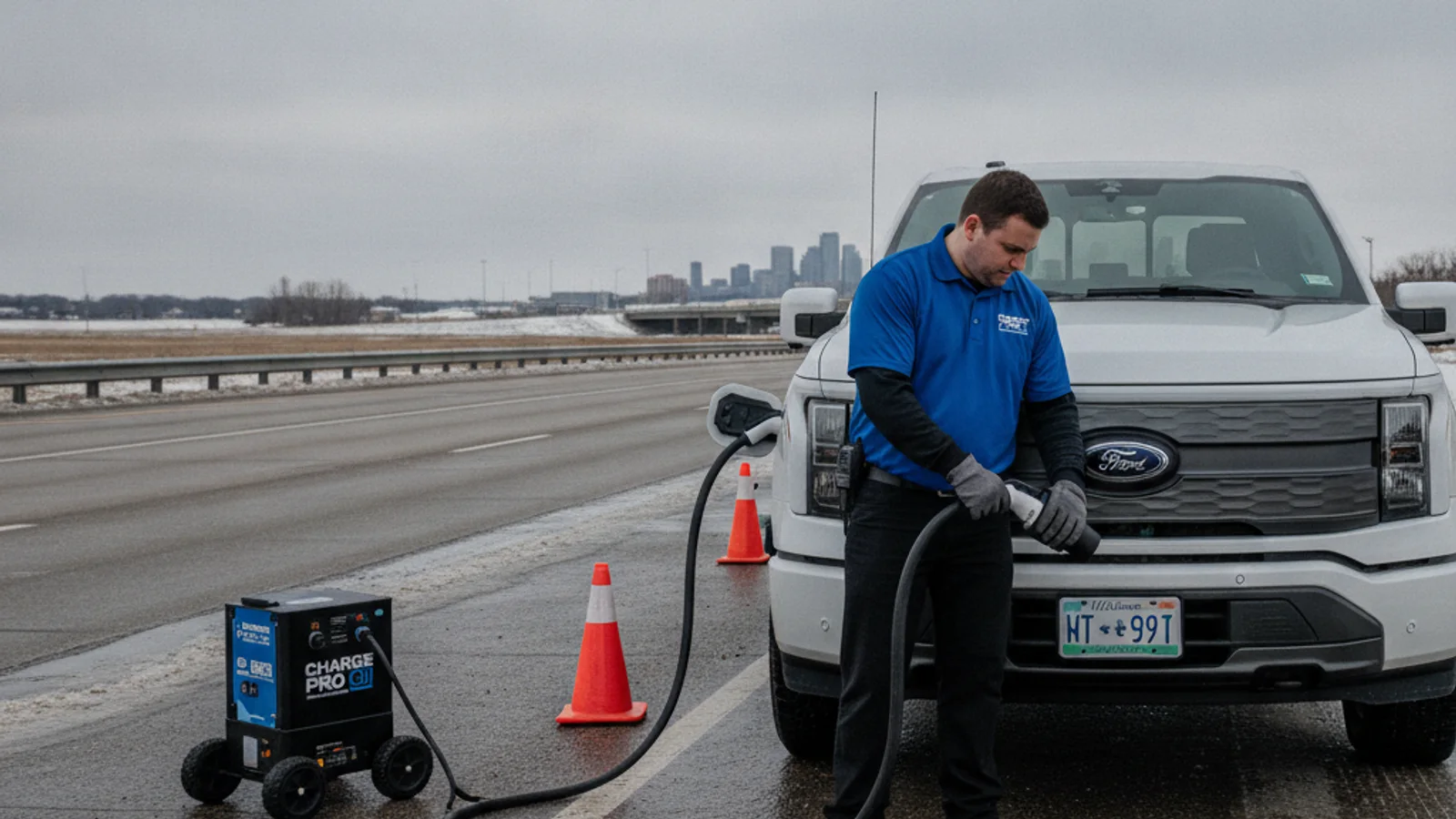
The pros we connect you with are licensed and insured. They bring a 240-volt Level 2 source to the vehicle. The Lightning takes a CCS or J1772 adapter. A typical boost adds 10 to 20 miles of range in 15 to 30 minutes of charging. That’s charging time, never an arrival time. They can also jump or replace a dead 12-volt battery on site.
That referral covers the I-55 belt through Joliet, Bolingbrook, and the rest of Chicagoland. Book through our mobile EV charging line or our non-Tesla EV rescue line. Call (858) 925-5546 and we’ll connect you with a local operator who can look at the truck.
Frequently asked questions
How long does a full home charge take on a Lightning?
On a Level 2 unit like Ford’s Charge Station Pro, plan about 6 to 8 hours for Standard Range. Extended Range is about 8 to 10 hours from empty to full. A 48-amp box can push a full charge toward 12 to 14 hours. Starting percent and amperage change that clock.
How fast does a Ford Lightning charge on DC fast?
Ford’s published specs list about 41 minutes for Extended Range from 15 to 80 percent. Standard Range is about 44 minutes on a charger that can match the truck’s peak rate. Cold packs and weak cabinets stretch those numbers. Real stops on the I-55 belt often run longer than the sheet.
Does cold weather slow Ford Lightning charging here?
Yes. A colder pack accepts power more slowly at a fast charger. That’s a regular winter fact along I-55. A truck that sat overnight in Joliet or Romeoville tapers until the pack warms. Home Level 2 still finishes. It just takes longer than the spec sheet implies.