A Ford F-150 Lightning can charge another EV from the bed. Ford’s Pro Power Onboard feeds outlets in the box. Higher trims add a 240-volt receptacle in the bed. You still need a portable EVSE and the right vehicle plug. Work trucks along I-55 get asked to share that power. That happens at job sites toward Joliet, Bolingbrook, and Romeoville. The truck can help in a parking lot. It’s Level 2 AC, not a DC fast charge. Nobody’s filling a pack in a couple of minutes.
What Ford actually puts in the bed
The Lightning doesn’t feed another car through its DC charge port. Pro Power Onboard is Ford’s vehicle-to-load system. It’s the same system that runs tools or a trailer from the truck. Ford publishes 2.4 kW on the standard Pro Power Onboard setup. Higher trims publish 9.6 kW with a 240-volt bed outlet. Confirm the rating on your own truck before you offer. Model year and option code change what you get. Trust the in-truck screens and the owner’s manual. Don’t guess from the Lightning parked next to you.
At 2.4 kW you’re in slow Level 1 territory. A 9.6 kW bed outlet sits in home Level 2 territory. Neither one is a highway DC stall. You’re parked, waiting, and spending the Lightning’s own pack. Sharing charge isn’t free energy from the truck. If the truck is already low, you can strand both vehicles.
Why this ask shows up on the I-55 fleet belt
I-55 is the fleet belt from Chicago southwest into Will County. Lightnings show up as job-site trucks, not only family pickups. Joliet’s 2024 population estimate is 151,837 people. Bolingbrook’s 2024 estimate is 74,756 people. Romeoville’s 2024 estimate sits at 41,177 people. Plainfield’s 2024 estimate is 48,881 people. Those towns mix warehouses, contractors, and newer housing. ACS data puts Plainfield’s pre-1980 housing at 6.7 percent. Bolingbrook’s pre-1980 share is 12.3 percent. Romeoville’s pre-1980 share is 20.6 percent. Chicago’s ACS figure is 68.6 percent older stock. The inner stretch of I-55 also passes Cicero. Cicero’s 2024 estimate is 82,090 people. ACS figures put 90.2 percent of Cicero housing before 1980.
A Lightning in a Bolingbrook lot looks like a generator on wheels. A low Tesla, Mach-E, or Ioniq is an easy ask. The true answer is yes, if the gear is in the bed. The follow-up is that this is a parked, slow charge. Don’t do that wait on a live I-55 shoulder. An empty pack on I-55 is a different problem. Read stranded on I-55 with an empty EV pack.
Gear that has to be in the box
A household extension cord isn’t an EV charger. You need a portable EVSE in the bed. That’s the Level 2 brick most owners keep in a garage. Match that brick to the 240-volt outlet in the bed. Read the plug blades against the receptacle first. Don’t force a mismatch if the blades don’t line up. Don’t build an adapter on the tailgate. If the truck only has 120-volt outlets, you stay on slow power.
Most non-Tesla EVs in the U.S. take J1772 on AC. A Chevy, Hyundai, Kia, Volkswagen, or Mach-E will take that handle. That’s if the EVSE already has J1772. A Tesla needs a NACS inlet on AC. If your portable charger is J1772, you need a J1772-to-NACS adapter. If you already carry a NACS EVSE, skip the extra piece. Check both ends before you tell anyone you can help.
Two EVs sharing power is a wider question. Can one EV charge another when you’re stranded in the metro covers it. The Lightning is the rare pickup that makes it plausible. That’s because the bed already has AC outlets.
Look at the cord, the brick, and the charge door. Cracked housings and wet plugs are a stop. This post isn’t a wiring spec or a how-to for homemade leads. If anything looks off, don’t improvise a connection.
What the other driver should expect
Tell them this is a wait, not a fill-up. They should keep the car in park. Then unlock the charge port on their car. Watch the dash for a charging icon. If the car never starts a session, stop. A wrong plug can fail the handshake on the first try. A sleeping 12-volt can look the same from the curb. So can a pack that’s too empty to talk to the EVSE. Don’t keep cycling the connection if it never latches.
You’re buying miles to reach a charger they already picked. Or you’re buying enough range to finish a short hop. You’re not replacing a public DC session. Keep the Lightning’s own reserve in mind. Ford’s screens show outbound power while you’re sharing. If the truck’s range is dropping faster than you like, end the session.
This also isn’t how you fill the Lightning. For that, see how long it takes to charge a Ford F-150 Lightning.
When bed charging is enough
Use it when both vehicles can sit still. A job-site driveway in Romeoville is a good example. A warehouse lot in Joliet works the same way. A friend’s street in Bolingbrook after a short commute is the same idea. Time isn’t the issue in those stops. A few miles of range will finish the trip. You’ve got the EVSE and the right adapter. The Lightning still has plenty of pack left.
That’s neighbor help, not highway rescue on I-55. Stay out of live lanes while the cars are plugged in. Park so the cord doesn’t cross traffic. Keep people away from the connections while power is flowing.
The corridor mixes old city blocks and new subdivisions. Lightnings show up as work trucks across all of it.
When you should call instead
Don’t run a cord on an I-55 shoulder with traffic moving. Don’t start if you don’t have a 240-volt EVSE. Don’t start if the Lightning’s own range is already thin. Don’t start if the other car won’t wake up at all.
A car that won’t power on is often a 12-volt problem. That isn’t the same as an empty traction pack. The Lightning has its own 12-volt path. If the truck itself is dark, start with the 12-volt. Ford F-150 Lightning won’t start: the dead 12V fix is the checklist. Jumping the 12-volt is a different job. It isn’t feeding the high-voltage pack through the charge port.
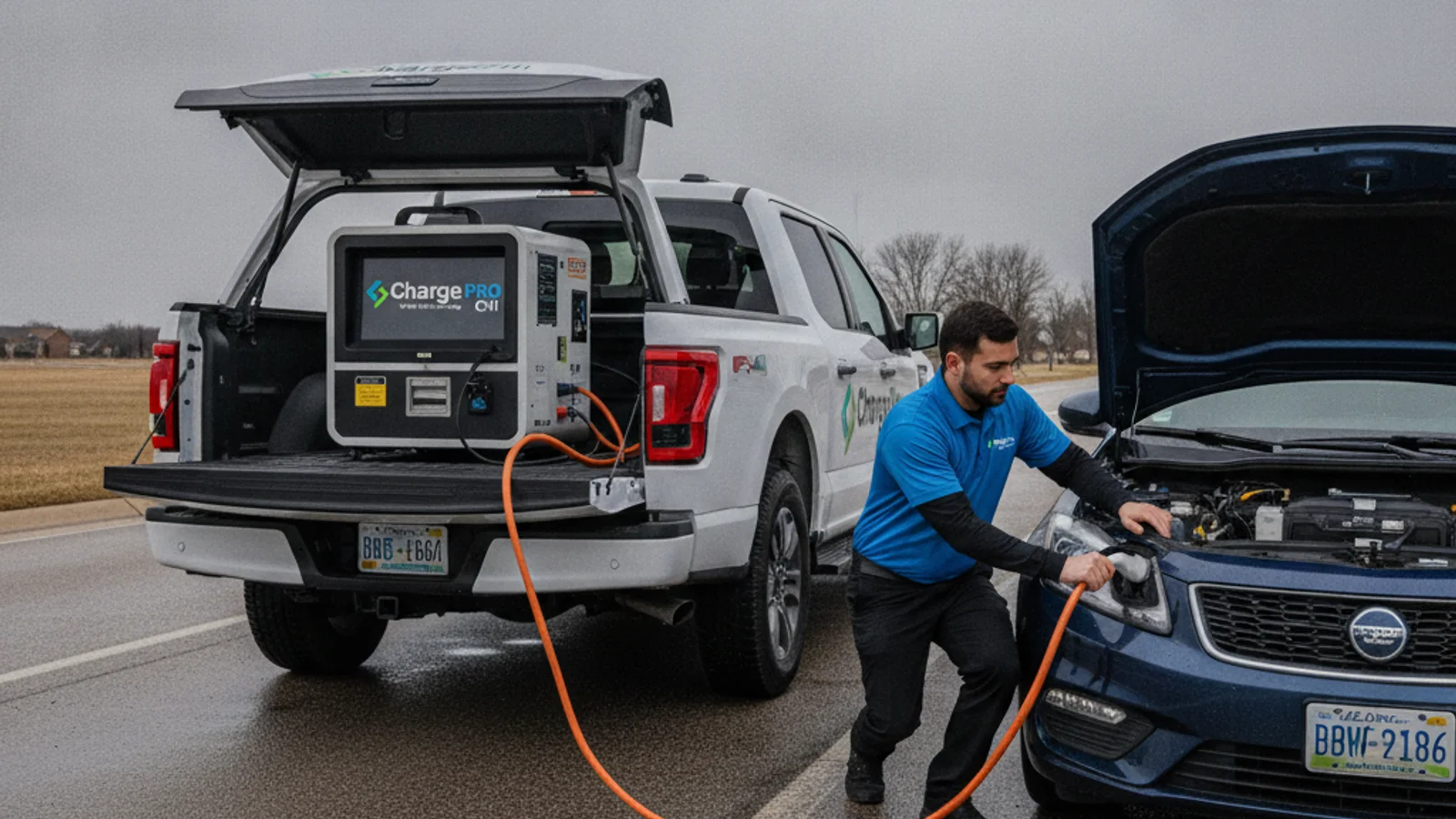
If the other driver needs to move soon, a dedicated mobile boost is cleaner. The operators we connect you with bring a 240-volt Level 2 source. They bring that source to the stranded car. They typically add 10 to 20 miles of range. That takes 15 to 30 minutes of charging. That window is charging time, never an arrival time. Native NACS is on the truck they send. CCS or J1772 adapters cover non-Tesla EVs. Tesla and every major EV brand are in that mix. A Lightning owner without an EVSE in the bed can’t match that kit.
What’s an EV charging truck, and how mobile rescue actually works. That page walks through the stop. Mobile EV charging is the service page for the call. Independent operators quote before they start work. They bill the driver directly for the stop. Charge Pro CHI doesn’t own the truck and doesn’t set the price.
Getting a local operator on this corridor
Charge Pro CHI is a referral line for Chicagoland. It matches stranded EV drivers with independent local mobile rescue operators. The brand doesn’t hold a trade license of its own. It doesn’t own a fleet or employ technicians. The pros we connect you with are licensed and insured.
Joliet, Bolingbrook, Romeoville, Plainfield, Cicero, and Chicago all sit in that service area. For local orientation, start with Joliet EV charging. If you’re the one stuck, call (858) 925-5546. An operator quotes you before any cable goes in.