A Hyundai Ioniq 5 that won’t start is almost always a dead 12-volt battery, not an empty traction pack. The small battery powers the computers that bring the high-voltage system online. When it fails, the car stays dark even with range left in the pack. That happens after overnight sits in Chicago. It also happens in older Cook County neighborhoods and suburban lots after a long day.
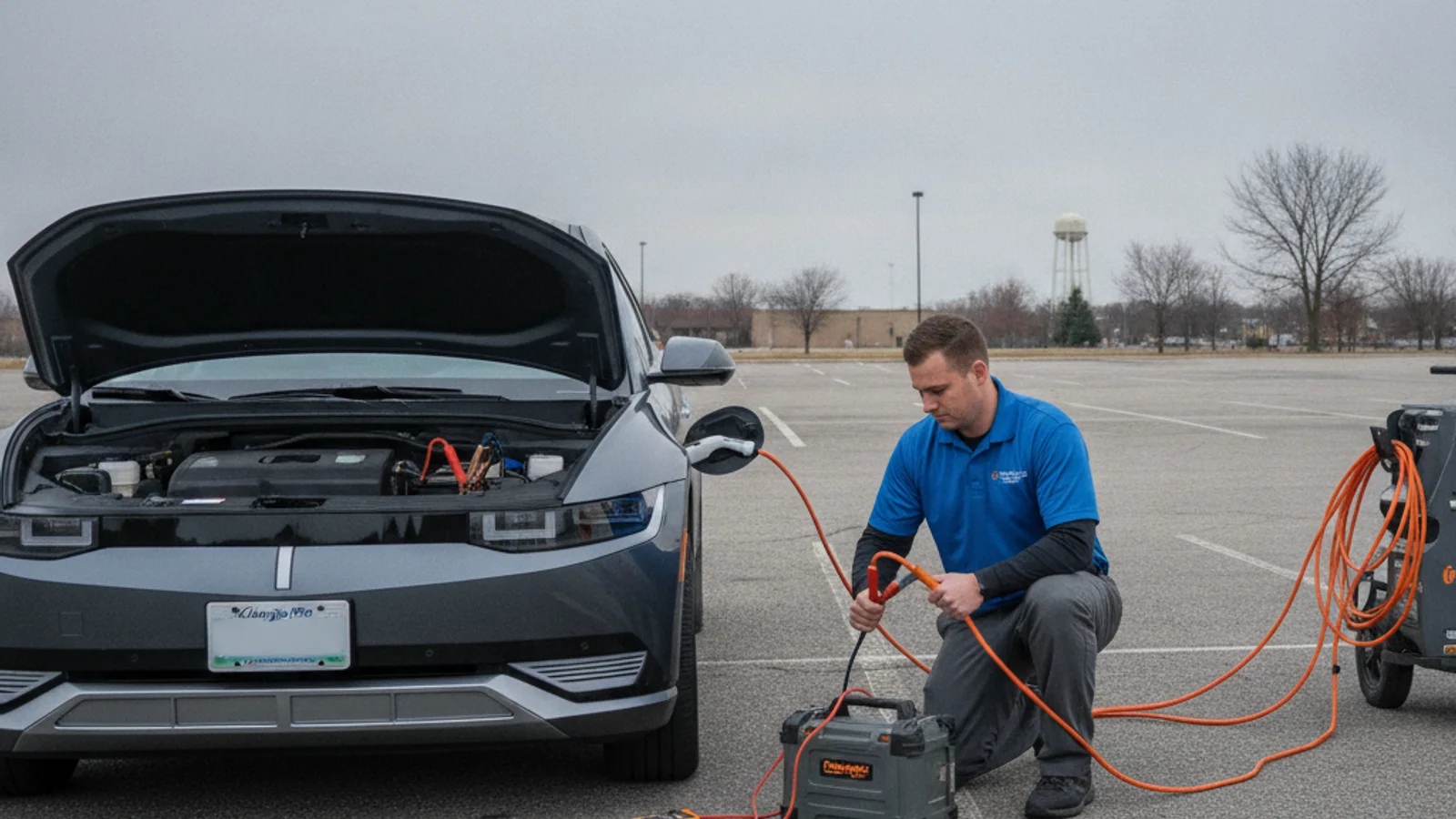
The start button can feel broken. It usually isn’t. Check the 12V, the brake-and-button sequence, and the fob before you book a tow.
Two batteries, and only one of them boots the car
An Ioniq 5 is two electrical systems in one shell. The traction pack moves the wheels. The 12-volt battery runs locks, windows, lights, and the cluster. It also powers the computers that decide whether the pack may wake. If that 12V is flat, Ready mode never happens. The pack can be healthy. You still sit in a silent cabin.
Owners often treat a silent EV like a gas car that’s out of fuel. That’s the wrong map. Hyundai protects the big pack. The 12V is the part that actually strands you. Short trips, accessory drains, and cold sits all wear it down. For the same failure on other EVs, read what happens when an EV 12V battery dies.
Chicagoland winters make that drain worse. Chicago still has a large older housing stock. 68.6% of housing was built before 1980. Oak Park sits at 78.6%. Cicero is 90.2%. Berwyn is 90.0%. Evergreen Park is 87.7%. An Ioniq 5 in those neighborhoods still has to start after a cold night. Many 12V batteries won’t.
Newer suburbs aren’t immune. Naperville has only 11.7% pre-1980 housing. Gurnee has 9.5%. Plainfield has 6.7%. Huntley has 3.8%. Garages help. They don’t make the 12V immortal. A car that sat after a Kennedy crawl can still refuse to boot. An Eisenhower commute does the same. So does a full day in a Schaumburg office park.
The Ioniq 5 pack size in this climate is a range question. It isn’t a 12V question. A large pack can’t talk to the car if the computers have no 12V power.
How a dead 12V looks, versus an empty pack
Trust the cabin. A dead 12V usually means no cluster, no screen, no chime, and no fans. Door handles may not answer the fob. You may need the physical key hidden in the fob to get in. That’s a low-voltage blackout, not a range problem.
An empty traction pack still tends to show life on the 12V side. Warnings can appear. The car may tell you it can’t drive. It may limit functions and still light the cluster. If the car can talk, you aren’t looking at a fully dead 12V.
The messy middle is flicker. Lights pulse. A relay clicks. Random messages flash, then the cabin goes dark. That battery is collapsing under load. Stop pressing Start. Each press pulls more current from a battery that can’t hold it.
If locks work and the cluster lights, pause the 12V diagnosis. Check the start sequence. Check the fob. A lit cabin with no Ready is a different problem. A dark cabin is the 12V.
Foot on the brake, then Start, then wait for Ready
The Ioniq 5 wants a brake press with the Start/Stop button. Skip the brake and accessories may come on. Ready won’t. The car looks awake and still won’t move. That mix-up is common in a dark garage or a tight city spot.
Sit down. Foot on the brake. Press Start/Stop once. Wait for Ready. If the cluster never lights, you’re back on 12V. If accessories come up and Ready doesn’t, try one more clean brake press. Don’t hammer the button.
The fob can fake the same stall. A weak fob cell means the car never sees a key. Try the spare. If the spare works, replace the tired cell. You can also hold the fob on the in-car sensing area. That’s often in the center console. The owner’s manual marks the exact pad. A closer fob can wake recognition even when the cell is weak.
If both fobs fail and the cabin is dark, stop blaming the key. That pattern is the 12V again.
Try a reset only if the car still has some life
A hung module can block Ready the way a frozen phone blocks apps. If the cluster still lights, a reset is a fair try. Hold Start/Stop for 10 to 15 seconds with your foot off the brake. Watch for a flicker or a screen reboot. Wait a minute. Then do a normal start with the brake down.
Skip the reset if the cabin is fully dark. A reboot doesn’t charge a flat 12V. It only clears a glitch.
Fuses are a later check. A single dead circuit with a living car can be a fuse. Total silence is rarely one fuse. Don’t start pulling fuse-box covers in the street unless you know what you’re looking at.
Jump points under the hood, not on the battery case
Hyundai doesn’t want you clipping to the 12V case. The Ioniq 5 has remote jump terminals under the hood.
Pop the hood. On the driver’s side, find the black fuse-box cover. Open it. Look for a red cap or a marked positive (+) post. That’s the positive hookup. For negative, use an unpainted metal ground on the body, or a marked ground point. Don’t put the negative clamp on the 12V battery’s negative post even if you can see it.
Hook up in order. Positive on the Ioniq 5 first. Positive on the jump pack or donor next. Negative on the pack or donor. Last, negative on the Ioniq 5 ground. Let it sit a couple of minutes. Then try Start with your foot on the brake.
If clamps make you uneasy, don’t guess. A reverse hookup can damage electronics. The winter walkthrough for jumping an EV is the safer read in the cold. A jump pack is cleaner than another vehicle if you have one.
When Ready comes up, don’t shut the car off and walk back inside. Drive it. Give the charging system time to work. If the car dies again a block later, the 12V isn’t holding. That’s a replace, not a second jump. When an EV 12V dies again after a jump, treat it as a failed battery.
12V replacement signs often show up first. Slow locks. Dim interior lights. Odd warnings. A car that needs a jump more than once. Catch those and you may avoid a dark-cabin morning.
Where this shows up around the metro
The 12V fails after a sit. Overnight on a Chicago residential block. A full workday in Arlington Heights or Schaumburg. Long-dwell parking in Orland Park or Tinley Park. A cold garage in Evanston or Wilmette. Short hops around Skokie, Park Ridge, or Oak Park that never let the battery recover.
Highway emptiness is the other stall. A pack at zero on the Kennedy, the Dan Ryan, or I-55 is a range problem. A silent Ioniq 5 in a driveway after a normal day is usually the 12V. Name the symptom when you call. Dark cabin versus low-charge warnings changes what the operator brings.
A tow for a car that only needed a 12V wake is extra hassle. If you do tow, it still needs to be done as an EV, not dragged. Most owners are better off waking the car, then getting the 12V tested. Ioniq 6 and Kona Electric owners in the same household will see the same pattern.
North Shore and DuPage commutes add their own version. Highland Park, Glenview, Northbrook, and Libertyville owners still get a no-start after a short trip and a long sit. Wheaton, Downers Grove, Elmhurst, and Lombard see it after an Eisenhower run. Will County commutes out of Joliet, Bolingbrook, and Plainfield do it after I-55 or I-80. The geography changes. The 12V story doesn’t.
West suburban Kane County is the same battery in a different driveway. Aurora, Elgin, St. Charles, Geneva, and Batavia all sit in real winter. A 12V that was already weak can refuse a cold morning. You don’t need a scan tool to see that. You need a dark cabin, the underhood posts, and a plan if the jump won’t hold.
Lake County isn’t gentler. Waukegan, Gurnee, and Libertyville still freeze. An Ioniq 5 that sat outside a Gurnee lot or a Waukegan curb can look totally dead at start time. McHenry County repeats it in Crystal Lake, McHenry, Algonquin, and Huntley. Farther from the lake doesn’t save the 12V.
South Cook has the same morning. Oak Lawn, Evergreen Park, Chicago Heights, Homewood, and Calumet City all see cars that won’t wake after a sit. Cicero and Berwyn add older housing stock to that list. The car doesn’t care which suburb you parked in. It cares whether the 12V held overnight.
What to skip while you’re stranded
Don’t keep cycling Start on a dark car. You’re only deepening the drain.
Don’t stand in a live lane on the Tri-State, Lower Wacker, or the Bishop Ford to hunt terminals. Get the car into a safer spot if you can. If you can’t, wait for help rather than working over a fuse box in traffic.
Don’t treat a successful jump as a finished repair. If the battery is tired, it’ll strand you again. Plan a test and a replacement.
When a local operator is the right call
Charge Pro CHI is a referral line. We don’t own trucks. We don’t do the work. We match stranded drivers with independent local operators. For an Ioniq 5, that’s usually an on-site 12V jump. It can also be a 12V replacement if the battery won’t hold. If the traction pack is actually empty, operators bring a 240V Level 2 source. They quote you before starting. They bill you directly.
This car isn’t a Tesla. A pack boost needs the right adapter for a non-Tesla. Operators bring CCS or J1772 adapters. That’s why non-Tesla EV rescue is the service that fits. The metro version is non-Tesla EV rescue in Chicagoland.
Call if the cabin is dark and you don’t want to work under the hood. Call if a jump works and the car dies again. Call if Ready never comes up after a reset and a jump. A silent Ioniq 5 isn’t a mystery once you separate 12V from pack.
If the pack is the empty one, operators typically add 10 to 20 miles of range in 15 to 30 minutes of charging. That’s charging time, not an arrival time. It’s enough to reach a charger you already planned. It isn’t a promise about when someone shows up.
Call (858) 925-5546 and we’ll connect you with a local operator. Say it’s an Ioniq 5 that won’t enter Ready. Say whether the screens are dark. That one detail tells them 12V versus pack before they roll.