The Hyundai Ioniq 5 battery size is 58.0 kWh on Standard Range and 77.4 kWh on Long Range. Usable energy sits lower on both packs, about 54 kWh and 74 kWh. EPA labels list about 220 miles on Standard Range, 303 miles on Long Range rear-drive, and 260 miles on Long Range all-wheel drive. Those figures come from a lab loop. They don’t include a Chicagoland cabin heater running for the whole commute. Pack size is easy to ignore in mild months. It starts to matter here once winter heat draws from the same battery that has to get you home.
Why the kWh number waits for winter here
A full Ioniq 5 in May can hide a small pack. You can cross Chicago, sit in light traffic, and still park with a buffer. January changes the draw. The cabin needs heat. The pack needs to stay in a working temperature band. Defrost and seat heat add more load. There’s no leftover engine warmth to steal. Every bit of that heat comes out of the traction battery.
That’s the local catch. The Hyundai Ioniq 5 battery size isn’t trivia on a window sticker. It’s how much energy you can spend on heat before the miles run out. A 77.4 kWh Long Range car still feels the heater. It just starts with more energy to spend. A 58 kWh Standard Range car can cover a short city day in fair weather. The same commute with heat on uses a bigger share of the pack.
Don’t treat the EPA figure as a winter promise. The label is still useful as a ranking. Long Range rear-drive sits at the top. Long Range AWD sits in the middle. Standard Range sits lowest. Cold weather moves all three down. The smaller pack has less room to absorb that move.
This metro isn’t one climate pocket. Streets in Evanston and Wilmette take lake wind that inland Naperville doesn’t. A garage in Glenview isn’t a curb space in Cicero. The pack doesn’t care about the suburb name. It cares about cold air, idle time, and whether you plugged in overnight.
Idle is the quiet drain. Heat stays on while the car barely moves. A crawl on the Kennedy spends energy without buying miles. The Dan Ryan does the same in a backup. So does the Eisenhower after a stall in traffic. You aren’t climbing a mountain. You’re sitting still and warming air. The 58 kWh pack shows that first.
Preconditioning while plugged in helps. It warms the cabin and the pack from wall power. That only works if you have a plug tonight. Plenty of owners here don’t.
The two factory packs in plain numbers
Hyundai built the common 2022 through 2024 Ioniq 5 around two lithium-ion sizes. Standard Range is 58.0 kWh gross. Long Range is 77.4 kWh gross. Both ride on the car’s 800-volt system. That layout is why a strong DC station can push energy in fast. It doesn’t change how much the pack stores.
Standard Range usually pairs with a single rear motor. Long Range is sold in rear-drive and all-wheel drive. The bigger pack is the same in both Long Range layouts. AWD adds a second motor, so it uses more energy per mile. That’s why EPA range falls from about 303 miles to about 260. The pack is still 77.4 kWh either way.
Usable capacity is the figure that turns into driving. Hyundai keeps a buffer at each end of the pack. The car won’t let you spend every stored kilowatt-hour. On these Ioniq 5 packs, Standard Range is about 54 kWh usable. Long Range is about 74 kWh usable. The buffer protects the cells. It isn’t a defect.
If you’re shopping, read the sticker for Standard Range or Long Range. Don’t guess from a trim nickname. If you already own the car, check the original sticker, the manual, or the Hyundai app. When that paperwork is gone, a dealer can confirm the pack. Don’t rely on a rounded range number on the dash. Winter heat moves that estimate around.
Model years after that window can change. Confirm the kWh on the car in front of you. A blog shouldn’t override the door jamb and the screen.
What cabin heat does to a 58 kWh pack
Cabin heat is the winter tax. The Ioniq 5 can warm the interior quickly. That comfort still costs energy. Battery thermal management costs more after a cold soak. A car that sat on a Waukegan street overnight soaks cold. One that slept in a Northbrook garage starts milder. The pack has to work to reach a happy temperature. You pay for that work in range.
Short trips make it worse. You heat the cabin, drive a few minutes, and shut down. The next start heats everything again. A Standard Range pack can absorb a few of those cycles. A week of them in January adds up. Long Range owners feel it too. They just start with more stored energy.
Highway speed stacks on top of heat. A moderate pace on I-90 toward Elgin uses less energy. A hard run at the same heater setting uses more. The Jane Addams is a long winter run on a low pack. Give a Standard Range car a glance before you leave. That’s not a claim about missing stations. It’s a claim about heat and miles stacking up.
Regen helps when you can slow down with the motors. City stop-and-go can return some energy. A dead-stop crawl with the heater pinned doesn’t give much back. One-pedal driving is useful on surface streets in Oak Park or Skokie. It can’t refill a pack that heat already spent.
Tire pressure drops in the cold. Low tires waste energy. Check them when the weather turns. That’s free range, and it applies to both pack sizes.
Housing stock, and who actually plugs in overnight
Chicagoland housing isn’t one pattern. That matters more than people think for an Ioniq 5. A Level 2 session can hit up to 10.9 kW on this car. That’s enough to refill much of either pack overnight. You only get that session if the building can take a charger. You also need to control the stall.
Census figures show how old the stock is. In Cicero, 90.2% of housing predates 1980. Berwyn sits at 90.0%. Evergreen Park is 87.7%. Oak Park is 78.6%. Chicago is 68.6%. Those are brick two-flats, courtyards, and tight lots. Many drivers park on the street. A 240-volt circuit to a dedicated stall isn’t a given. For those owners, pack size is a winter-heat problem. It’s also a public-session problem, not a garage problem.
If you live in Cicero, some houses can’t take a charger. You already know the drill. You plan around sessions away from home. Winter just shortens the comfortable window. Our note on home charging in Cicero when the house cannot take a charger is for that setup.
Compare that with newer west and northwest suburbs. Naperville’s pre-1980 share is 11.7%. Gurnee is 9.5%. Plainfield is 6.7%. Huntley is 3.8%. Schaumburg is 15.9% pre-1980. Bolingbrook is 12.3%. Orland Park is 11.8%. Attached garages are common in that newer stock. Overnight Level 2 is easier there. A Standard Range pack can look fine when it starts every morning full. It looks different if you only charge twice a week.
North Shore towns split down the middle. Evanston’s pre-1980 share is 71.2%. Wilmette is 74.3%. Skokie is 72.0%. Park Ridge is 67.1%. Glenview is 40.3%. Northbrook is 39.1%. Highland Park, in Lake County, is 60.6%. An Ioniq 5 on a Wilmette side street lives one charging life. The same car in a Northbrook garage lives another. Pack size shows up when you can’t top off at home. The heater on the drive is then the whole story.
Northwest Cook is a mix. Des Plaines is 58.8% pre-1980. Mount Prospect is 53.7%. Arlington Heights is 42.0%. Palatine is 31.2%. Hoffman Estates is 32.1%. Elk Grove Village is 38.6%. Work lots in Schaumburg and Elk Grove Village often mean a car sits for hours. If it sits without a plug, you leave on whatever you arrived with. Winter heat on the drive home is then the whole story.
DuPage follows the same split. Elmhurst is 56.6% pre-1980. Lombard is 48.6%. Glen Ellyn is 46.7%. Downers Grove is 41.3%. Wheaton is 35.2%. Carol Stream is 14.2%. Naperville, again, is the new-build end of that county. A Wheaton garage car and a street-parked Elmhurst car can share a pack. They can still have different winter weeks.
South Cook and the Will County edge add distance. Oak Lawn is 58.4% pre-1980. Homewood is 66.5%. Chicago Heights is 74.3%. Tinley Park is 17.2%. Joliet’s pre-1980 share is 39.0%. Romeoville is 20.6%. New Lenox is 7.9%. Longer suburban loops mean more heater-on miles between plugs. Long Range has more cushion on those loops. Standard Range can still do the job if you charge often.
Kane and McHenry sit farther out for a lot of commutes. Aurora’s pre-1980 share is 33.1%. Elgin is 41.5%. St. Charles is 26.6%. Geneva is 25.9%. Batavia is 33.0%. Crystal Lake is 25.7%. Algonquin is 10.1%. McHenry is 21.5%. Huntley is 3.8%. Those towns aren’t a different physics problem. They’re more miles with the heat on, more often.
Housing age is the local tell, not a brochure grade. Wilmette and Cicero can share an Ioniq 5 and not share a garage. Calumet City, Chicago Heights, and Chicago have older stock in different shares. Newer Huntley and Plainfield lean the other way. The pack size doesn’t change with the ZIP. The overnight plug does.
Gross, usable, and the number on the dash
Gross kilowatt-hours are the physical pack. Usable kilowatt-hours are what the car will let you spend. Drivers talk about the bigger number because it’s on spec sheets. Range follows the smaller one. You can’t drain a 77.4 kWh Ioniq 5 to a true zero on the road. Hyundai holds a buffer on purpose.
The dash range estimate is a guess. It looks at recent use. If you just ran heat on a slow Kennedy crawl, the guess drops. If you then drive a milder afternoon without heat, it climbs. That swing isn’t the pack shrinking and growing. It’s the estimate reacting. A Long Range pack still has more stored energy. The guess is just louder in winter.
Keeping daily charge out of the very top and very bottom is a common habit. Many owners hold a mid band for errands. They charge higher before a long trip. That’s a cell-care choice. Confirm Hyundai’s current guidance in the manual for your model year. Don’t treat a blog as the warranty.
A large leftover on a 74 kWh usable Long Range pack is a lot of miles in May. The same habit in January, with heat on, can feel tight on a Standard Range car. You’re not required to copy someone else’s charging band. You’re required to leave enough energy for the heater and the trip you actually have.
How this car takes a charge in this climate
The Ioniq 5’s onboard AC ceiling is 10.9 kW on Level 2. That’s a vehicle limit, not a station promise. A home or workplace box may deliver less. A Long Range pack is an overnight fill at that rate when you start low. A Standard Range pack fills sooner because there’s less to replace. Cold weather can slow the curve. Watch the live kW on the screen instead of a clock in your head.
There’s a companion piece on how long it takes to charge a Hyundai Ioniq 5 in this climate. Pack size sets how much energy you still need. Temperature sets how fast the station will give it.
DC fast charging is the Ioniq 5’s strength. Peak rate is up to 239 kW on a compatible station when the pack is ready. Hyundai’s published 10% to 80% window is about 18 minutes in favorable conditions. A cold pack won’t hold that peak. Winter here is when people notice the taper. You still gain a lot of range at a strong DC stall. You just shouldn’t plan a trip around a best-case minute count.
The port is CCS. Tesla Superchargers that allow other brands need a NACS adapter. Confirm the stall, the adapter, and the app before you sit down. A frozen charge door is a separate winter failure. If the cable won’t release, start with how to free a frozen Ioniq 5 charge port.
Level 1 at 120 volts is a trickle next to a 58 or 77.4 kWh pack. It can add a little overnight. It won’t rebuild a winter deficit after a heater-heavy day. If the house only has a standard outlet, treat that as a weak backup. It isn’t a daily plan for this battery size.
Public DC and overnight Level 2 aren’t rivals. Overnight Level 2 is easier on the pack for daily life. DC is the tool for a trip or a low arrival. In this climate, DC on a cold pack is slower than the brochure. Cold packs charging slower is expected in this climate. It isn’t a broken car.
Range on real days across the counties
EPA miles are a comparison tool. They aren’t your Thursday. Speed, heat, and stop-and-go matter more here than a brochure grade.
Steady speed on the Tri-State uses less energy. Hard launches between lights on the North Side use more. High speed still costs more than a moderate pace, heat on or not. Cook County covers the core of that mix. Chicago’s ACS population is 2,707,648. That’s a lot of Ioniq 5 trips on surface streets and expressways. A downtown day with garage parking doesn’t match a street-parked night in the same city.
Lake County adds Waukegan, Gurnee, Libertyville, and Highland Park. Overnight wind off the lake can make a street-parked car soak colder. A cold pack in Waukegan still has the same kWh as a pack in Wheaton. More of those kWh may go into heat at the start of the drive.
Will County stretches southwest through Joliet, Bolingbrook, and Plainfield. Kane County does the same to the west through Aurora and Elgin. McHenry County towns like Crystal Lake, Algonquin, McHenry, and Huntley add longer loops for a lot of households. None of that requires a Long Range pack. It does reward starting full in January. A Standard Range car can still cover those loops if you charge on a schedule. The winter tax is just a larger slice of a smaller tank.
Libertyville and Highland Park sit on the same Lake County map as Gurnee, with very different housing ages. Libertyville’s pre-1980 share is 34.7%. Gurnee’s is 9.5%. A garage in Gurnee and street parking in an older Lake County pocket aren’t the same overnight story. The 58 kWh pack cares about the plug, not the county line.
When the Ioniq 5 won’t wake, and it isn’t the pack
A dark dash isn’t always an empty 77.4 kWh or 58 kWh battery. The Ioniq 5 also has a 12-volt battery. That small battery runs computers, locks, and the contactors that connect the big pack. If the 12-volt is flat, the car can sit with a charged pack. It can still refuse to start.
Winter is hard on 12-volt batteries. Cold cuts available power. Short trips with heat on can mean the 12-volt never gets a full recharge. Before you call for a pack boost, check the simple 12-volt signs. Our walkthrough on what to check when a Hyundai Ioniq 5 won’t start covers that order.
Don’t confuse a 12-volt failure with a spent traction pack. If the car died while you were driving and the range hit zero, that’s the big battery. If it was fine last night and won’t unlock this morning, start with the 12-volt. The wrong call wastes time. It can also send a tow for a problem that a jump can clear.
If the traction pack actually hits empty
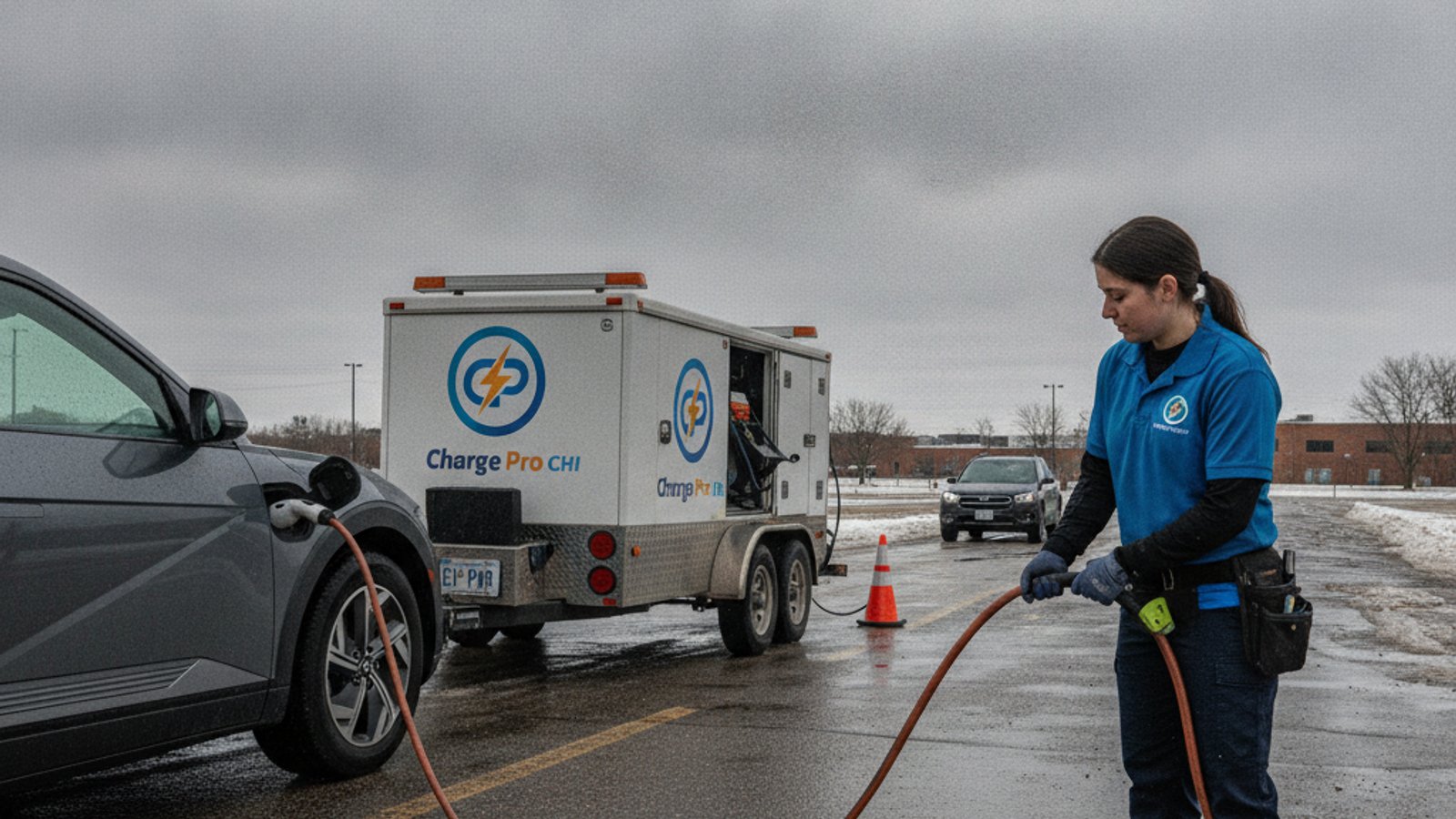
An empty traction pack still happens on a winter day. A heater-heavy crawl, a closed stall, a longer errand than you planned. If the Ioniq 5 shut down on an empty pack, you need traction energy. A 12-volt jump won’t refill it. A tow is one path. A mobile Level 2 boost is another.
Charge Pro CHI is a referral line. We match stranded EV drivers with independent local mobile rescue operators. We don’t hold a trade license. We don’t own trucks or equipment. We don’t employ technicians. We don’t set prices. We don’t promise an arrival time. The operator quotes you before work starts and bills you directly.
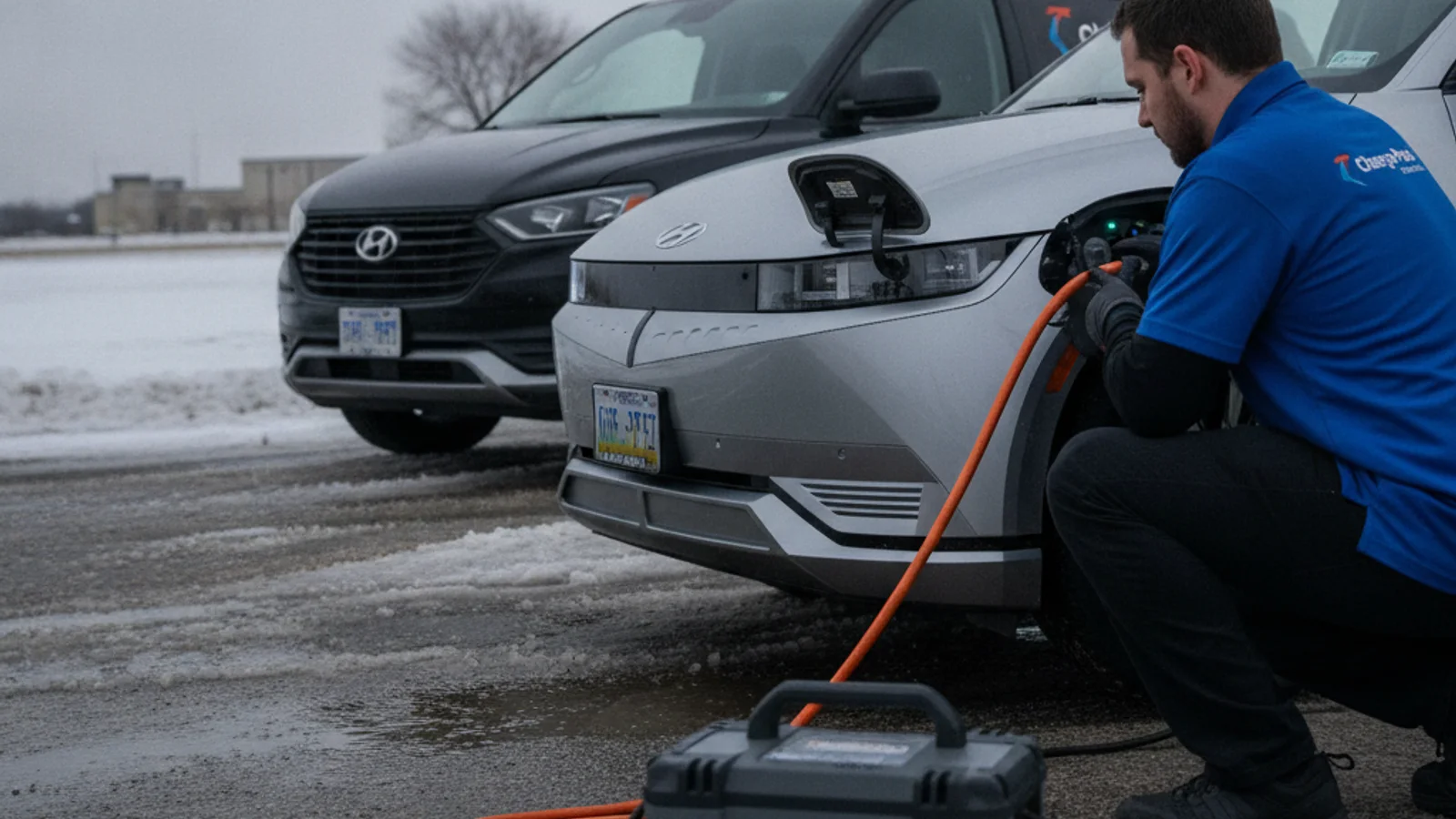
The operators we connect you with bring a 240-volt Level 2 source to the car. For an Ioniq 5 that’s a CCS job, so they use a CCS adapter. Native NACS is for Teslas. They also carry J1772 for other EVs. The boost typically adds 10 to 20 miles of range in 15 to 30 minutes of charging. That interval is charging time, never an arrival time. It’s meant to get you to a charger or home. It isn’t a curb-side fill of a 77.4 kWh pack.
The pros we connect you with are licensed and insured. They handle Tesla and every major EV brand, including the Ioniq 5. They can also jump or replace a dead 12-volt on site when that’s the actual fault.
For a stall in the city, what to do when you’re out of charge in Chicago walks through the next moves. If you want the network path for a Hyundai, start with non-Tesla EV rescue in Chicagoland or mobile EV charging.
Don’t sit in a live travel lane. Move to a legal, safe spot if the car can still roll. Turn the hazards on and stay with the car if it’s safe. Then make the call. If you need the referral line, Charge Pro CHI is (858) 925-5546.
Frequently asked questions
Does Hyundai Ioniq 5 battery size matter more in a Chicagoland winter?
Yes. Both packs lose some driving energy to cabin heat and pack warming. The 58 kWh Standard Range car has less stored energy to spend on that load. The 77.4 kWh Long Range car has more cushion. EPA miles don’t include this climate’s heater use. Starting every day from a full overnight charge hides the issue. Street parking without a plug makes it obvious.
What is the usable capacity on each Ioniq 5 pack?
Standard Range is about 54 kWh usable from a 58.0 kWh gross pack. Long Range is about 74 kWh usable from a 77.4 kWh gross pack. The car keeps a buffer at both ends to protect the cells. Rear-drive and AWD Long Range share the larger pack. AWD just uses more energy per mile, which is why its EPA range is lower.
What should you do if the Ioniq 5 hits empty before you charge?
Treat it as a high-voltage pack problem if the car ran until empty. Don’t start with a 12-volt jump in that case. Get to a safe spot. Then choose a mobile Level 2 boost or a tow. A boost from the operators we send typically adds 10 to 20 miles. That’s after 15 to 30 minutes of charging. That’s enough to reach a charger or home in many cases. Confirm the quote before work starts. If the car won’t wake at all, check the 12-volt path first.