A Hyundai Ioniq 6 that won’t start around here is usually a 12V problem. The sedan looks fully dead. The fob does nothing. Door handles stay asleep. The start button is silent. That doesn’t mean the drive battery is empty. The small auxiliary battery is what wakes every computer on the car. Chicagoland winters knock that 12V down fast. Then the whole car goes dark.
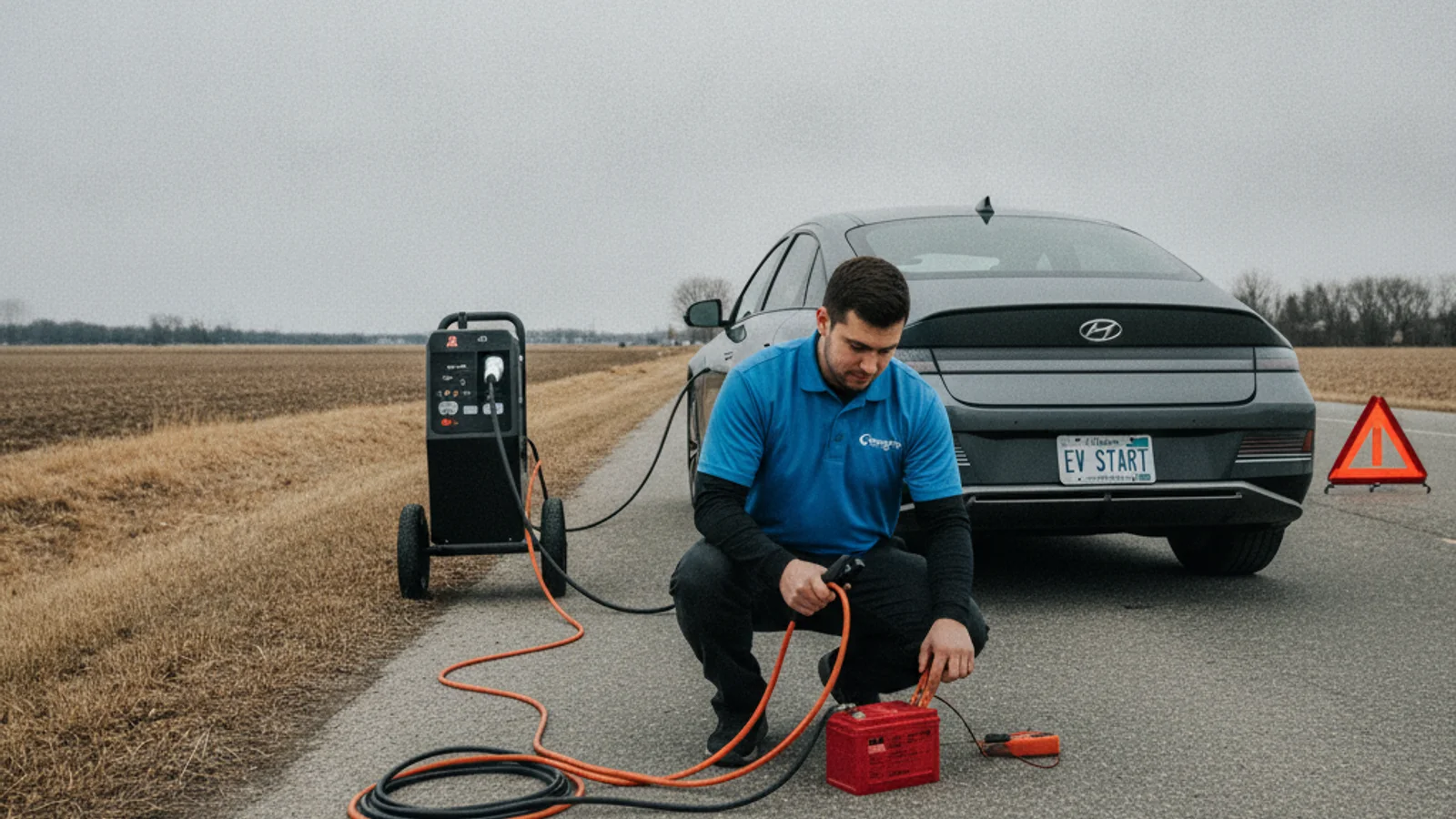
Ioniq 6 no-start calls in this metro follow a winter pattern. A night parked in Chicago. A long sit in a Des Plaines or Elk Grove Village work lot. A short hop that never warms the pack. The traction battery can still hold a useful charge. The 12V can’t keep up in the cold. The same E-GMP layout shows up on the Ioniq 5, so the checks overlap. The sedan just stores that 12V in the trunk, not up front.
Two batteries, one that actually starts the car
The Ioniq 6 has a high-voltage pack and a 12V auxiliary battery. The pack moves the wheels. The 12V runs locks, windows, lights, and the screen. It also feeds the modules that talk to each other. One of those modules has to boot before the pack can connect. No 12V means no boot. The car stays dark even with range left. You couldn’t read the display anyway.
Hyundai’s E-GMP cars have a second trap. When the traction pack gets very low, it can stop topping off the 12V. Park that car for a few days and the auxiliary battery keeps draining. You come back to a dark sedan. It still had miles left when you left it. Cold makes that drain worse. A driveway in Oak Park doesn’t help a weak 12V recover. A street space in Berwyn doesn’t either.
Read what happens when an EV’s 12-volt battery dies in the cold for the full cascade.
How to tell a dead 12V from an empty pack
Stand outside and look at the symptoms. A dead 12V looks like a total blackout. No interior lights. No window drop. No chime. The charge port may not release. The app may show the car offline. An empty traction pack is different. The car still wakes. Screens still boot. You usually get a low-charge warning before it stops moving.
If the Ioniq 6 is a brick, start with the 12V. Don’t book a flatbed yet. Don’t assume you need a public charger first. A jump at the under-hood posts often brings the computers back. Then you can read the true pack level. If the pack is actually empty, that’s a different call. A mobile 240V boost can add range on site. If the 12V is the only failure, jumping or replacing it is the path.
The Ioniq 5 no-start checks cover the same E-GMP logic on the crossover. Use that if you also drive the hatch. The sedan steps below are the ones that differ.
Where the Ioniq 6 hides the 12V
This is the part owners mix up. The Ioniq 5 keeps its 12V under the hood. The Ioniq 6 sedan puts the actual battery in the trunk. It sits on the driver’s side under the cargo floor trim. Open the trunk. Peel back the left side of the liner. You’ll see a standard AGM battery. That’s an absorbed-glass-mat unit, not a flooded lead-acid box.
Don’t clamp jumper cables onto that trunk battery. The designed jump points are under the hood. The hood still opens, even without a storage bin up front. Use the interior hood release. On the driver’s side of the bay you’ll find a black fuse box. A red cap covers the positive jump post. Ground is a bare metal chassis bolt. Don’t use the trunk negative terminal.
| Spot | What you will find |
|---|---|
| Trunk, driver’s side under the liner | The real 12V AGM battery |
| Under the hood, driver’s-side fuse box | Positive jump post under a red cap |
| Engine bay chassis | Unpainted bolt for the negative clamp |
| Cluster, when the car is awake | Auxiliary battery save setting |
Jumping from the trunk posts can nick trim and still miss the intended path. Use the hood posts. Leave the trunk battery for inspection or replacement, not for clamps.
Winter sits that drain an Ioniq 6 here
Cold is the local stress. A 12V that rolled through fall can fail after a stretch of January nights. Chemistry slows in an AGM battery. The car still sips power for alarms, telematics, and cabin preconditioning. Chicago’s housing stock is old. About two thirds of city homes were built before 1980. Oak Park, Cicero, and Berwyn skew even older. Plenty of Ioniq 6 owners in those places park outside through winter.
Long-dwell lots do the same damage. Office parking in Schaumburg or Hoffman Estates. A weekend at a mall. A work lot in Des Plaines or Elk Grove Village. You leave the sedan for days. If the traction pack was already low, the 12V may not get a top-off. You return to a car that won’t wake.
North Shore overnight cold hits the same way. Evanston, Wilmette, and Highland Park see long sits near the lake. A parked Ioniq 6 loses 12V overnight more readily in that air. The Evanston winter battery care guide is for owners who park outside.
Commuter miles add a third pattern. A Naperville or Aurora drive into the city can land you home thin. A Joliet run can do the same. If that pack is low enough, the car may stop supporting the 12V. Morning no-starts follow. The sedan isn’t out of charge in the way people mean. It’s out of 12V.
Don’t hunt a charger in the dark first. Confirm the 12V. Then decide whether you need a jump, a replacement, or a range boost.
The auxiliary battery save setting
The Ioniq 6 has a setting the Ioniq 5 doesn’t present the same way. Auxiliary battery save lives in the instrument cluster menus. Turn it on when you’ll sit in the car with the screen on. Keep the drivetrain off. It limits 12V draw so the battery doesn’t fall past a recovery point.
It won’t revive a battery that’s already dead. Use it before a long wait, not after. Typical path is Settings, then Vehicle, then Auxiliary Battery. Trim and software versions move that item around. Hunt the vehicle settings if you don’t see it. A long wait at a game in Wheaton is when this earns its keep. So is a pickup in Naperville.
How to jump an Ioniq 6 without frying anything
You need a jump pack or a second vehicle and cables. Use the hood posts. The winter jump-start steps for an EV apply here. Use the Ioniq 6 posts in this order.
- Pop the hood from the interior release.
- Find the black fuse box on the driver’s side of the bay.
- Lift the red cap to show the positive post.
- Clamp the red lead to that post.
- Find a bare, unpainted chassis bolt for ground. A strut tower bolt or a solid firewall bolt works.
- Clamp the black lead to that bolt. Don’t use the trunk negative.
- If a donor car is helping, connect its battery last. Positive to positive. Negative to negative. Then start the donor.
- Wait a couple of minutes. Let the Ioniq 6 12V take a charge.
- Press start. The boot can take longer than a normal start after a dead 12V.
If it wakes, get it on a charger. A single jump doesn’t rebuild a depleted AGM. If it dies again within the next drive, the 12V needs replacement, not another jump. EV 12V battery replacement: signs, and what to do on site covers that call.
After it starts: charger, replacement, or a boost
Read the traction percent once the screens are alive. High pack and a dark car means the 12V was the whole story. Low pack plus a dead 12V means you have two jobs. The car may need a 12V recovery and a range add. Do that before it’s safe to drive across town.
Charge Pro CHI is a referral line. We match you with an independent local operator. That operator quotes you before any work starts, then bills you directly. The brand doesn’t own the truck and doesn’t set the price. Operators who take these calls can jump or replace a 12V on site. They can also bring a 240V Level 2 source to the car. For a Hyundai that usually means a CCS or J1772 connection. A typical on-site charge adds about 10 to 20 miles of range. That takes 15 to 30 minutes of charging time. That’s charge time, not a promise of when someone arrives.
If you’re stuck and the car won’t take a jump, start with non-Tesla EV rescue. That’s the service path for an Ioniq 6. A tow should be the last option. A no-power EV needs a flatbed and a careful load. Fixing the 12V in the lot is cleaner.
What to try, in order
Work this list before you spend the afternoon on hold with a tow desk.
- Confirm it’s a blackout, not a low-pack warning on a living screen.
- Try the fob from a second key if you have one.
- Check that a charge cable isn’t latched in the port.
- Open the hood and jump from the fuse-box post and a chassis ground.
- If it starts, read the traction percent and drive to a charger.
- If it starts and dies, treat the 12V as failed. Plan a replacement.
- If it never wakes, call for on-site 12V help. If the pack is empty, ask for a 240V boost.
Skip the temptation to jump from the trunk. Skip random public chargers while the car is still a brick. The port may not even unlock until the 12V is alive.
Frequently asked questions
Can an Ioniq 6 refuse to start with charge in the pack?
Yes. The 12V runs the computer that wakes the high-voltage system. When that battery is dead, the traction pack can’t connect. You get a dark car and no start, even with miles left. Cold Chicagoland nights make that split more common.
Do you jump the trunk battery on an Ioniq 6?
No. The real 12V lives in the trunk on the driver’s side. It’s under the cargo liner. The jump posts are under the hood. Positive is the red-capped terminal in the driver’s-side fuse box. Negative is a bare chassis bolt. Clamp there, wait a couple of minutes, then try start.
What if it starts and then dies again?
The 12V didn’t recover. Another jump is a short delay, not a repair. Have the battery tested and plan a replacement. A local operator can jump it again to get you moving. They can replace it on site if that’s the quote you accept. If the pack is also low, add a 240V boost. Do that before you drive far.
Your Ioniq 6 is dark on a Chicagoland street. Charge Pro CHI can connect you with a local operator. That can be a 12V jump or a mobile charge. Call (858) 925-5546. The operator confirms the work and the price with you before they start. We serve every city in the Chicagoland map.