The mobile EV charging service cost is the operator’s quote. They give it before they start. Then they bill you directly. Charge Pro CHI doesn’t set that number. It doesn’t take a share. An empty pack on a Chicagoland shoulder makes that spoken figure the one that matters. A dark lot and a car that won’t wake work the same way.
What you’re actually buying
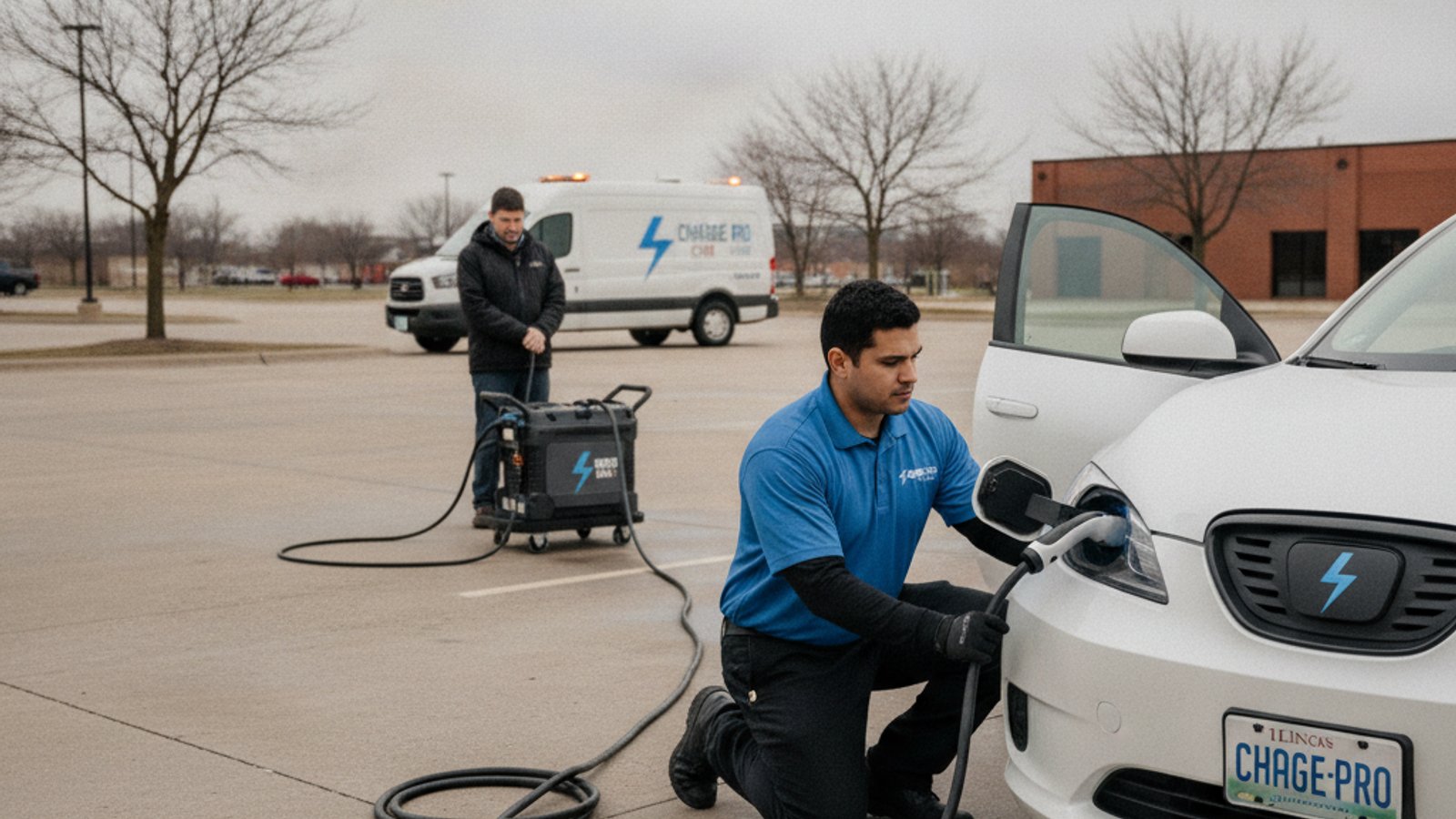
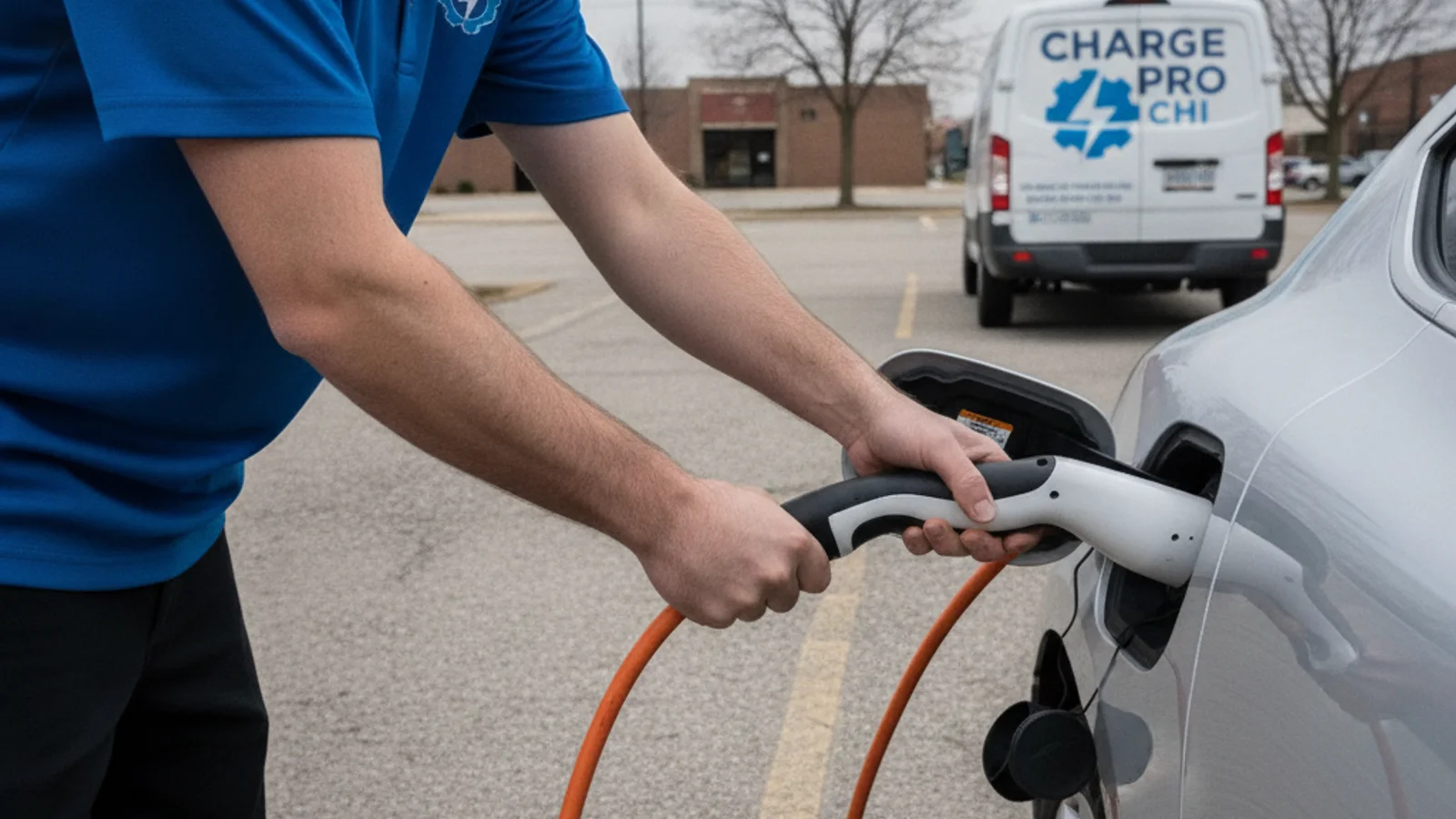
You’re not buying a full charge. You’re buying enough energy to roll again. The operators this line connects you with bring a 240V Level 2 source to the car. Tesla owners get a native NACS plug. Other EVs get a CCS or J1772 adapter. The usual boost adds about 10 to 20 miles of range. That energy typically goes in over 15 to 30 minutes of charging. Charging time is plug time. It’s not an arrival promise.
A mobile EV charging stop isn’t a shop visit. If the 12V is dead, the pack can still hold energy. The car just won’t boot. It may not unlock. It may not take a charge. Ask the operator which job they’re quoting. A pack boost and a 12V jump aren’t the same invoice.
The quote isn’t a Supercharger session. It isn’t a wall-box install. It isn’t a shop diagnostic. If you need a repair, that’s a different business. The operators on this line are there to get you rolling. For the plugs and the bed source in plain order, read what’s an EV charging truck, and how mobile rescue actually works.
Who names the price
Charge Pro CHI is a referral line. It matches stranded EV drivers with independent local mobile rescue operators. It doesn’t perform the work. It doesn’t own trucks. It doesn’t employ technicians. It doesn’t hold a license. It doesn’t publish hours.
The operator quotes you before they start. They bill you themselves. If you don’t like the figure, you can say no. That’s the point of a quote.
No verified public rate card for this work turned up for this page. That includes Cook County. It includes Lake, DuPage, Kane, Will, and McHenry as well. A site that invents a dollar range is guessing. Don’t treat a guess as a bill. Confirm the current figure with the operator on the call. Get that figure before anyone unspools a cable.
What a complete quote should list
Ask them to talk in pieces, not one lump.
They should say whether travel to your pin is in the figure. They should say whether setup is in it too. Setup might mean a shoulder. It might mean a garage apron. It might mean a parking deck. They should say whether the energy itself is a separate line. They should say whether a 12V jump is extra. They should name a 12V replacement if that’s the plan.
They should say who you pay. If they can’t say that in one sentence, wait.
Independent shops sometimes price nights and holidays differently. Charge Pro CHI doesn’t publish a clock. It doesn’t publish a surcharge table. If timing matters to you, ask on that call. Don’t assume a night pin costs the same as a noon pin. Don’t assume it costs more. Ask them to say it out loud.
Your model matters. A Tesla doesn’t take charge like a Rivian. A Chevy doesn’t take charge like a Hyundai. The operator still brings the adapters. You still name the car. Confirm whether that adapter kit sits inside the quoted figure.
Chicago isn’t the suburbs, and the suburbs aren’t one place
A pin on Lower Wacker isn’t a pin on Randall Road. A stall after an Eisenhower crawl isn’t a stall in a Crystal Lake driveway. The operator prices access, traffic, and the parking you’re in. They aren’t pricing the metro as one blob.
The city and the near west
Chicago’s 2024 Census estimate is 2,721,308 people. About 68.6% of its housing predates 1980. That’s a lot of brick two-flats, greystones, and tight alleys. Many owners never got a wall box. They charge at work. They charge in a garage. They charge at a public stall. When that plan fails, they sit at the curb.
Cicero’s 2024 estimate is 82,090. About 90.2% of its housing predates 1980. Berwyn sits at 55,152 people. About 90.0% of Berwyn’s housing predates 1980. Oak Park’s 2024 estimate is 52,947. About 78.6% of its housing predates 1980. Evergreen Park is 19,301. About 87.7% of its houses predate 1980. Those shares come from Census ACS 2019-2023 table B25034. The head counts come from the 2024 Population Estimates Program. They aren’t a guess.
Older housing doesn’t prove a block lacks public stalls. It does explain a common west-side pattern. The house never took a 240V circuit. The stall happens at the curb after the commute. The quote still has to cover a narrow block. That’s different from a wide office lot.
Oak Lawn, Calumet City, Chicago Heights, and Homewood sit farther south in Cook. Oak Lawn’s 2024 estimate is 56,531. Calumet City is 34,855. Chicago Heights is 26,533. Homewood is 18,789. About 74.3% of Chicago Heights housing predates 1980. About 66.5% of Homewood’s does. About 58.4% of Oak Lawn’s does. About 54.8% of Calumet City’s does. Those are different traffic patterns than the Loop. Tell the operator the suburb. Give a cross street. Say whether you’re on a private lot.
The North Shore and Lake County
Evanston’s 2024 estimate is 76,006. About 71.2% of its housing predates 1980. Skokie is 65,850. About 72.0% of Skokie’s housing predates 1980. Wilmette is 27,443. About 74.3% of its housing predates 1980. Inner North Shore streets run older and tighter than a new cul-de-sac. A lakefront pin in Wilmette or Highland Park is also a weather pin. Wind and winter range loss stack. The operator still needs a legal place to stand the truck.
Glenview’s 2024 estimate is 47,634. About 40.3% of its housing predates 1980. Northbrook is 34,546. About 39.1% of its housing predates 1980. Those suburbs mix ages. They’re not a 1920s grid. Highland Park, in Lake County, is 30,794. About 60.6% of its housing predates 1980. Libertyville is 20,643. About 34.7% of its housing predates 1980.
Waukegan is a different Lake County job. The 2024 estimate is 88,570. About 57.0% of residents are Hispanic or Latino, per ACS table B03003. About 54.0% of housing predates 1980. Gurnee is 30,546. Only about 9.5% of Gurnee’s housing predates 1980. A Gurnee mall lot isn’t a Waukegan neighborhood street. Name which one you’re in.
Northwest Cook and the office parks
Schaumburg’s 2024 estimate is 77,099. Only about 15.9% of its housing predates 1980. That’s office parks, malls, and wide arterial roads. Arlington Heights is 75,596. About 42.0% of its housing predates 1980. Palatine is 65,951. About 31.2% of its housing predates 1980. Des Plaines is 58,832. About 58.8% of its housing predates 1980. Mount Prospect is 55,460. About 53.7% of its housing predates 1980. Hoffman Estates is 50,920. About 32.1% of its housing predates 1980. Elk Grove Village is 31,802. About 38.6% of its housing predates 1980. Park Ridge is 38,445. About 67.1% of its housing predates 1980. Park Ridge reads more like the inner suburbs than Schaumburg.
A dead EV in an Elk Grove industrial park after a delivery route is a fleet-shaped call. A dead EV in a Schaumburg garage after a long shift is a parking-deck call. Give the floor if you have it. Give the nearest garage letter. Give the car’s color. The quote gets cleaner when the pin is real.
DuPage and the western commute
Naperville’s 2024 estimate is 153,124. Only about 11.7% of its housing predates 1980. Wheaton is 53,741. About 35.2% of Wheaton’s housing predates 1980. Downers Grove is 50,552. About 41.3% of its housing predates 1980. Elmhurst is 46,108. About 56.6% of its housing predates 1980. Lombard is 44,490. About 48.6% of its housing predates 1980. Glen Ellyn is 28,872. About 46.7% of its housing predates 1980. Carol Stream is 39,556. Only about 14.2% of its housing predates 1980.
Those towns sit on the Eisenhower pattern and the western Metra pattern. People leave work with just enough range. Then they sit in a crawl. The pack that looked fine at noon isn’t fine later. Newer DuPage housing is more likely to have a garage. That doesn’t mean the wall box worked tonight. A tripped breaker and an empty pack are different faults. The quote should say which one they’re coming to fix.
Kane County and Randall Road
Aurora’s 2024 estimate is 180,710. About 42.8% of residents are Hispanic or Latino. About 33.1% of Aurora housing predates 1980. Elgin is 114,701. About 48.4% of residents are Hispanic or Latino. About 41.5% of Elgin housing predates 1980. St. Charles is 33,482. About 26.6% of its housing predates 1980. Geneva is 21,168. About 25.9% of its housing predates 1980. Batavia is 26,555. About 33.0% of its housing predates 1980.
A stall on Randall Road after the Fox Valley commute is a corridor pin. Say northbound or southbound. Say the nearest named cross road. Operators price a moving shoulder differently from a driveway in Geneva.
Will County, I-55, and I-80
Joliet’s 2024 estimate is 151,837. About 34.7% of residents are Hispanic or Latino. About 39.0% of Joliet housing predates 1980. Bolingbrook is 74,756. Only about 12.3% of its housing predates 1980. Plainfield is 48,881. Only about 6.7% of its housing predates 1980. Romeoville is 41,177. About 35.7% of residents are Hispanic or Latino. About 20.6% of its housing predates 1980. New Lenox is 28,480. Only about 7.9% of its housing predates 1980. Orland Park sits just north of that Will edge, in Cook, at 58,020. Only about 11.8% of its housing predates 1980. Tinley Park is 54,856. About 17.2% of its housing predates 1980. Long-dwell mall and theater parking shows up in both.
I-55 strandings are highway jobs. I-80 strandings are highway jobs too. The Bishop Ford near Oak Lawn is a highway job. The Tri-State is a highway job. The Jane Addams on I-90 is a highway job. The Reagan Tollway is a highway job. The Dan Ryan is a highway job. The Kennedy is a highway job. Stay in the car with hazards on if that’s the safe move. Tell the operator you’re on a shoulder. The quote has to cover a stop that isn’t a quiet driveway.
McHenry County
Crystal Lake’s 2024 estimate is 41,513. About 25.7% of its housing predates 1980. McHenry is 28,825. About 21.5% of its housing predates 1980. Algonquin is 30,539. About 10.1% of its housing predates 1980. Huntley is 28,495. Only about 3.8% of its housing predates 1980. That’s some of the newest stock in this Census set. Distance from the dense Cook grid is still real. The operator quotes the pin they have to reach. They don’t quote a metro average.
Pack empty versus 12V dead
This split changes the bill more than most people expect.
If the dash still lights, look at the miles. Zero miles usually means the high-voltage pack needs energy. That’s the Level 2 boost. If the car is a brick, start with the 12V. Dark screens are a clue. Doors that won’t release are a clue. Tesla still uses a low-voltage battery to close contactors. Ford, Hyundai, Chevy, and Rivian do too.
A Tesla 12V battery jump is a different visit than a pack rescue. Some stops need both. The operator should say so before they start. If they only quote a boost and the car won’t accept charge, you’re not done.
Don’t assume a jump is the smaller bill. Don’t assume a boost is the smaller bill. There’s no verified price table on this page for either one. There’s only the quote you hear.
Tesla roadside, clubs, and insurance
Tesla publishes its own roadside policy. Read Tesla’s site for what that line covers this year. Some plans send a tow. Some talk about charging. Coverage changes by model year. It also changes by what you bought. Charge Pro CHI isn’t Tesla. A local operator’s boost is a separate hire. Use it if Tesla’s path doesn’t put energy in the pack.
AAA and auto insurers sometimes reimburse EV help. Sometimes they send a tow and call it done. A verified metro-wide coverage rule couldn’t be confirmed here. Call the number on your card and ask. Ask whether they pay a mobile Level 2 boost. Ask whether they pay a 12V jump. Ask whether they pay only a hook. Then compare that answer with the operator’s quote.
Keep names and times in a note. Keep the quoted figure too. If you seek reimbursement later, you’ll need that trail. The operator bills you either way unless your club told you otherwise in writing.
For a longer pass on OEM versus local help, see what Tesla roadside assistance covers, and when you still need local help.
Boost versus tow
A tow moves the car. A boost tries to make the car move itself.
Towing an EV has extra rules. You may need a flatbed. You may need transport mode. You may need a low-voltage unlock first. Damage from a wheeled-tow is a real risk on many EVs. The hidden costs of towing a dead EV in Chicagoland aren’t always on the first number you hear. Yard storage can appear later. So can a wait at a charger. So can a second ride home. This page doesn’t invent those amounts. The tower has to name them.
Take 10 to 20 miles if that reaches a charger you trust. A boost may be the smaller interruption. If the car won’t go into transport, you may still need the bed. If you need a shop, you may still need the bed. Compare the two quotes. Mobile EV charging or a tow: which quote should you take walks that choice. It doesn’t pretend one price fits the metro.
Waiting it out on a live lane isn’t a third quote. It’s a safety problem. If you’re on the Dan Ryan or the Kennedy, treat the shoulder as the hazard it is.
What the 10 to 20 miles are for
The boost is a bridge. It isn’t a fill-up.
Use it to reach a charger you can actually sit at. Use it to reach home if home will take the car. Don’t spend the new range hunting. Open the car’s map. Open the app you already use. Pick one stall and drive there.
Cold weather in this climate cuts range. Cabin heat cuts range. A crawl on the Eisenhower cuts range. A crawl on the Reagan Tollway does too. Plan the 10 to 20 miles as a short, direct hop. If home is farther than that, say so on the quote call. The operator can tell you whether they’ll add more energy. More energy is more time on the plug. The 15 to 30 minute band is for the typical 10 to 20 mile boost. A larger ask is a different conversation. Charge Pro CHI still doesn’t set that figure.
How to call so the quote is real
Have this ready.
Name your city or neighborhood. Don’t just say Chicago. Chicago is huge. Evanston, Skokie, and the Loop aren’t interchangeable pins. Give cross streets. Say whether you’re on I-90, I-55, I-80, the Tri-State, or a lot. Give make, model, and year. Say Tesla or not. Say whether the screens work. Say whether the charge port opens. Say whether you already tried a 12V jump. Say whether kids or a pet are in the car. Say whether the car is in a gated garage.
Charge Pro CHI uses that intake to match you. The operator uses it to price you. Bad pins make vague quotes.
The service area is Chicagoland. City pages live under EV charging in Chicago and the suburbs. Open the city that matches your pin if you want local context before you call.
What this brand won’t claim
Charge Pro CHI won’t quote you a dollar figure on a blog. It won’t promise a clock. It won’t say the truck is around the corner. It won’t say the boost is free. It won’t say it owns the equipment.
The pros the network connects you with are licensed and insured. They quote before they start. They do the 240V work. They handle the 12V work when that’s the fault. They bill you.
Forums sometimes list a typical mobile EV charging service cost. Treat those Chicagoland figures as unconfirmed. Match them to a current operator quote or ignore them. This page won’t repeat an invented range.
Winter, housing, and why people stall here
Chicagoland winters are hard on packs. They’re hard on 12V batteries too. That’s a climate fact, not a scare line. Cabin heat, frozen ports, and a weak 12V show up together. Gurnee feels that wind. So does Evanston. So do the lakefront towns. Inland Naperville feels the cold too. So does Aurora. The quote doesn’t change because of a lake view. It changes because the car may need a port thawed. It may need a 12V wake. Then it may still need energy.
Home charging is still the quiet backup that prevents a lot of these calls. In Cicero, Berwyn, and older Chicago blocks, a wall box may not be on the table. Huntley, Plainfield, Gurnee, and much of Naperville skew newer. Those houses often have a garage that can take a circuit. That Census housing-age split is why two owners with the same EV live different lives. Neither pattern is a claim about public stalls. Both patterns still produce stalls when a plan fails.
If your house can’t take a charger, you already know your public routine. Build a reserve into that routine. Don’t roll to the last bar on purpose.
Other EVs charging you
Most EVs can’t charge another EV. A few trucks advertise bidirectional power. That isn’t a plan you should wait on in a live lane. If a friend can legally get to you with the right gear, that’s luck. It isn’t a substitute for a quoted operator boost.
Before you ever need the quote
Keep the car’s 12V healthy. Watch for random brownouts. Watch for odd door behavior. Watch for repeated 12V alerts. Charge to a buffer you can live with in winter. Learn one public stall on the way home. Don’t collect five you’ve never used. If you drive the Kennedy a lot, know which exit you’d actually take. The same goes for the Dan Ryan. The same goes for I-55.
None of that replaces a quote when you’re already stuck. It just makes the stuck days rarer.
Frequently asked questions
Does Charge Pro CHI set the mobile EV charging service cost?
No, it doesn’t. Independent operators quote you before they start. They bill you directly. Charge Pro CHI doesn’t publish a rate. No verified public figure for this metro turned up for this page. Confirm the current number with the operator on the call.
How much range does the boost add?
Operators on this network typically add about 10 to 20 miles. That energy usually takes 15 to 30 minutes of charging once they’re plugged in. It isn’t a full pack. It’s meant to get you to a charger or home if that’s in range. Ask if you need more. That becomes a different quote.
Will AAA, Tesla, or my insurer pay the operator?
Sometimes a club or an OEM line covers a tow or a boost. Sometimes they don’t. Tesla’s published policy is on Tesla’s site. Your insurer’s rule is on your policy. A single Chicagoland reimbursement rule couldn’t be confirmed here. Ask those providers. Then compare their answer with the operator’s quote.
When you’re ready to match with a local operator, call Charge Pro CHI. The number is (858) 925-5546. You’ll leave a pin and a vehicle. The operator quotes before they start. You decide from there.