Downtown Chicago street parking puts Teslas beside gas cars all day. A stranger knocks on your glass and asks for a jump. Your traction pack looks full, so the ask feels fair. Don’t clip your Tesla to that dead gas car. A Tesla isn’t built to jump-start another vehicle.
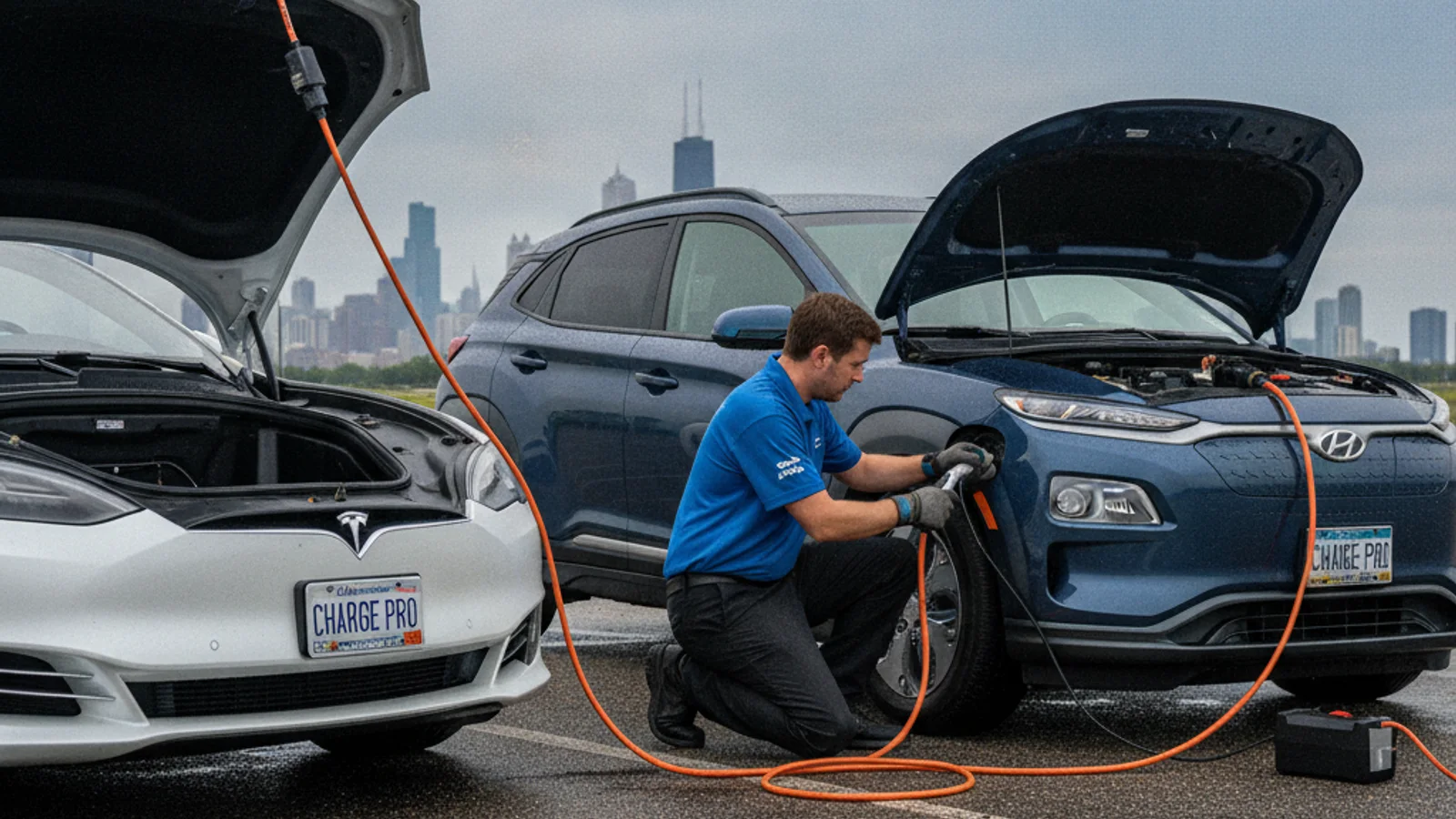
Why Chicago curbs keep producing this question
The mix is the point. Teslas and gas cars share the same curb downtown. They share it on older residential blocks across Cook County too.
Census ACS data for 2019-2023 shows 68.6% of Chicago housing predates 1980. Oak Park, Evanston, and Skokie sit at 78.6%, 71.2%, and 72.0%. Park Ridge is at 67.1%, Cicero at 90.2%, and Berwyn at 90.0%. On those blocks, a Model Y sits in the same curb line as a Civic. The Civic won’t start. Someone looks at the Tesla and figures a battery is a battery.
They’ve jumped cars for years with cables and two 12-volt batteries. A Tesla badge doesn’t continue that favor. It only looks like it should.
Newer housing doesn’t rewrite the electrical rule. Only 11.7% of Naperville housing predates 1980. Schaumburg sits at 15.9%, and Gurnee sits at 9.5%. Plainfield is at 6.7%. The ask still happens in those lots. A Tesla still shouldn’t donate the jump.
Chicago’s 2024 population estimate is 2,721,308. That’s a lot of mixed parking. A Chicago EV charging question can land the same week. The jump question can too. They happen on the same streets. They’re not the same problem.
No is the whole answer
Drivers still ask if a Tesla can jump start another car. It can’t. Don’t use a Tesla to jump-start a gas car. Don’t use it on another EV either. Tesla’s owner’s manuals warn that doing so can damage your vehicle. That warning is the case.
The frunk still hides posts that look like jump points. A Tesla still has a 12-volt battery. Familiar hardware isn’t a donor system. Treat the manual as the rule, not the cables in the bin.
A gas car’s 12-volt battery is a cranking tool
In a gas car, the 12-volt battery has a hard job. It spins a starter motor. That motor turns a heavy engine. The battery has to dump a large burst of current, then step aside. The alternator takes over once the engine runs.
Those batteries are built for that burst. They’re a cranking tool. They’re not a small wake-up circuit sitting in front of a high-voltage pack.
A Tesla’s 12-volt battery is a wake-up circuit
Your Tesla doesn’t crank anything. There’s no starter. There’s no engine to turn.
The 12-volt battery is a low-voltage key. It powers modules, locks, lights, and the screen. It closes the contactors that connect the high-voltage pack to the drive unit. If that small battery is down, the big pack can’t come online. The car looks dead even with miles sitting in the pack.
A DC-to-DC converter feeds the 12-volt side from the high-voltage pack. That converter is built for a steady, modest load. It keeps the small battery topped off while you drive. It isn’t a jump pack hiding under the hood.
Older Teslas used a small lead-acid 12-volt battery. Many newer Model 3 and Model Y cars use a lithium 12-volt battery. Chemistry doesn’t create a donor. Tesla’s rule is the same on both. We map the hardware in Do Teslas have a 12V battery.
Your traction pack isn’t a jumper either
People see a full pack and think that’s plenty of power to share. It’s plenty for driving. It isn’t wired as a 12-volt donor. The high-voltage pack feeds motors through contactors and inverters. It doesn’t dump cranking current out of the frunk posts.
The 12-volt system is isolated on purpose. That isolation is why a dead 12-volt battery can leave a full pack stranded. It’s also why a full pack doesn’t make you a safe donor. Energy in the floor isn’t energy at the clamps.
Those frunk posts only take power in
Owners open the frunk, see posts, and reach for cables. Those posts are there so an outside source can feed the Tesla. They’re an inbound path. They wake a dead 12-volt system. They aren’t an outlet for the next car.
Clip them to a dead gas car and you reverse the design. You ask a small, protected circuit to act like a cranking battery. Tesla tells you not to do that. The company says it can damage your car.
You may keep cables for a family gas vehicle. Leave them disconnected from the Tesla. Cables in the bin don’t change what the posts are for. Two Teslas don’t make a workaround either. Don’t daisy-chain a second EV into someone else’s starter.
What Tesla’s manual actually tells you
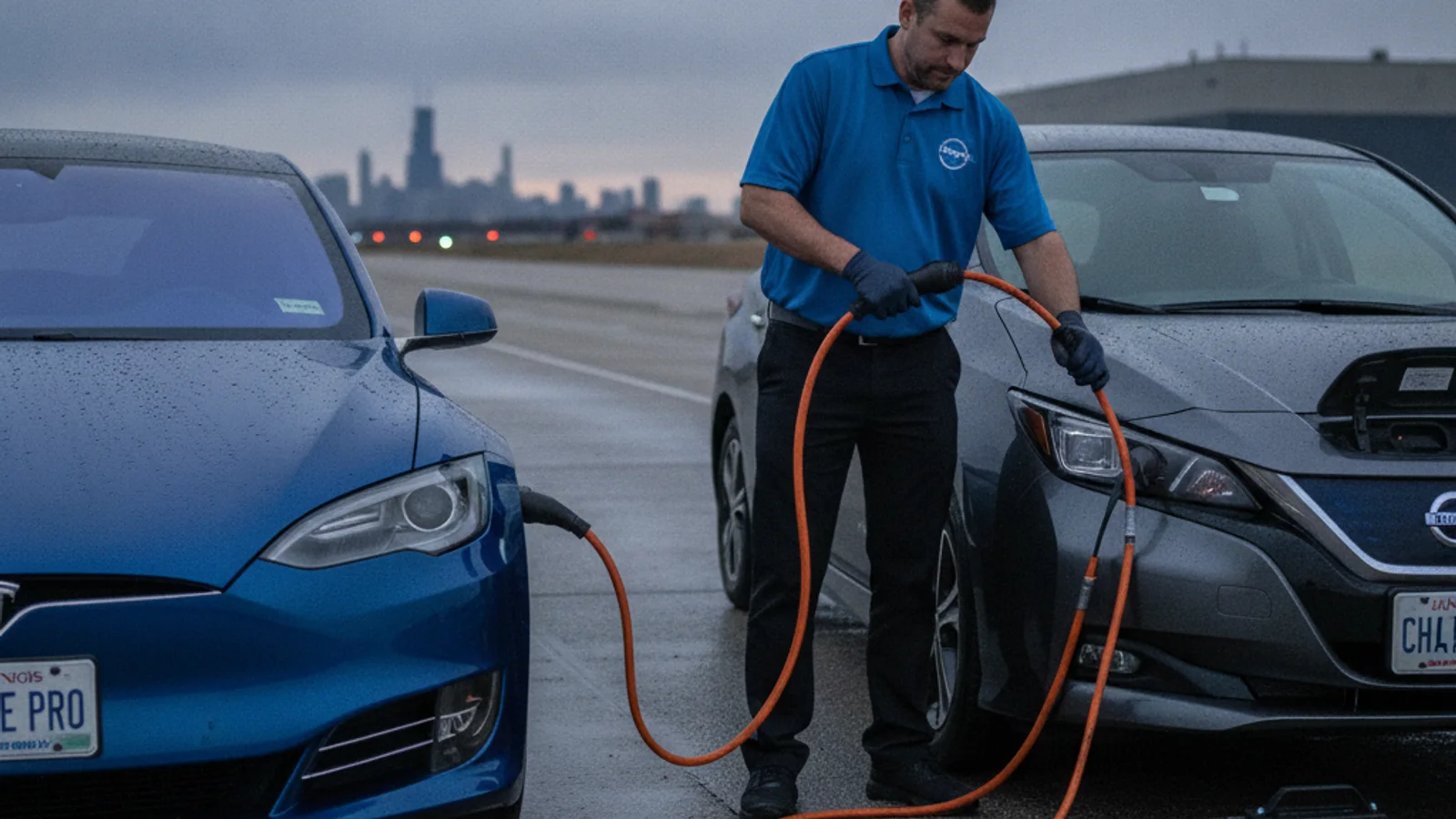
Skip the comment threads. Open the owner’s manual for a Model 3, Model Y, Model S, or Model X. Tesla tells you not to jump another vehicle with your car. The language is plain. Damage is the risk they name.
That matches how the car is wired. The posts exist so you can receive 12-volt power. They don’t exist so you can start someone else’s engine. One clip that seemed to work on a video isn’t a procedure. You don’t see the cars that needed service later.
Other EVs follow the same pattern. A small 12-volt network sits in front of a high-voltage pack. We cover that in whether any EV should jump a gas car. For the Tesla-only version, read why you shouldn’t jump a gas car from your Tesla.
Help the driver without becoming the battery
You can still be useful. You just shouldn’t be the power source.
Carry a portable jump starter if you want that role. It’s a small pack with its own clamps. It’s made to crank a gas car. You connect the pack to their battery, not your Tesla. Their engine starts. Your 12-volt system never enters the circuit.
No pack in the frunk? Help them call roadside assistance from the curb. Stay nearby if they want a witness. Offer a ride to a family member or a shop. A ride uses a little range. It doesn’t stress your low-voltage system.
Don’t stand in a travel lane to look helpful. Get people onto the curb. Let a jump pack or a truck built for gas cars handle their starter.
When your Tesla is the dead car
This is the 12-volt story that actually belongs to you. The car can look fully dead. Handles may not pop. The screen stays black. The app stops seeing the vehicle. You might have had a 12-volt service warning earlier. You might not.
That’s a receive-a-jump job. An outside 12-volt source can wake the low-voltage side. Once the contactors close, the high-voltage pack can come up. Then the car is a car again.
Steps vary by model. Tesla documents the posts and the order. Follow that page, not a random clip. If you don’t want to make the connection, don’t. A bad clip can still harm the Tesla you’re trying to save.
Charge Pro CHI doesn’t perform the work. We’re a referral line. We match stranded EV drivers with independent local mobile rescue operators. Operators can jump or replace a dead 12-volt battery on site. They quote you before they start. They bill you directly.
For the owner-led path, use our Tesla 12-volt jump guide. If you want an operator on that 12-volt job, see Tesla 12V battery jump.
An empty pack is a different problem
A silent Tesla isn’t always a 12-volt failure. The high-voltage pack can be empty. Those two failures look adjacent. They aren’t the same call.
If the car is awake and at zero miles, you need a charge. Operators we connect you with bring a 240-volt Level 2 source to the car. Teslas get a native NACS plug. Non-Tesla EVs use a CCS or J1772 adapter. They typically add 10 to 20 miles of range. That takes 15 to 30 minutes of charging. That’s charging time. It isn’t an arrival time.
If the car won’t wake, start with the 12-volt side. A charge-port door that won’t open is often that small battery. Level 2 into a car that can’t close contactors won’t fix the wake-up path first.
Say what you see when you call. Dark screen and no locks points to 12-volt. Car awake and stuck at zero points to a pack boost.
The rule doesn’t move when you leave downtown
Highland Park still has 60.6% pre-1980 housing, and Wilmette sits at 74.3%. Des Plaines is at 58.8%, Elmhurst at 56.6%, and Joliet at 39.0%. The curb changes. The 12-volt architecture doesn’t.
A Tesla in Glenview or Northbrook still shouldn’t donate a jump. A Tesla in Aurora or Elgin still can receive one. Waukegan, Oak Lawn, and Tinley Park don’t get a special exception. Tesla wrote one rule for the car.
Frequently asked questions
Can a Tesla jump start another car?
No. Don’t use a Tesla as the donor vehicle. Tesla warns that doing so can damage your car.
Can another car jump a Tesla?
Yes, a Tesla can receive 12-volt power when the small battery is dead. Use your model’s manual for the posts. Or have an operator who knows Teslas make the connection.
What should you offer instead of a jump from your Tesla?
A portable jump starter is the tool that cranks a gas car. You can also help the driver call roadside assistance. Don’t clip your Tesla to their battery.
If your own Tesla won’t wake, call (858) 925-5546. We’ll connect you with a local operator. They quote before they start.