A dead gas car on a Chicago curb doesn’t need your traction pack. An EV can sometimes jump-start a gas car from its small 12-volt. The big pack never joins that jumper circuit. On mixed downtown street parking, skip the cables.
Mixed parking is why neighbors keep asking
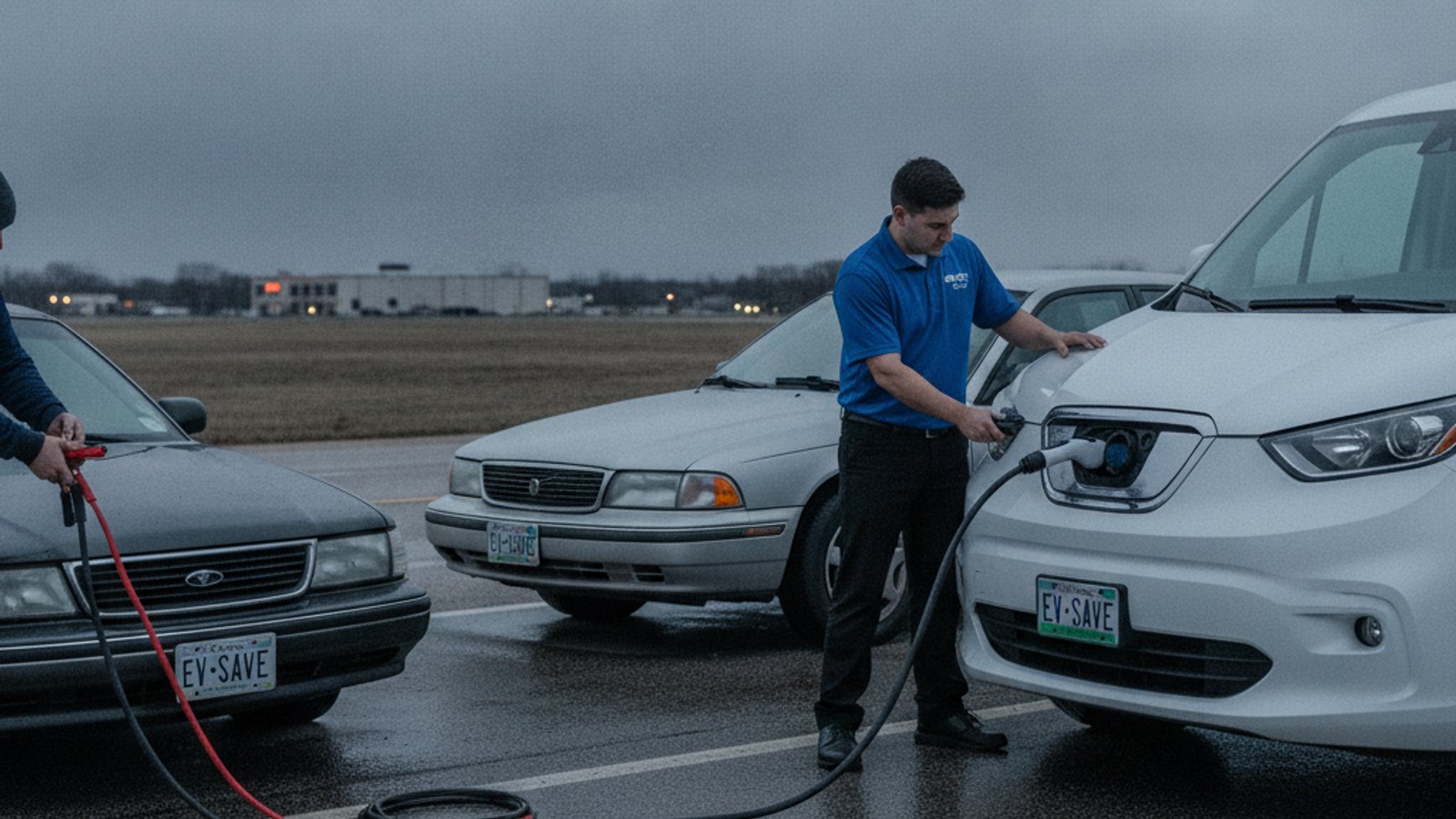
Chicago street parking puts EVs next to gas cars on the same block. Someone’s Civic won’t crank after a night on the curb. You’re in the EV beside it. The pack looks like spare power. It isn’t.
The city’s housing makes that scene routine. ACS 2019-2023 puts pre-1980 housing at 68.6% of Chicago. Cicero is 90.2%, Berwyn is 90.0%, and Oak Park is 78.6%. Evanston is 71.2%, and Skokie is 72.0%. Those inner Cook County blocks still park on the street. An EV and a gas car share the same curb. Street parking is the default on those blocks.
Newer suburbs don’t erase the same ask. Naperville’s pre-1980 share is 11.7%. Gurnee is 9.5%, Plainfield is 6.7%, and Huntley is 3.8%. Those towns have more garages. Chicago’s 2024 population estimate is 2,721,308. That’s a lot of curb space, and a lot of neighbors.
Your EV has two batteries, not one
Every EV around Cook County carries two separate electrical systems. The high-voltage pack turns the motors. The 12-volt wakes the computers, locks, lights, and contactors. A gasoline car uses that same 12-volt size to spin a starter. Your EV never asks the 12-volt to crank an engine. A DC-DC converter recharges the 12-volt once the car is awake.
That’s why a full pack can still leave you stuck. A weekend sit in Oak Park can kill the 12-volt. Evanston sits do the same with the pack still full. The same small battery is the only source jumper cables can tap. Those cables never reach the traction pack.
A jump uses the 12-volt, not the pack
A jump doesn’t power the gas car’s engine. It only borrows current so the starter can turn. That current draw is short, and it’s severe. An EV 12-volt is built for modules and accessories. It isn’t built as a jump pack for a starter on a downtown block.
Most EV 12-volt batteries are lead-acid units sized for accessories, not cranking. Newer Teslas and some other EVs use a lithium 12-volt. Those units are lighter than a starter battery. They may open a protection circuit under a starter load. They can also sag until your own car dies.
Confirm clamp order in that year’s owner’s manuals. NHTSA publishes public jump-start safety material at nhtsa.gov. Charge Pro CHI doesn’t publish amp draws or cable sequences. If your EV’s book says not to jump another car, stop there.
Why you can end up with two dead cars
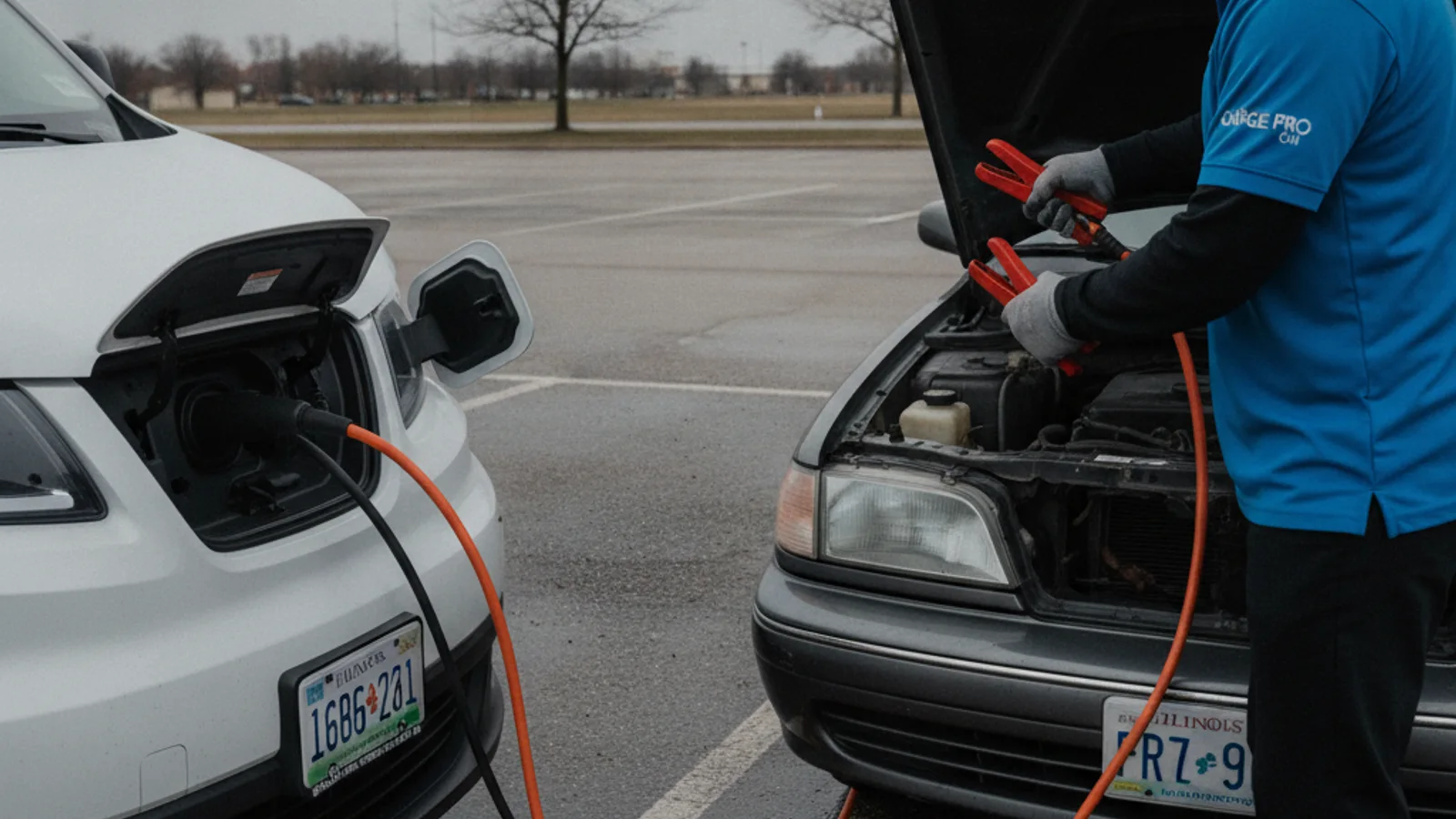
If your 12-volt dumps, you now have two silent vehicles. One is the neighbor’s gas car. The other is yours. Tesla’s published support material generally advises against using a Tesla to jump another car. Confirm the current wording on tesla.com/support before you clip anything.
Tesla-only steps sit in can a Tesla jump-start another car. The Tesla jump-risk notes cover the same 12-volt limit.
A reverse clamp or a spike can hit the EV’s low-voltage circuits. The DC-DC converter that tops up your 12-volt isn’t a starter battery. Flatten that converter and your own car may not wake. Then the rescue you need isn’t a gas-car crank.
Safer help on a mixed block
Carry a portable jump starter if you want to help a gas car. That pack is built for cranking current. It never touches your EV’s 12-volt. Another gas car on the same curb is the usual donor. Their own roadside plan is the other path.
If you’re in a live travel lane, get the cars out of traffic first. Lower Wacker is a different stall if it’s your EV that died. Read your EV died on Lower Wacker for that case, not for jumping a Civic. Can roadside assistance jump-start an EV sorts a 12-volt jump from a pack boost.
Don’t reverse the job. Your EV can receive a 12-volt jump. It shouldn’t give one to a starter motor. How to jump start an electric car is for waking your own EV, not theirs.
If your EV is the one that won’t wake
A failed jump can flatten your own 12-volt. Lights and screens run on that small battery. Independent operators we connect you with jump or replace a dead 12-volt on site. They handle Tesla and every major EV brand.
If the traction pack is actually low, they bring a 240-volt Level 2 source. It uses a native NACS plug, or a CCS or J1772 adapter. Typical charging time is 15 to 30 minutes. That usually adds about 10 to 20 miles of range. That’s time on the plug, not an arrival time. Tesla 12-volt work is on the Tesla 12V battery jump page. City notes start at EV charging in Chicago.
Charge Pro CHI is a referral line. It matches stranded EV drivers with independent local mobile rescue operators. It doesn’t own trucks, employ technicians, or hold a trade license. It doesn’t set prices or publish hours. The operator quotes you before work starts and bills you directly. The pros we connect you with are licensed and insured. Call (858) 925-5546 when your EV is the one that won’t wake.
Frequently asked questions
Can an EV jump start a gas car?
Sometimes the 12-volt can pass enough current to crank a starter. You still shouldn’t try it on a Chicago curb. The traction pack never joins that circuit. If your owner’s manual says no, don’t clip the cables.
Does the big battery power a jump?
No. Jumper cables never tap the traction pack. They only see the 12-volt accessory battery. That’s why a full pack can still leave both cars stuck.
What if my EV’s 12V dies while I try to help?
Then you may have two cars that won’t wake. Get a 12-volt jump for your EV. Let the gas car use a portable pack or another gas car.