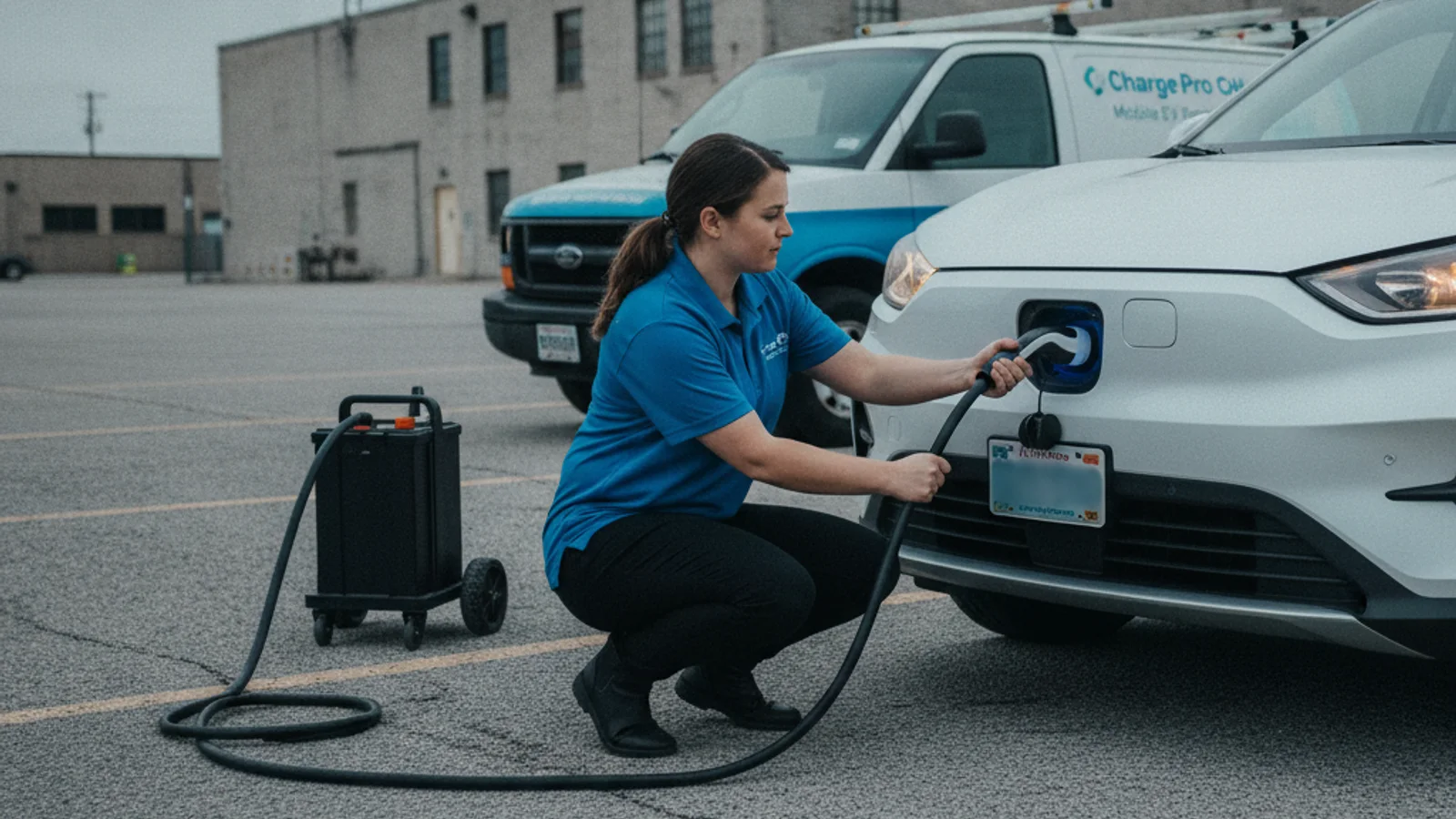
EV roadside assistance in Joliet starts with a mobile boost, not a tow. The other common fix is a 12-volt jump on site. Charge Pro CHI connects stranded drivers with independent local operators. We don’t perform the work, own trucks, or set prices. Fleet vans on I-55 and I-80 are the local stall pattern.
Why Joliet stalls look like fleet work
Joliet is the Will County seat, and it’s a working city. Census figures put the 2024 population at 151,837. The ACS 2019-2023 count was 149,785. The land area is about 66 square miles. That size splits a stall into very different scenes. A van at CenterPoint isn’t a sedan by the Rialto Square Theatre.
This city is one of the biggest intermodal freight hubs in North America. Vans and electric trucks work those yards south of town. They run I-80 and I-55, the Stevenson, between drops. A pack that looked fine at the gate can sit empty on the ramp. The driver still has a route to finish after that. Sitting on the ramp doesn’t finish the route.
Delivery EVs work the same interstate belt through town. Last-mile vans cut between Illinois 59, US-52, and Larkin Avenue. Jefferson Street is US-30, and it runs the in-town spine. Those roads feed downtown, the west side, and the east side. They also feed the I-80 corridor neighborhoods. The car doesn’t care that you were almost back. Empty is still empty on the last stretch to the yard.
Casino lots add a long-dwell version of the same stall. Harrah’s and Hollywood keep cars parked for hours. Chicagoland Speedway and Route 66 Raceway sit nearby. A cabin left on climate control will drain a low pack. Accessory drain will do the same in a long casino sit. You walk back from the floor with your bag. Then the car doesn’t wake when you need it.
Shift-change stalls at the yards look different from a casino lot. At CenterPoint the van is in a working facility with other trucks moving. Stay where you’re allowed to wait. Tell dispatch the gate or lot you can name. A Hollywood or Harrah’s stall is a public lot with pedestrians. It’s the same dead car in different traffic.
About 39 percent of Joliet housing was built before 1980. That’s a Census figure for age, not for chargers. If your driveway has no working plug tonight, you still need miles. ComEd is the electric utility that serves Joliet. If a home charger died, confirm the outage with ComEd. Or have an electrician check the tripped gear. Charge Pro CHI doesn’t repair wall boxes or home circuits. The operators we connect you with rescue the car.
I-55, I-80, and the in-town grid
I-55 through Joliet is freight plus commute traffic toward Chicago. A low pack on the Stevenson isn’t a good time to hunt by feel. Get to a safe stop if you can do it without blocking a lane. Keep hazards on if you’re stopped on a live shoulder. Stay in the vehicle unless you’re in immediate danger.
I-80 is the east-west belt across this part of Will County. It also feeds the intermodal yards. A stall there is a highway problem, not a mall-lot problem. We collected the corridor steps in our I-80 Will County rescue note. The useful move is the same on every night. Don’t roll on a wish, and don’t crawl an unknown exit. Call and ask for a boost quote.
If you’re on I-55 with an empty pack, use the Stevenson out-of-charge steps. Don’t walk the interstate, and don’t stand behind the bumper. Give dispatch the mile marker or the last exit you passed. Jefferson, Larkin, and downtown pins are easier to read. An interstate pin still works if you stay put.
US-30 on Jefferson Street is the in-town spine through downtown Joliet. Illinois 59 and US-52 carry west-side and through traffic. These streets are slower than I-80, but a dead car is still stuck. Cathedral-area blocks and east-side streets see quiet driveway no-starts. Those often look like a 12-volt failure, not a drained pack.
Crest Hill, Shorewood, and Rockdale sit on Joliet’s edge. New Lenox and Plainfield sit on the same freight and commute grid. If you stall just over the line, say the city name. The service area is Chicagoland, not one neighborhood line. The Joliet city charging page is the local hub for in-town calls.
We couldn’t confirm a verified public-charger inventory for this article. We also couldn’t confirm a distance to any site. You may already know a charger that worked last week. A 10 to 20 mile boost is often enough to reach it. If you don’t, say that on the call. The operator quotes a Level 2 boost to get you moving. They don’t guess a map for you.
What the operator brings to the car
Charge Pro CHI is a referral line, not a shop. We don’t hold a trade license for this work. We don’t run a yard or a fleet. We match you with an independent local operator. The pros we connect you with are licensed and insured. That person quotes you before a cable goes in. They bill you directly after you accept the quote.
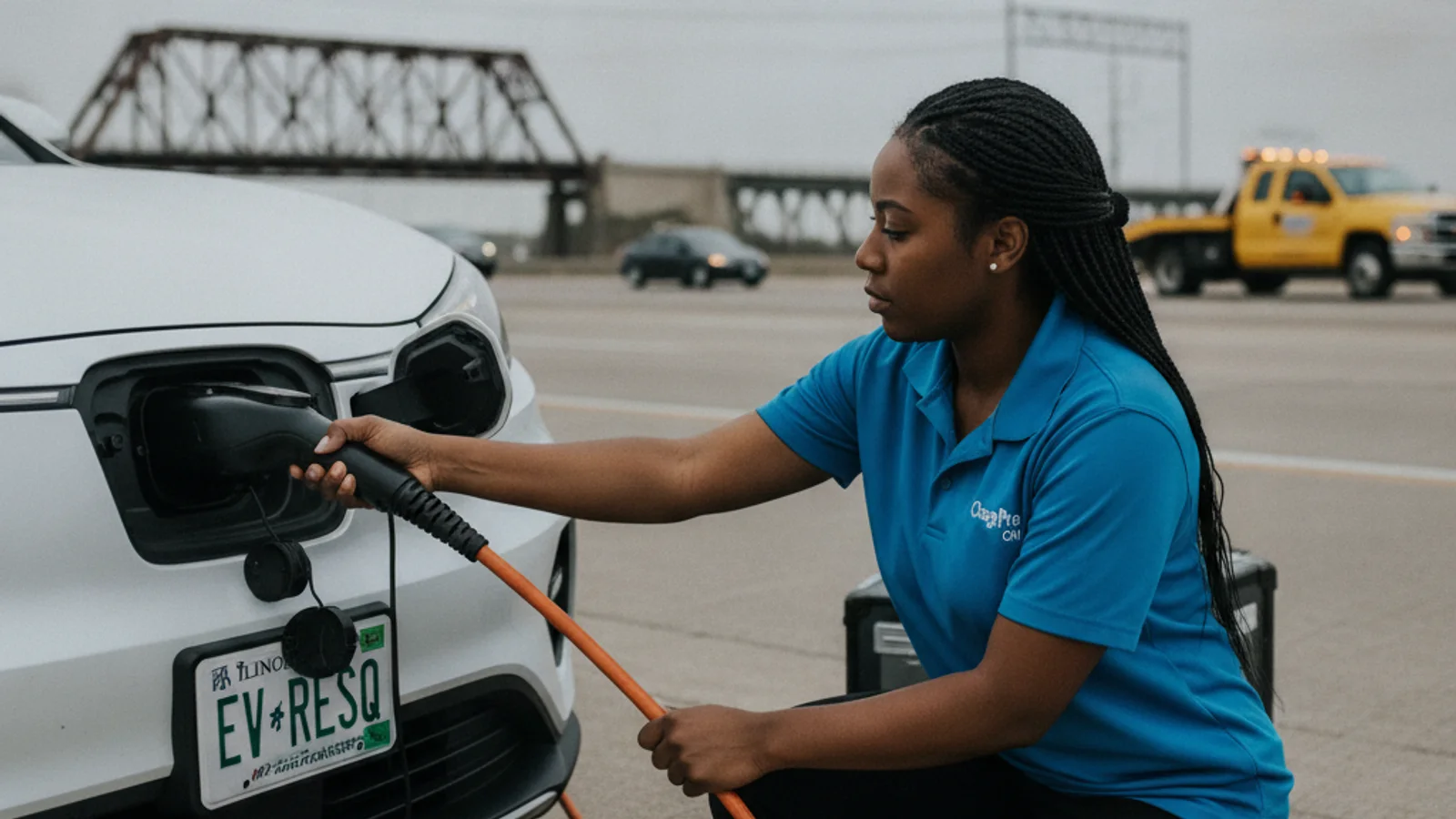
The source on the truck is 240-volt Level 2. Teslas use a native NACS plug on that truck. Other EVs use a CCS or J1772 adapter. Typical charging time is 15 to 30 minutes. That clock is plug time, never an arrival window. Most boosts add about 10 to 20 miles. That’s often enough to leave CenterPoint or get off I-80. It can also finish a short remaining route.
This is mobile EV charging, not a shop visit. Nobody is filling the pack to 100 percent. Nobody is rewriting the range estimate on your dash. You get enough energy to drive away from the stall. Then you choose the next plug on your own. If the car has a mechanical fault, say so early. A boost won’t straighten a wheel or free a destroyed charge port.
A dead 12-volt battery is the other Joliet call. The traction pack can still hold plenty of energy. The car just won’t wake, unlock, or accept a charge. Computers and contactors both need that small battery. Teslas show this no-start a lot. Other major EV brands show it too. Operators we connect you with can jump that battery on site. They can replace it on site when that’s the right call.
Tesla owners here often compare the OEM line with a local operator. We laid that out in Tesla roadside backup in Joliet. OEM roadside may send a tow instead of a charger. It may not send a 240-volt boost. Ask what they’re actually dispatching before you wait.
How to tell pack empty from 12-volt dead
An empty pack usually still lets the car talk to you. You see zero miles, a turtle icon, or a charge warning. Lights and locks still work on an empty pack. The car just refuses to propel you forward. That’s a range rescue, not a mystery no-start.
A 12-volt failure is a quieter kind of stall. There’s no dash, no app, and no friendly chime. Door handles may not pop for you. The charge port may not open either. You might think the whole car is dead. The big battery may still be fine. Don’t keep cycling a tiny jumper pack until it dies again. Get a proper on-site jump, then plan a replacement if it fails twice.
If the 12-volt takes a jump and dies again, stop jumping it. Repeated no-starts usually mean the small battery can’t hold a charge. Replacement on site is the next conversation with the operator. That’s still rescue work, not a dealer visit. It isn’t a high-voltage pack job.
Cold weather makes the small battery look worse. A 12-volt that sat in a lot all day can refuse to wake. Casino dwell and yard dwell both do that. A van at CenterPoint with a weak 12-volt is still a roadside call. It’s not a tow by default after a good jump.
Boost or tow in this city
Choose a tow when the car can’t roll after it has power. Use a tow for bent suspension or a tire you can’t change. Use a tow if the inverter won’t take the pack. Choose a boost when the car can drive after it has miles. Or choose it after the 12-volt wakes the computers.
We don’t publish fees, and we don’t set them. The operator quotes you first, before any work starts. Get a flatbed quote from a tow company if you want that comparison. Then pick the quote that actually solves the stall. Our guide to a mobile charge versus a tow is the decision frame. If the car is driveable after a boost, staying with it is simpler.
A boost isn’t a high-voltage pack repair. If it wakes and still throws pack faults, go to a qualified shop. Rescue gets you off I-55 or out of a casino lot. Rescue doesn’t rebuild a high-voltage battery. Old Joliet Prison and the Rialto aren’t repair shops. A CenterPoint yard gate isn’t a service bay either. The car still needs energy, or it needs a 12-volt.
What to have ready when you call
Have the make, model, and plug type. Tesla, Rivian, Ford, Hyundai, Chevy, and other major EVs are in scope. Share I-55, I-80, Jefferson, Larkin, or a lot name. CenterPoint, Harrah’s, a west-side driveway, or downtown all help. Stay out of live lanes while you wait for the quote. If you’re in a delivery van, say it’s a work vehicle. The operator still quotes before they start. You decide who pays that quote.
EV roadside assistance is the dispatch path for this. Charge Pro CHI connects you with the operator. The independent operator does the work on site. Call (858) 925-5546 when you’re stuck in Joliet. You’ll get a quote before anyone starts.