A no-power Tesla on a Chicagoland tollway shoulder shouldn’t go on a flatbed first. You still need Tesla’s tow method if the car has to ride. The opening job is to tell a dead 12V from an empty pack. A jump or a 240V boost often gets you moving without a wrecker. Dragging the wheels before Transport Mode is what actually hurts the car.
A black screen on I-90 isn’t a wrecker job by default
Teslas crawl the Jane Addams and the Reagan Tollway on the last bar. Drivers leave Naperville, Aurora, and Joliet pointed at Chicago. Range falls in the stop-and-go. Naperville’s 2024 population estimate is 153,124. Aurora’s is 180,710. Joliet’s is 151,837. Chicago itself sits at 2,721,308. That’s a lot of cars on the same handful of tollways. A dark screen on the shoulder feels like a tow, and it often isn’t.
The same stall shows up on the Tri-State after a Schaumburg office day. It shows up on the Kennedy when traffic stops. It shows up on the Dan Ryan and the Bishop Ford. The car didn’t become a wrecker problem when the display went black. It became a diagnosis problem.
Tell a dead 12V from an empty pack
Two failures look alike from the driver’s seat. They need different help.
The 12V battery runs the screens, locks, computers, and contactors. When it dies, the high-voltage pack can still hold miles. The touchscreen stays dark. The doors may not open the usual way. Transport Mode is unreachable because the menu lives on that screen. Cold parked hours make this more common. Evanston, Skokie, and Oak Park sit through long winter nights. A Tesla can lose 12V in a driveway just as it can on I-90.
An empty drive pack is the other stall. You watched the range fall. The car drove until it wouldn’t. The screen may still work until the 12V follows it down. That car needs energy in the big battery. It doesn’t need a winch as the first tool.
A 12V jump is only a low-voltage wake-up. It doesn’t refill the drive pack. It can bring the screen back so you can set Transport Mode. It can also let you drive if the pack still has range. Jump posts are usually behind the front tow-eye cover. Follow the manual for your Model 3, Y, S, or X. Newer 3 and Y cars use a lithium 12V. Tesla’s published jump steps still apply.
If you’re locked out, read what to do when a Tesla is dead and locked. The operators we connect you with do this through a Tesla 12V battery jump on site. They quote before they clip on.
Why a mobile boost often beats the wrecker
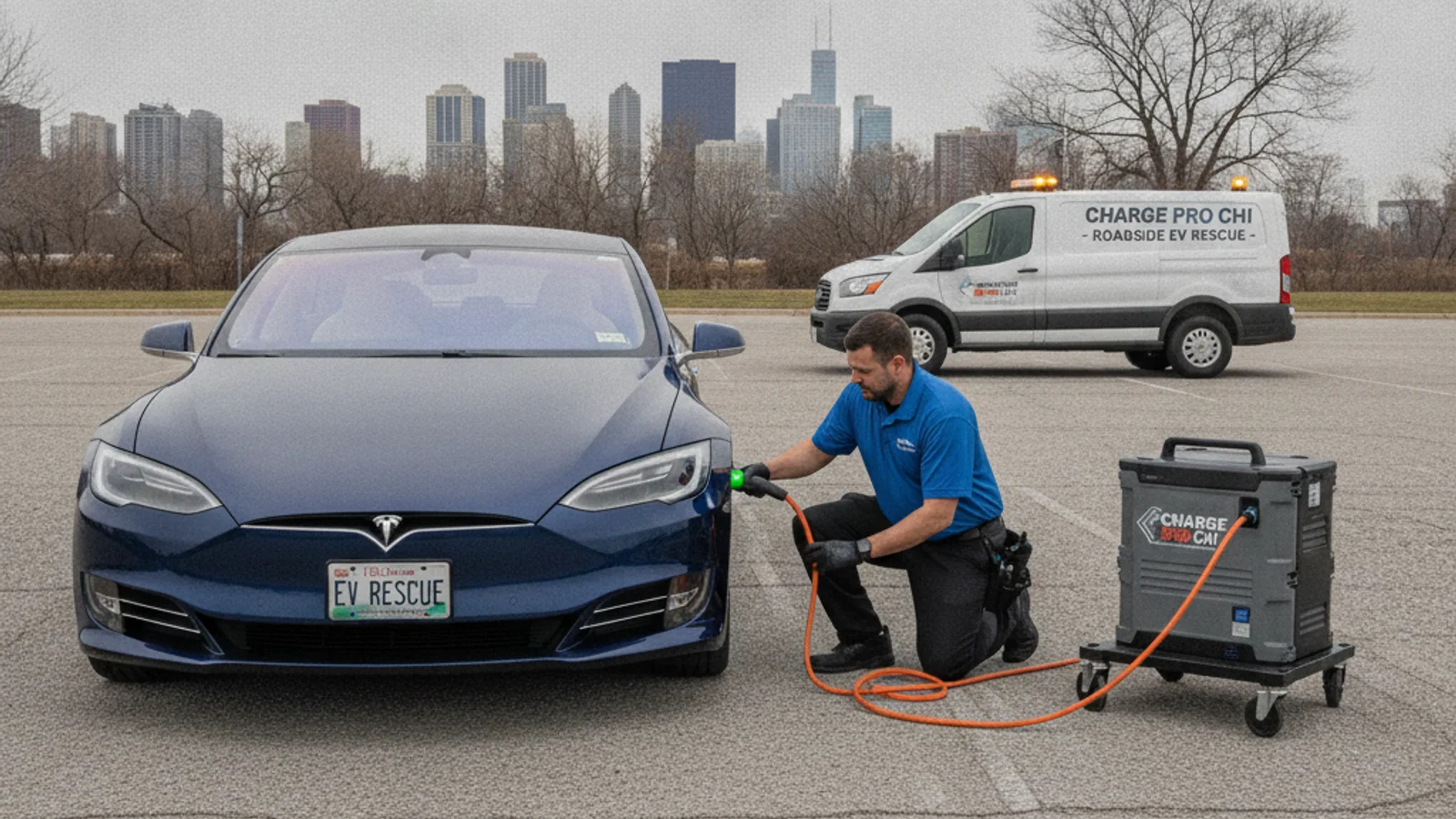
If the pack is empty, a flatbed still isn’t the only path. Independent operators in this network roll up with a 240V Level 2 source. On a Tesla they use a native NACS plug. They typically add 10 to 20 miles in 15 to 30 minutes of charging. That’s charging time, not an arrival time. Charge Pro CHI doesn’t publish a clock for when someone shows.
Those miles are often enough to leave the shoulder under the car’s own power. You can then drive to a Supercharger or a home charger you already trust. This page doesn’t guess the nearest stall. Public stalls go down, and a made-up distance would be a guess. Open the Tesla app and confirm a working site before you roll.
A tow still has a place. The car may have other damage. Transport Mode may refuse to enable after a jump. You may not want to drive at all. Put that next to a boost in mobile charging versus a tow. The hidden costs of towing a dead EV are extra handling and risk. Charge Pro CHI doesn’t set fees. The operator quotes you before work starts and bills you directly.
If you’re already on I-88, start with stranded on the Reagan Tollway. The choice is the same on I-90 and I-80. Boost first when the pack is empty and the car is otherwise intact.
If the car still has to ride, use Tesla’s tow order
Tesla’s published method is a flatbed with Transport Mode on. All four wheels leave the pavement. A dolly that leaves two wheels on the road is the damage path. So is a hook-and-chain drag.
Transport Mode releases the parking brake. It lets the wheels roll without using the motors as generators. On a living screen, look under Controls, then Service. On a dead screen, you don’t get that menu until the 12V is jumped. Don’t winch first and hope the car likes it.
Point the wheels straight before the cable pulls. Use Tesla’s designated tow points. Don’t wrap a strap around a control arm. Don’t grab random underbody metal. If the operator can’t name the attach points for your year, pause. Ask them to open Tesla’s towing guide for that model. This research didn’t turn up an Illinois statute that sets a Tesla-specific tow method. Tesla’s own manual is the authority. Confirm the method with the operator before anyone tensions a cable.
AWD Teslas put motors at both axles. There’s no safe pair of wheels to leave on the ground. Rear-wheel Model 3 and Y cars still shouldn’t be flat-towed. Tesla’s instruction doesn’t change with the motor count. Use a flatbed.
What spinning wheels do to the motors
EV motors sit on the axles through a single-speed reduction gear. They don’t disconnect like a gas transmission in neutral. If those wheels turn while the car is inoperable, the motors generate current. That current has nowhere useful to go. Heat builds in the motor and the inverter. The high-voltage system takes abuse it wasn’t designed for in tow.
A two-wheel dolly is a bad idea on a Cook County shoulder. The Jane Addams shoulder looks tempting for a quick drag onto a bed. The motors don’t care that it was a short pull. Keep every wheel off the pavement until Transport Mode is on. If the 12V won’t wake, don’t roll the car. The operator should follow Tesla’s no-power steps for that model first.
What to say before anyone hooks a cable
Say the car is a Tesla and it has to ride on a flatbed. Say whether the 12V is dead. Say Transport Mode is off until that 12V is jumped. Ask them to use the tow eye and Tesla’s published attach points. Ask them not to roll any drive wheel on the pavement.
Say it before they hook up on the Tri-State, the Kennedy, or the Dan Ryan. Shoulder room is tight. The first truck that stops may be set up for gas cars. You’re allowed to decline a method that drags the wheels.
This research didn’t confirm an Illinois Tollway rule that names Tesla recovery. It also didn’t confirm a required contractor for a disabled passenger car. Check the Illinois Tollway’s current disabled-vehicle guidance if you’re on a toll road. Don’t accept a pavement-drag because someone is in a hurry.
Charge Pro CHI is a referral line. We don’t own wreckers and we don’t drive them. We don’t perform the tow. The Tesla roadside rescue path matches you with an independent local operator. That operator may jump the 12V or add a Level 2 boost. They can also help you get a proper flatbed. They quote before they start.
North Shore stalls and Will County stalls fail the same way
Wilmette, Northbrook, and Highland Park sit on a different commute than Joliet, Bolingbrook, or Romeoville. The cars still die the same two deaths: 12V or empty pack. A Model Y on the Wilmette lakefront still needs the 12V check first. So does a Model 3 on I-80 in Will County. Schaumburg’s office parks add a third pattern. The car sat through a long workday and won’t wake. The tow order doesn’t change. The first move still isn’t the flatbed.
Gurnee and Libertyville drivers hit the same wall after an errand. Oak Lawn and Evergreen Park drivers hit it after a south-side trip. Cicero and Berwyn’s housing is mostly pre-1980. A wrecker has less room to be wrong there. None of that changes Tesla’s method. Jump the 12V if the screen is dead. Boost the pack if the miles are gone. Tow on a flatbed only after those two are off the table. Tow if the car can’t roll on its own. Elk Grove Village and Des Plaines sit on the approach to the Jane Addams. Downers Grove sits on the Eisenhower and the Reagan.
Frequently asked questions
Can you flat-tow a Tesla that has no power?
Keep all four wheels off the road. A flatbed is Tesla’s method. Two wheels up still drags the other pair. Don’t let a gas-car dolly become the plan on a Chicagoland shoulder.
What if Transport Mode will not turn on?
Don’t roll the car to force it. Jump the 12V and retry the Service menu. If the screen stays dead, tell the operator Transport Mode is off. They should follow Tesla’s recovery steps for your model before the winch moves.
Does a dead 12V mean the Tesla has to be towed?
Often it doesn’t. A low-voltage jump can restore the electronics. You may then drive if the pack has range. You may enable Transport Mode if it doesn’t. For an empty pack, a mobile EV charge is the other way off the shoulder.
If the screen is black and you’re on the shoulder, call (858) 925-5546. Charge Pro CHI will connect you with a local operator. That person quotes the work before it starts. They can bring a 12V jump or a 240V boost. They can also point you to a proper flatbed. You choose after you hear the quote.