DuPage traffic on the Reagan Tollway can leave an EV pack lower than planned. If you’re already stranded, pull fully onto the right shoulder. Switch on the hazards and stay with the car. Charge Pro CHI is a referral line. We connect you with an independent operator for a 240V boost.
The Reagan is a DuPage commute, not a blank map
The Reagan Tollway is I-88, the east-west run through DuPage. Weekday traffic here is a west-suburban crawl, not a Sunday drive. Drivers from Naperville and Downers Grove use it toward Chicago. Wheaton, Lombard, Elmhurst, and Glen Ellyn feed the same road. Aurora sits farther west in Kane County on this run.
Heaters, defrost, and stop-and-go all tax a pack. A Naperville car can leave home with a thin buffer. Peak traffic then uses more energy than the dash first showed. That’s traffic talking, not a guess about stations.
I couldn’t confirm a charger inventory for the Reagan from the files we checked. If you still have range, confirm a live station in your charging app. If the remaining miles aren’t clearly enough, don’t gamble on a detour. Stop while you can still steer.
Tell the operator your direction, eastbound or westbound. Those two directions feel different in the peaks. Give the last interchange you passed, even if it’s approximate. I-355 and the ramps into Downers Grove and Naperville are useful landmarks. Don’t walk the shoulder just to read a better sign.
Who’s actually on this road
These aren’t random suburbs along a generic highway. They’re the DuPage and Kane places that load the Reagan on weekdays.
Naperville is the large western node on this commute. The ACS 2019-2023 count was 149,424 people. The 2024 population estimate was 153,124. Only 11.7% of housing dates to before 1980. Newer stock often has a garage. That still doesn’t mean every car left home full. People skip a plug after a late night. They leave with a work-day buffer that traffic then eats.
Downers Grove sits on the same corridor with older housing. The ACS population count was 49,867. The 2024 estimate was 50,552 people. Pre-1980 housing was 41.3%, a much older mix than Naperville. Older homes can mean a harder 240V install. Some drivers count on a workplace plug they never reached. The Reagan is where that day can end.
Wheaton feeds the same weekday pattern from just off this spine. ACS population was 53,453, and the 2024 estimate was 53,741. About 35.2% of housing is pre-1980.
Elmhurst’s ACS count was 45,538 people. The 2024 estimate was 46,108. Pre-1980 housing was 56.6%, more than half the stock.
Lombard’s ACS count was 43,722 people. The 2024 estimate was 44,490. Pre-1980 housing made up 48.6% of the stock.
Glen Ellyn’s ACS count was 28,270, and the 2024 estimate was 28,872. Pre-1980 housing was 46.7% of the stock.
Carol Stream is smaller and newer than those neighbors. The ACS population was 39,427 people. The 2024 estimate was 39,556. Only 14.2% of housing is pre-1980.
Aurora, in Kane County, is the large west-end city on this run. The ACS population was 179,867 people. The 2024 estimate was 180,710. Hispanic or Latino share was 42.8%. A third of the housing, 33.1%, predates 1980.
Chicago is the east-side destination for a lot of this traffic.
None of those figures is an EV-ownership rate. We don’t have a verified count of Teslas or other EVs on this tollway. The point is simpler than a guess about who owns what. This is a DuPage commute with mixed housing and mixed charging habits. Packs run down in traffic on I-88. That’s the setting for a stranded EV on the Reagan Tollway.
For local context after you’re moving again, see EV roadside help in Naperville and EV roadside help in Downers Grove.
Empty pack or a dead 12V
Two failures look like a dead EV from the shoulder. They aren’t the same rescue.
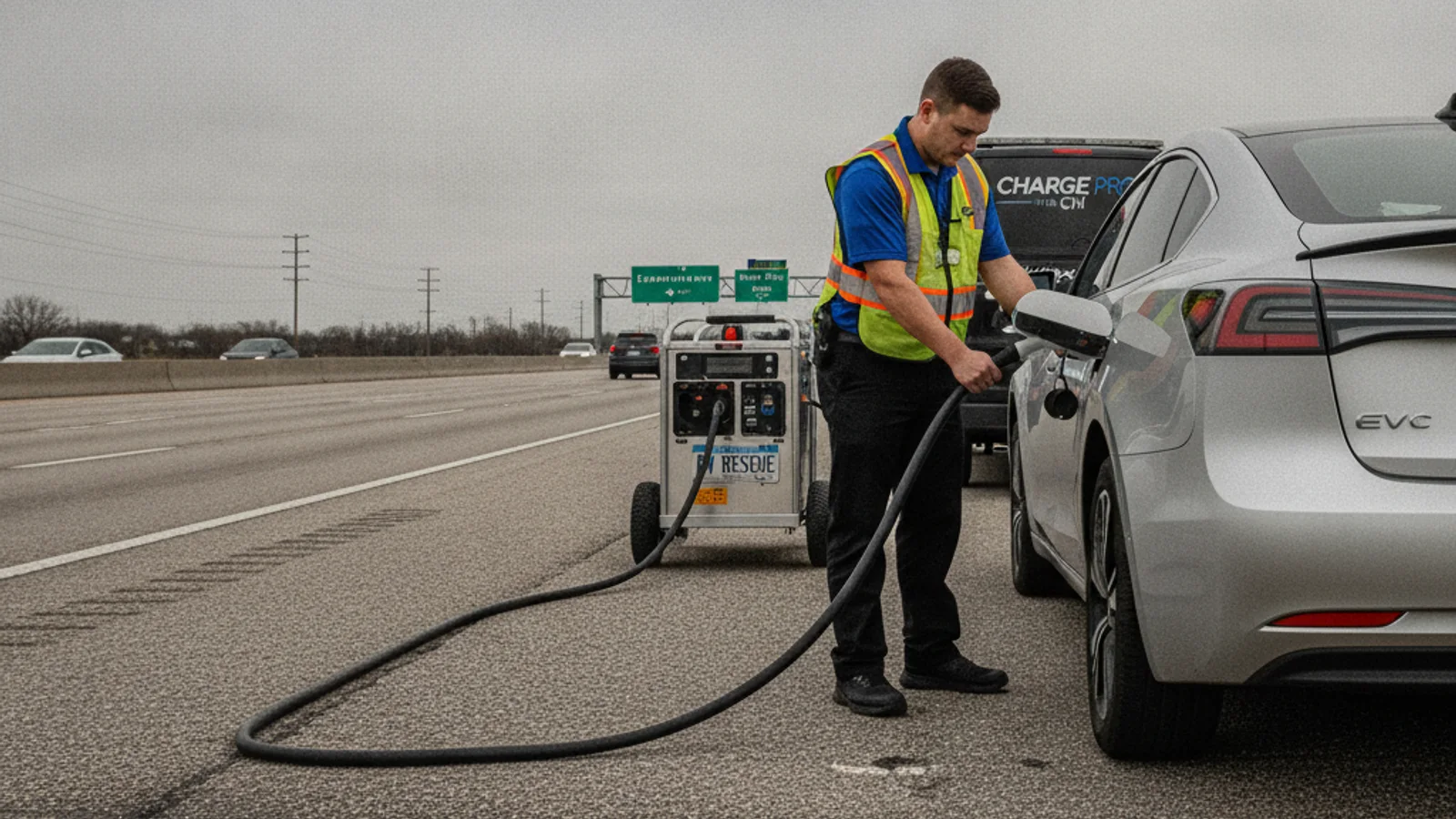
An empty high-voltage pack is the one you watched fall. Range dropped in the crawl, then kept falling. The car went into a low-power mode. Then it wouldn’t keep highway speed. You need energy in the traction battery. That’s out-of-charge recovery, not a tow by default. An operator brings a 240V Level 2 source to the car. Teslas take a native NACS plug. Other EVs use a CCS or J1772 adapter. A typical session adds 10 to 20 miles of range. That takes 15 to 30 minutes of charging. That window is plug time, never an arrival time.
A dead 12V is sneakier than an empty pack. The big pack can still have range. The small battery runs the computers, the contactors, and often the door latch. Lights act odd, or they don’t come on at all. The screen stays black and the car won’t wake. You might be locked out of a car that still has miles. Operators jump or replace that 12V on site. They handle Tesla and every major EV brand.
If you’re not sure which failure you have, say what you see. Give the last range reading you remember. Say whether the dash still boots. Say whether the charge port door will open. The operator quotes the work before anything starts. They bill you directly, not through a brand invoice we set. Charge Pro CHI doesn’t set that price.
A mobile EV charging stop is for the pack. A 12V jump is for a car that won’t even wake. Mixing those up wastes time on the shoulder.
If you’re still rolling
A few miles left is a decision, not a dare. Open your charging app while you’re still in gear. If a station you can actually reach is confirmed, use it. Do that only when the remaining range makes the math obvious. If it isn’t obvious, stop on your own terms.
Don’t aim for home on hope. Don’t ride the left lanes until the car dies in a travel lane. Move right early, while you still have steering authority. Look for a wide shoulder, not a tight smear of pavement. Skip a merge if you can still creep forward. Skip a blind curve if you can still roll a bit. Skip a plaza approach if there’s room ahead to get farther right.
Call while you’re moving if you can do it hands-free. Give direction, last interchange, make, color, and the percent on the dash. That’s enough for an operator to start routing. If you still have miles, read our guide on what to do before you stall.
Illinois Tollway-specific stall rules weren’t in the files we checked. Follow the posted signs on that stretch. If you need an official roadside check, ask Illinois State Police. Ask how they want a disabled vehicle reported. We didn’t find a verified non-emergency number to publish here. Don’t guess a hotline from memory.
Once you’re stopped
Get the car as far right as it will go. Clear the travel lane if the car still has a last creep in it. Put the hazards on right away. Don’t wait to see if the pack recovers.
Stay out of the live lanes the whole time. On a right-shoulder stop, the driver’s door opens toward traffic. Use the passenger side if you have to get out. The safer place to stand is behind the car. Stay away from live lanes and close to the vehicle. Don’t walk the shoulder looking for a better landmark.
Sitting inside with the hazards on is often the better choice. Keep kids on the side away from traffic. If a responder asks you to exit, follow that instruction. Stay to the right of the car.
If someone is hurt, or you’re in a live lane, call 911. That’s the emergency path, not a charging call. Charge Pro CHI doesn’t replace police or a crash response.
Don’t pop the hood and start clamping cables on a guess. Know the jump points for your car. A high-voltage pack isn’t a 12V battery. You don’t jump the orange cables. If you’re unsure, wait for the operator.
What the operator actually brings
Charge Pro CHI doesn’t own trucks and doesn’t send employees to the Reagan. We’re the match, not the crew on the shoulder. The independent operator who takes the job brings a 240V Level 2 source. Teslas use a native NACS plug. CCS or J1772 adapters cover non-Tesla EVs. They can also jump or swap a dead 12V.
They quote you before they start. You pay them directly for the work they do. We don’t publish a brand price list, because we don’t set rates. If a number isn’t in the operator’s quote, it isn’t ours to invent.
A boost is meant to get you to a charger you can confirm. It also covers home if that range is enough. It isn’t a full charge to 100%. Read how a mobile EV charging truck works if you want the hardware picture. If the car needs a flatbed instead, start with charge, jump, or tow.
Tesla, Rivian, Ford, Hyundai, and Kia are in that set. Chevy, VW, BMW, Mercedes, and other major EVs are too. That’s if they take a standard plug. Say the make and model on the call. That way the operator brings the right adapter.
After you’re moving again
Once you have those 10 to 20 miles, keep the drive gentle. Keep climate modest and stay out of sport modes. Head to a station your app shows as working. A home plug you know is live is the other good option. We won’t name a nearest charger on this tollway. That distance wasn’t verified in the files we checked. A wrong pin is how people stall twice.
If the car dies again a mile later, think 12V, not just the pack. A jump that doesn’t hold is a replacement conversation. It isn’t another roll of the dice on I-88.
Wheaton, Elmhurst, Lombard, and Aurora drivers use the same sequence. The Reagan doesn’t care which suburb is on the registration.
Frequently asked questions
What should I do first if my EV dies on the Reagan Tollway?
Pull as far right as you can and turn on the hazards. Stay with the vehicle after that. Don’t walk the shoulder for a better view. If you’re in danger, call 911. Then call Charge Pro CHI so we can connect you with a local operator. Ask for a 240V boost or a 12V jump, based on what you see.
Do local operators help non-Tesla EVs on the Reagan?
The operator brings a 240V Level 2 source. It has a native NACS plug. It also carries CCS or J1772 adapters. Tesla, Rivian, Hyundai, Kia, and Ford are in that set. GM, Volkswagen, and other major EVs are too. Confirm the make and model on the call. They’ll show up with the right hardware.
Should I wait for a tow or take a mobile boost?
If the pack is empty and the car is otherwise fine, get a boost. You stay with the car instead of waiting on a bed. You drive off with 10 to 20 miles. A tow still makes sense after a crash. It also fits a mechanical failure. It fits a pack that won’t accept charge. The operator will tell you if the car won’t take energy. Charge Pro CHI doesn’t perform the work and doesn’t promise which option you’ll need.
If your EV is dead on the Reagan Tollway, call (858) 925-5546. We’ll connect you with an independent local operator. They’ll quote the job before they start, and they bill you directly.