Two regular Teslas can’t charge each other on the shoulder. A Cybertruck, an F-150 Lightning, or another export-ready EV can send power out. Your pack can hit zero on a Chicagoland tollway. Hoping a passing Model Y can top you up isn’t the plan.
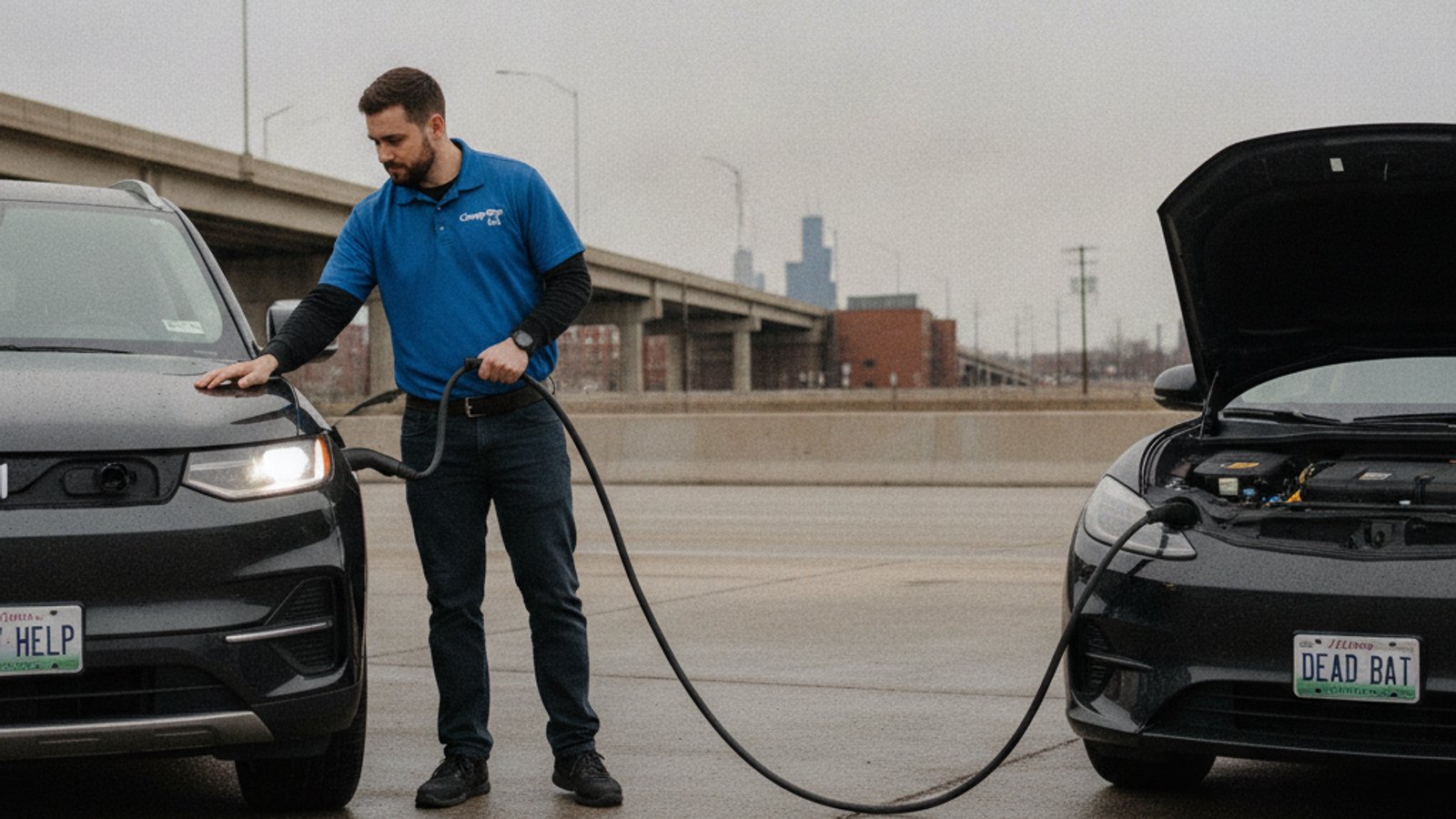
You’ve got a dead EV and another EV sitting right there. Batteries store energy, so sharing some of it sounds simple. Hardware, not hope, decides whether that transfer can happen.
The charge port only accepts power one way on most cars
The big pack under the floor is a tank of stored energy. That doesn’t mean there’s a tap on the outside. The stranded car’s charge port is only an inlet. The helper car has to be a real source.
A source needs an inverter that can run backward. It also needs a real outlet or a vehicle-to-load adapter. Then you still need a cable the dead car will accept. Use NACS, CCS, or J1772, matching the port.
Skip the outlet and the energy never leaves the helper. That’s the usual case on passenger Teslas, a Mach-E, and a Polestar. Job-site trucks are built to feed tools. Those are the cars that can feed another EV.
Passenger Teslas take charge. They don’t give it back
Model 3, Y, S, and X cars take AC from a wall charger. They convert it to DC for the pack. They’re not built to push useful AC back out of that same path.
The 12V lead at the tow eye is only a wake-up circuit. It can help another car’s 12V, but it can’t fill a high-voltage pack. That’s a different voltage, a different job, and a different plug.
Tesla has shown bidirectional charging in public demos. Cars already on Cook and collar-county roads still don’t export. Two Model Ys on the Reagan Tollway can sit nose to tail all afternoon. Neither car can charge the other from its pack.
EVs that can export power right now
Start with what’s actually shipping, not a brochure promise.
A Cybertruck has Pro Power outlets in the bed and the frunk. The bed-wall outlet is a 240V NEMA 14-50. Tesla rates that path up to 9.6 kW.
A Ford F-150 Lightning can feed loads from bed and cab outlets. The standard Pro Power Onboard rating is 2.4 kW. The extended setup raises that to 9.6 kW. See our note on whether a Lightning can charge another EV from the bed.
Hyundai Ioniq 5, Kia EV6, and Kia EV9 use a vehicle-to-load adapter. Rated output on that adapter is 3.6 kW.
Rivian R1T and R1S trucks with the Camp Package add 120V bed outlets. Those 120V outlets are rated at 1.4 kW. It’s camp power, not a highway range fill.
Chevrolet publishes Silverado EV power takeoff at 10.2 kW on multiple outlets. Current Lucid Air cars don’t export power at all.
The split is trucks and a few Korean models versus most commuter EVs. If the car next to you is a Model 3, you’re still waiting.
How much range that transfer actually adds
Kilowatts at an outlet aren’t kilowatts at a Supercharger. Tesla Superchargers run in the 150 to 250 kW class. A 9.6 kW 240V outlet is a trickle next to that.
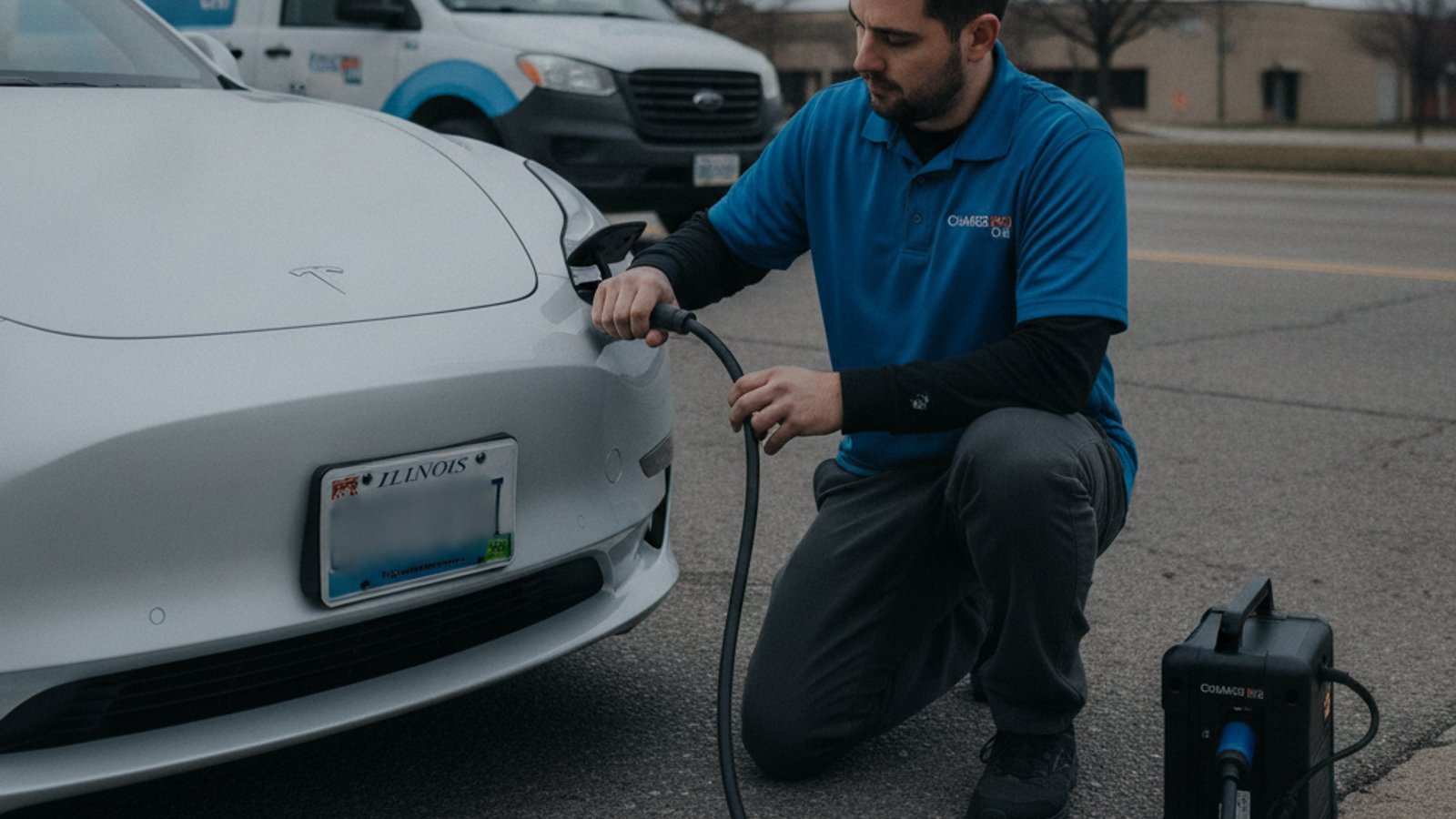
The 9.6 kW path, Cybertruck or extended Lightning, feeds the stranded car’s onboard charger. Miles added depend on the car and the weather. Operators we connect you with typically add 10 to 20 miles of range. That takes 15 to 30 minutes of charging, not travel. Call that charging time, never an arrival time.
Vehicle-to-load at 3.6 kW runs slower than 9.6 kW. Rivian’s 120V outlets are slower than that. Those rates can matter in a driveway in Naperville or a lot in Schaumburg. They’re a weak answer while you’re sitting in a live lane.
That’s why mobile EV charging brings 240V to the car. The pros we send roll a 240V Level 2 source to the charge port. Teslas get a native NACS plug on that boost. Non-Tesla EVs get a CCS or J1772 adapter. You get enough miles to leave the shoulder. You don’t wait for a second EV that might export.
Why a Chicagoland tollway stall is the wrong bet
Chicagoland isn’t one commute with a name swapped. Chicago’s 2024 Census estimate is 2,721,308 people. Drivers also pour in from Cook, Lake, DuPage, Kane, Will, and McHenry.
Inner-ring streets still sit on old housing. Cicero’s ACS share of pre-1980 homes is 90.2%. Berwyn sits at 90.0% pre-1980 housing in the same ACS tables. Oak Park’s ACS pre-1980 housing share is 78.6%. Chicago’s own pre-1980 share is 68.6%. A 240V wall box in those garages is a project, not a default.
Naperville’s ACS pre-1980 share is 11.7%. Newer houses take a home charger more easily. The trip back still uses the Jane Addams, I-55, or I-80. It also uses the Bishop Ford, the Kennedy, the Dan Ryan, or the Tri-State.
That’s where the car-to-car idea shows up. You’re on a limited-access shoulder with traffic at your back. You want a cable running between the bumpers. The second car has to be an export truck. It needs the right outlet and the right cord. If those pieces aren’t there, the transfer never starts.
A stall after work in Schaumburg has the same plug problem. So does a dead pack in an Oak Lawn lot near the Bishop Ford. The second car still has to export power. The useful move on a Reagan Tollway stall is a quoted boost. Then you roll to a charger you can sit at.
A dryer cord isn’t a rescue kit
A NEMA 14-50 looks like a dryer plug. That doesn’t make a household extension cord a vehicle-to-vehicle kit. Cable rating, grounding, and the stranded car’s onboard charger have to match.
Leave the hookup to the operator on scene. They quote you before any cable goes in. They bill you directly after that quote. Charge Pro CHI doesn’t own the truck or the gear. We don’t set the price or hold a trade license. We match you with independent local mobile rescue operators.
If the car is silent and the screens are dark, think 12V. That’s often a 12V fault, not an empty pack. It’s a jump or a replacement on site. Read which battery type matters when you’re stranded. Don’t assume you need a pack transfer first.
What to do instead of waiting on another EV
The pros we send bring a 240V Level 2 source to the car. They handle Tesla and every major EV brand. Typical charging time adds 10 to 20 miles in 15 to 30 minutes. That’s enough to get off the shoulder and reach a charger.
Compare that with hunting a helper EV in traffic. You’d need the right truck and the right adapter. You’d also need a safe place to sit. That’s a lot of luck in Joliet or Elgin. It’s the same bet on I-80 through Will County.
For an empty pack, start with out-of-charge recovery. Then read how a mobile charging truck actually works. City-level pages start at EV charging across Chicagoland.
Bidirectional hardware is spreading on new trucks and some Korean models. Ford already ships vehicle-to-home on the Lightning. Hyundai, Kia, and GM already ship vehicle-to-load. Tesla has shown the same idea in demos. Driveways in Oak Park, Aurora, and Arlington Heights still match that list. Plan around that fleet, not a future brochure.
If you’re stranded now, call (858) 925-5546. We’ll connect you with a local operator who quotes before they start.