A Honda Prologue won’t start after a weekend sit on a Cicero driveway. The 12V died, and the Ultium pack can still hold range. Ready never comes until that small battery wakes. Older housing on those blocks often can’t take a home wall box. The crossover then sits still for days.
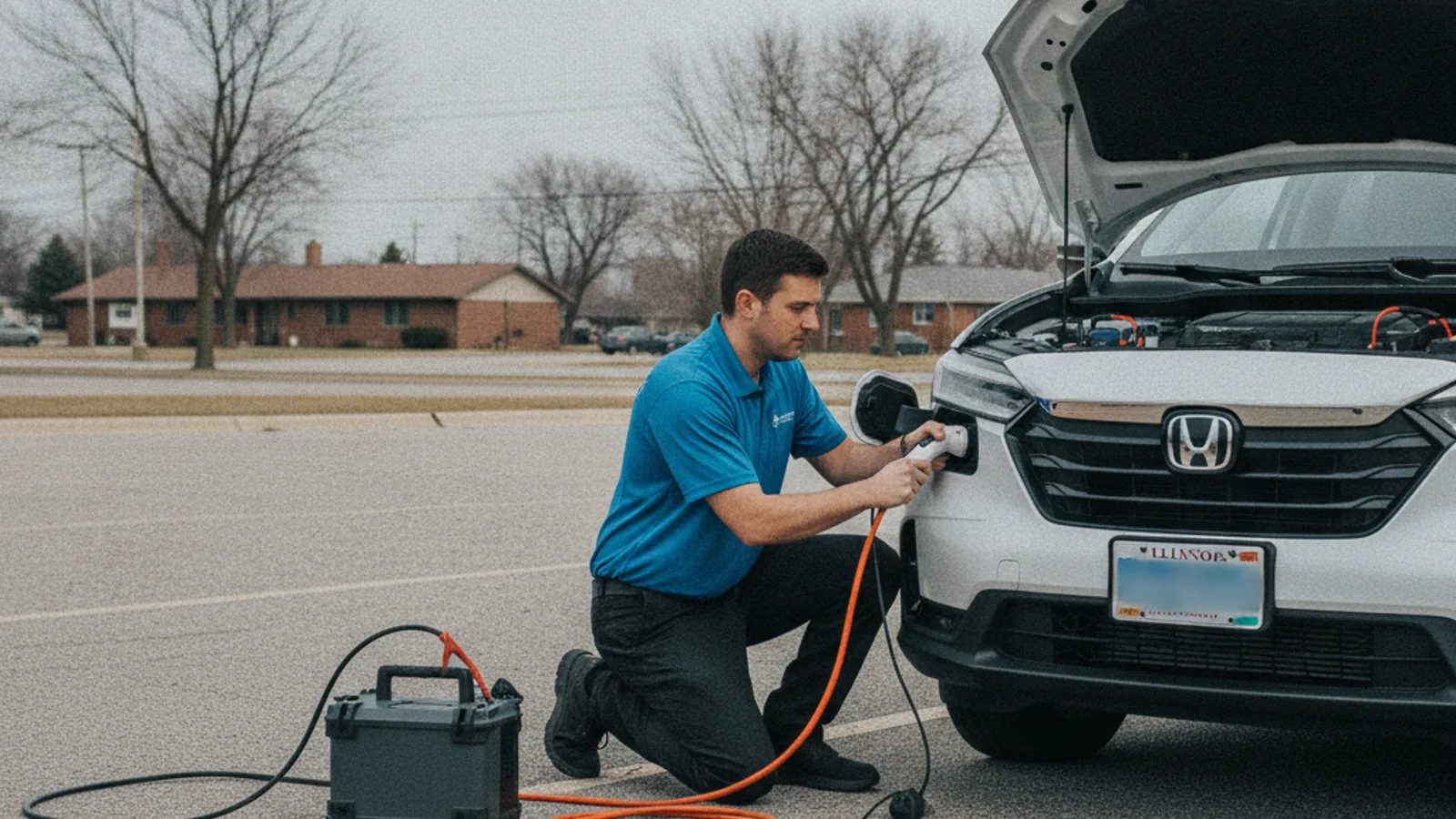
The crossover sat. The 12V paid for it.
A Honda Prologue spends long stretches parked between short trips. It sits after a school run, then through a work shift. The traction pack can stay high the whole time. The 12V still works in the background. Locks, alarms, and body computers sip from it while the car sleeps.
That drain is quiet, and you don’t get a loud warning every time. Some owners see a dim dash first. Others walk out to a dark cabin and a mute fob.
Cicero’s 2024 population estimate is 82,090. ACS 2019-2023 puts pre-1980 housing at 90.2% there. Berwyn is 90.0% on the same tables. Those blocks are the local version of a long sit. A home Level 2 wall box is often not a fit for that housing. Home EV charging in Cicero walks that housing limit. The Prologue then lives on a 120V outlet, or it sits unplugged.
Oak Park is 78.6% pre-1980, and Evergreen Park is 87.7%. Chicago is 68.6% on those same ACS tables. The housing is old, the sit is long, and the 12V is the first suspect.
Sort the 12V from the Ultium pack
Every Prologue runs two electrical systems. The Ultium pack turns the motors. The 12V runs lights, locks, and the computers that close high-voltage contactors. If the 12V is gone, those contactors never close. The car can’t start, and it often can’t charge. It often won’t unlock either.
The Honda Prologue shares that layout with other Ultium crossovers. The Acura ZDX is the mechanical twin. The Chevy Blazer EV and Equinox EV sit on the same architecture. A 12V no-start on one of those cars is the same kind of failure. Acura ZDX no-start checks cover the twin. Chevy Equinox EV no-start checks cover the GM sibling.
Read the cabin before you blame range. Total darkness and a mute fob usually mean the 12V is gone. Doors that still unlock with a black screen often mean a weak 12V. A screen that flashes and dies can be a module boot loop. A normal screen with a service warning points at Ultium. A locked charge-port icon is a latch fault, not a dead pack.
A charge readout that still works is showing the pack, not a 12V test. Treat it as one data point, then look at lights, locks, and the display. What you see when an EV 12V dies maps the same split.
Honda’s published 12V replacement interval could not be confirmed from the research on this page. Check the owner’s manual, or ask a Honda dealer what they publish for your model year.
What the cabin is telling you
Stay with the car if the spot is safe, then match what you see.
| What you see | Likely cause | Next step |
|---|---|---|
| Cabin dark, fob mute | Dead 12V | Open the hood, jump the labeled posts |
| Dim lights, Ready never comes | Weak 12V | Same jump, then get the battery tested |
| Dash is bright, range near zero | Empty Ultium pack | Need a charge, not a 12V jump |
| Dash is bright, charge session fails | Charge fault | Try another station or an on-site boost |
| Jump works, car dies again in days | Drain or DC-DC fault | Dealer diagnosis |
Dim power that never reaches Ready is a weak 12V. A fully dark cabin is a 12V that’s already flat. Either way, start with the small battery.
A bright dash with range near zero is the other job. That’s an empty pack, so a jump won’t add miles.
Wake the 12V under the hood
The Prologue keeps its 12V under the hood. That’s the same general area as a gas Honda. Labeled jump terminals sit there for this job. You are jumping the small battery. You are never jumping the high-voltage pack.
Get the hood open first. If the car is fully dead, the interior release may not work. Check the owner’s manual for emergency hood access on your model year. Don’t pry a latch.
Once you can see the labeled positive and negative points, connect a portable jump pack. A gas donor car can also feed those points. Don’t pull power from another EV’s drive battery. Don’t touch the orange high-voltage cables.
After the dash comes up, leave the car awake for a few minutes. Then disconnect and drive it. The DC-DC converter can refill the 12V from the pack once the car is running. Don’t shut it down in the same stall and walk away.
Keep the clamps on the labeled 12V jump points only. Keep them off the orange cabling. Stop if a terminal looks melted, loose, or badly corroded. How to jump start an electric car in winter is the cold-weather version of that habit.
If a jump works and the car dies again in a few days, stop repeating it. That loop can mean a drain or a DC-DC fault. Those need a dealer, not another driveway jump.
Newer suburbs still get the same dark cabin
Newer housing doesn’t cancel a weak 12V. Naperville’s pre-1980 share is 11.7%. Gurnee is 9.5%, Plainfield is 6.7%, and Huntley is 3.8%. The garages are often larger, but the chemistry is the same. A cold week in a two-car garage still flattens a tired 12V.
Schaumburg is 15.9% pre-1980, and Arlington Heights is 42.0%. The car can sit through a full workday there, then sit again at home. Orland Park is 11.8% pre-1980, and Tinley Park is 17.2%. A weekend sit does the same work on the 12V.
Lake County mixes the pattern. Waukegan is 54.0% pre-1980, and Highland Park is 60.6%. Evanston is 71.2%, Skokie is 72.0%, and Wilmette is 74.3%. A Prologue that sat in those garages overnight is a 12V suspect first.
Aurora is 33.1% pre-1980, Elgin is 41.5%, and Joliet is 39.0%. The 12V tracks how long the car slept. It doesn’t track which county line you crossed.
When the pack is empty, or a session failed
Sometimes the Prologue starts and still won’t go far. Sometimes it wakes and still won’t take a charge. That’s not the same as a dead 12V.
If the dash is bright and Ready comes on, look at range. Range at or near zero means the Ultium pack needs energy. The Prologue uses a CCS or NACS charge port. The fix is getting energy back in. A public station can do that, and so can an on-site 240V boost.
If the dash is bright and charging refuses to start, that’s often an Ultium charge fault. The same pattern shows up on the Blazer EV and the Equinox EV. Try a different station if you can get there. Don’t keep retrying the same failed plug.
If the connector won’t unlatch after a session, treat that as a port problem. Ice and slush can hold a latch. Clear the port before you assume the car is dead.
A Level 1 overnight that quietly stopped is another local fork. DOE puts Level 1 near 5 miles of range per hour. The session can quit while the 12V keeps drawing. Confirm the outlet actually delivered power. Then decide whether you need a 12V jump or a pack boost.
After Ready comes back
A successful jump is a start, not a repair. Have the 12V load-tested. If a Honda store replaces the battery, ask them to check for a quiet drain.
If the 12V was never the problem, a jump won’t create range. You’ll still need a charge. Independent local operators can bring a 240V Level 2 source to the car. On a Prologue they use a CCS or J1772 adapter. They can also use NACS if that’s your port. A typical connection adds roughly 10 to 20 miles of range. That takes 15 to 30 minutes of charging. That’s charging time, never an arrival time.
Non-Tesla EV rescue is the path for Ultium crossovers, including the Prologue.
Charge Pro CHI is a referral line. It matches stranded EV drivers with independent local mobile rescue operators. It doesn’t hold a license, own trucks, or employ technicians. It doesn’t set prices or publish hours. The operator quotes you before starting and bills you directly.
The pros we connect you with are licensed and insured. They handle Tesla and every major EV brand, including the Prologue. On a no-start, on-site work can include a 12V jump or a 12V replacement. If the pack is empty, they bring the 240V Level 2 source described above. The operator’s vehicle uses a 240V, 9.6 kW bed outlet with the right adapter.
What moves the operator’s quote is distance, time of day, and how much range you need. Ask before they start. The operator quotes you before any work begins.
Call (858) 925-5546 when you want that match. Say it’s a Honda Prologue that won’t start. Mention whether the fob is dead, whether the screen is dark, and how long the car sat.
Frequently asked questions
Why won’t my Honda Prologue start if the pack is charged?
A charged Ultium pack doesn’t start the car by itself. The 12V wakes the modules that close the high-voltage contactors. If that small battery is dead, Ready never comes. The car often can’t charge or unlock either. A 12V jump is the first fix to try.
Can I jump a Honda Prologue like a gas car?
You jump the 12V, not the high-voltage pack. The Prologue has labeled jump terminals under the hood. A portable jump pack or a gas donor car connects there. Never clamp onto the orange cables. If the hood won’t open, use the emergency path in the owner’s manual.
Is the Honda Prologue the same car as the Acura ZDX?
Mechanically, they’re twins on GM’s Ultium platform. They share the same 12V dependency and similar charging behavior. The Chevy Blazer EV and Equinox EV sit on that architecture too. A 12V jump that works on one of those cars usually applies to the Prologue.