Tesla high-voltage packs are built to last the life of the car. In Chicagoland, winter street parking is the harder overnight. A garage stay is gentler on the same cells. Most owners still see slow, modest aging, not a pack that falls apart. What shows up first is a cold curb sit, then short morning range. That isn’t the same as a pack at end of life.
Curb nights versus a garage in this climate
The pack sits under the floor and tracks the air around it. A Model 3 left on a Chicago street overnight stays as cold as the block. The same is true in Skokie or Oak Park. The same car in a Naperville garage starts the day sheltered. You feel it as less range on the first trip. A cold sit at a low charge is harder than a mid-charge sit indoors.
Housing age is the local tell. ACS 2019-2023 figures put Cicero pre-1980 housing at 90.2%, and Berwyn at 90.0%. Oak Park is 78.6%, Wilmette 74.3%, Evanston 71.2%, and Chicago 68.6%. Older blocks more often mean curb parking. Newer towns look different on that measure. Naperville’s pre-1980 share is 11.7%, and Gurnee’s is 9.5%. Plainfield sits at 6.7%, and Huntley at 3.8%. More of those owners can keep the car inside.
A Waukegan street park isn’t a Wheaton garage night. Northbrook and Glenview skew newer than Wilmette. Oak Lawn and Chicago Heights carry more pre-1980 stock than Bolingbrook. The pack doesn’t care about the suburb name. It cares whether it sat cold, full, empty, or in the middle.
If the car is a brick, check the 12V first
People search this topic and describe a different failure. The floor pack stores the driving range. A small 12V battery wakes the car. Locks, the screen, and the contactors all depend on it. That 12V usually needs attention every few years. The main pack is the long-life piece. If the app still shows miles, look at the 12V. If the car won’t unlock, that’s the 12V path. Read how to tell a dead Tesla pack from a 12V that won’t wake the car. That guide covers the split. Slow range loss over years is different. That’s the pack-aging question this post answers.
What ages the main pack faster than the odometer
Miles alone are a weak predictor. Charge habits and overnight conditions do more.
Tesla’s published daily guidance is still the one to follow. Keep most days in a middle band. That’s about 20% to 80%, and 100% is for trips. Don’t store the car full for long stretches. Don’t store it near empty for weeks. Winter curb parking makes the empty sit easy. You get home late off the Eisenhower. You crawl the Dan Ryan and skip the plug. The car then sits low until morning.
Supercharging isn’t the enemy of pack life. Occasional DC fast charging is normal. Using it as the only charge is harder. Day after day of DC heat cycles the cells more. Mix in slower charging when you can. See how long it takes to charge a Tesla in Chicagoland for session length.
A car that sits for weeks at a very low charge is a winter problem. A mid-charge sit is gentler on the chemistry.
Cold doesn’t kill the pack the way a viral post claims. It does cut available range while the pack is cold. It also makes a low overnight sit more punishing. How long a Tesla charge lasts through a cold Chicagoland day tracks usable miles. How to care for an EV battery through an Evanston winter covers the same physics.
How to read pack health without a phone-style score
Most Teslas don’t show a single battery-health percentage like a phone. Compare the car’s current max range with the original rated range. Use the figure for that configuration. A small gap after the early years is ordinary aging. A sudden, large drop is a fault. That’s a service visit, not a scolding.
Cold mornings lie about remaining pack life. A pack that looks short in a Glenview driveway often recovers indicated range. That happens once it’s warm and moving. Judge health on a warmed car. Don’t judge it on the first block from a Park Ridge curb.
High-mileage used Teslas in this metro
High miles scare buyers more than they should. After the early change, most packs age slowly. Ask for the current max range in the car. Compare it with the original rating for that model year. A modest gap is wear. A steep gap is a problem to solve before you buy.
Tesla’s battery coverage follows the vehicle. It doesn’t reset on the sale date. Confirm what’s left on Tesla’s site for that VIN. Read what Tesla’s battery warranty covers, and what a roadside boost is for. That post separates pack terms from the 12V. Charge Pro CHI doesn’t write those terms: Tesla does.
When the pack is healthy and you still can’t move
A pack that still has years in it can still leave you stuck. Zero displayed miles on Lower Wacker is an energy problem. The same is true on I-55, and that isn’t end of life. A 12V that won’t close contactors is a different call. Charge Pro CHI is a referral line. It matches stranded drivers with independent mobile operators. It doesn’t employ technicians or own trucks. It also doesn’t set prices. The operator quotes you before work starts and bills you directly.
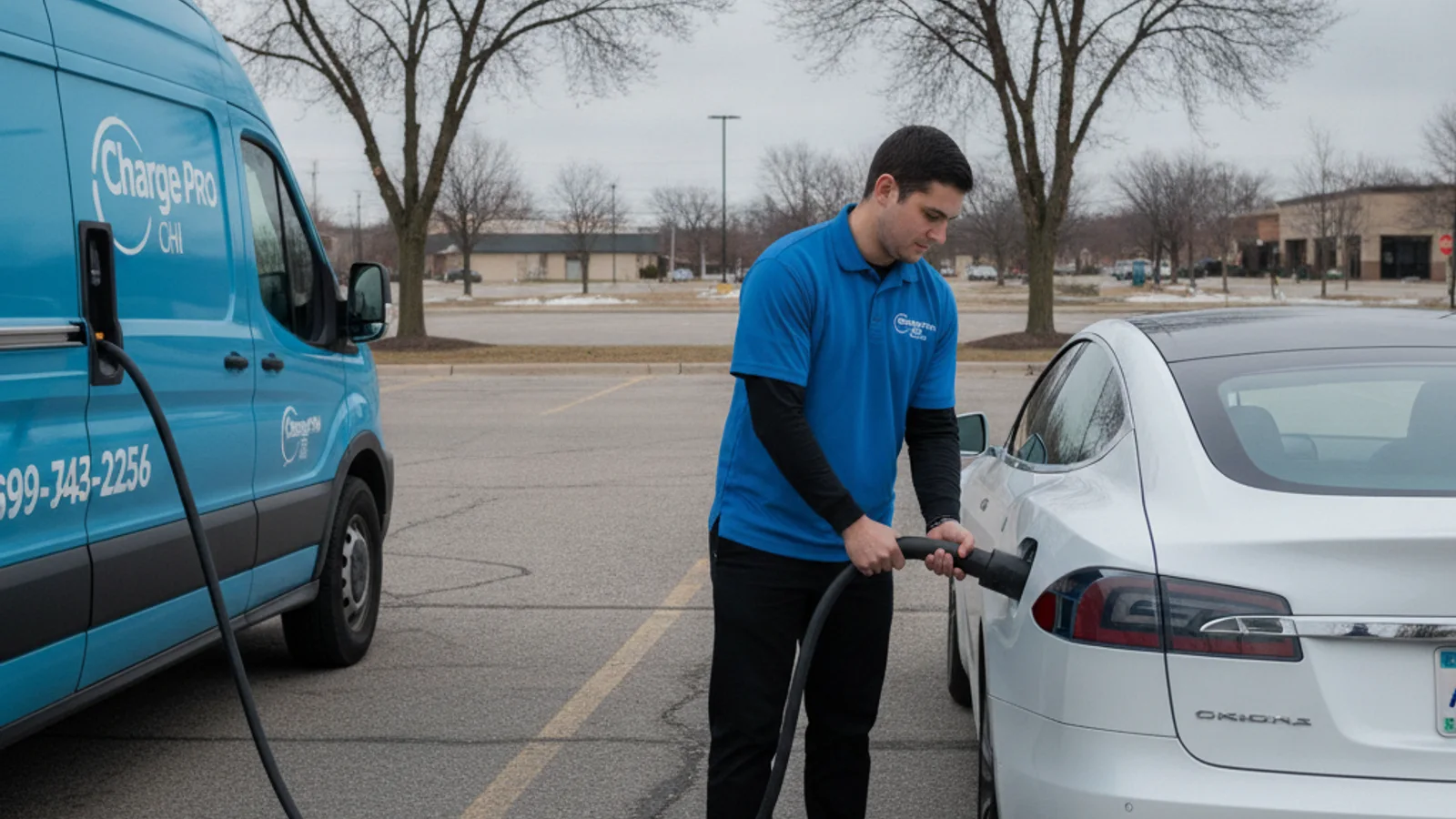
Those operators bring a 240V Level 2 source to the car. They typically add 10 to 20 miles of range. That’s in 15 to 30 minutes of charging. That’s plug time, never an arrival time. They can jump or replace a 12V on site. They don’t swap a high-voltage pack at the curb.
If the symptoms point at a pack, not a 12V, keep reading. When a Tesla needs a pack replacement, not a 12V rescue sorts those signs. For a stall already in progress, use Tesla roadside rescue.
Frequently asked questions
How long do Tesla batteries last in this climate?
The high-voltage pack is built to last the car. Winter curb parking here is harder than a garage stay. Watch overnight charge and cold sits. Don’t watch the odometer alone.
Does street parking in winter ruin a Tesla pack?
It doesn’t wreck a healthy pack by itself. Repeated cold sits at a low state of charge are harder. A sheltered mid-charge sit is easier. Plug in when you can, even on a slow circuit.
Which battery dies first, the pack or the 12V?
The 12V almost always needs work first. The main pack is the long-life component. A no-start with range still showing is usually the 12V.
If your Tesla won’t wake up, call (858) 925-5546. If you’re stuck with no usable range, use that number too. Charge Pro CHI will connect you with a local operator. That operator quotes you before any work starts.