A Model Y sits dark after a freeze in an Oak Park driveway. The screen stays black and the handles never pop. The owner types how much is a Tesla battery and pictures a pack swap. In Chicagoland, that search usually points at the 12V, not the floor pack.
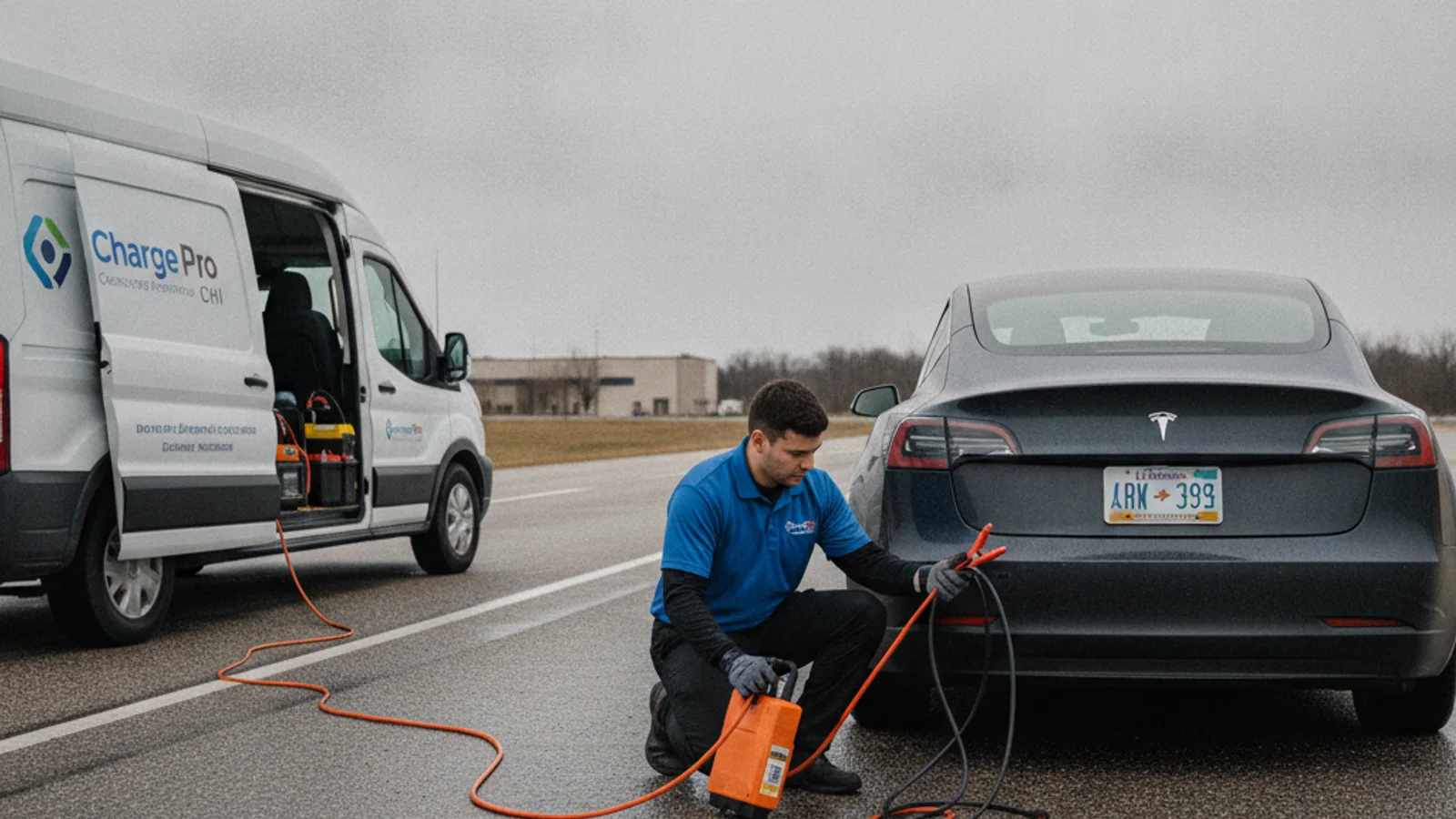
Two batteries, and they fail in different ways
Every Tesla on these roads carries two electrical systems. The pack under the floor moves the wheels. The 12V battery wakes screens, locks, and contactors. When that 12V dies, the car can look fully dead. Range can still sit on the main pack. That’s why the search mixes the two jobs together.
Check the 12V before you plan a pack job
If the car won’t wake, start with the 12V. See whether the Tesla app still finds the vehicle. Try the charge port from the key fob. Listen for a faint click from the front trunk. How to tell a dead pack from a dead 12V lists those tells in order. A Tesla 12V jump is work a mobile operator can do on site. A pack swap isn’t.
Winter here is hard on that small battery. Overnight sits in Naperville driveways drain that 12V. So do Schaumburg office decks and Chicago side streets. Oak Park’s housing is 78.6% pre-1980, and Chicago’s share is 68.6%. Older garages can make a wall connector a bigger electrical project. That doesn’t make the floor pack fail. It does mean cars sit unused, then refuse to wake on a cold morning.
A pack swap is shop work, not a roadside call
The high-voltage pack lives in the floor structure. Replacing it means a lift and high-voltage isolation. Tesla service or a shop built for EV pack work handles that. Charge Pro CHI is a referral line, not a repair shop. We match stranded drivers with independent local operators. Those operators bring a 240V Level 2 source to the car. They jump or replace a dead 12V on site. They don’t pull packs or judge cell groups inside them.
No public figure covers every Tesla
Tesla doesn’t publish one pack-replacement price for every model. No verified out-of-warranty pack price for this metro turned up on Tesla’s public pages. Forum threads mix model years, salvage cars, and partial repairs. None of that is a quote for your VIN.
What moves a shop’s number is specific to the car. Model and pack size matter on every quote. Model S and Model X packs are larger than Model 3 and Model Y packs. A module repair, if it’s possible, is a different job than a full swap. Labor at that service center changes the quote. Remaining Battery and Drive Unit warranty changes it too. So does the cause: a defect, a crash, or water. Ask Tesla service or a qualified independent EV shop to inspect the car. Get that quote before anyone orders a pack.
Roadside work is a separate quote from any shop pack job. The operator tells you the amount before starting, then bills you directly. Distance, time of day, and the range you need all change a mobile boost. They don’t set Tesla’s shop price for a pack.
Warranty is why most owners never buy a pack
Tesla’s Battery and Drive Unit Limited Warranty runs 8 years. Mileage caps depend on the model, and some variants go up to 150,000 miles. Defects inside that window usually go through Tesla. They don’t start as an out-of-pocket pack order. Model-by-model terms are in our pack versus 12V warranty guide.
Warranty covers defects, not crash or flood damage. If the car took a hit on the Dan Ryan, call the auto insurer. The same is true if it sat in standing water. Collision coverage and other physical-damage coverage on the policy are the desks to try. Have Tesla or an EV shop inspect the pack before anyone writes the car off. A scraped underbody isn’t always a full pack order.
Packs fade slowly, and no-starts are usually the 12V
Ordinary miles wear range down slowly over years. A sudden dark car is a different pattern. How long Tesla batteries last in this climate covers that slow fade. A true pack failure is more often crash damage, water, or a warrantied defect. It isn’t the typical cold start in Waukegan or Joliet.
Module work stays on a lift
Some failures hit one module group inside the pack. A shop may repair that section without a full swap. Only Tesla service or a qualified EV shop can say if that’s possible. A rescue van can’t open the high-voltage pack. If range still shows and the car stays dark, treat it as a 12V clue.
When you’re already stranded
Stay with the car if you’re on a shoulder. In a lot in Orland Park, note a landmark for the operator. Do the same in a Schaumburg parking deck. Open the Tesla app and check rated range. If range looks healthy and the cabin is dark, ask for a Tesla 12V jump. If the pack itself is empty, ask for a 240V mobile charge. Operators typically add 10 to 20 miles in 15 to 30 minutes of charging. That window is charging time, never travel time.
Cold nights push more owners onto the 12V path. Replacement versus a jump after a freeze covers what that looks like on site.
The operator quotes you before any work starts. Charge Pro CHI doesn’t set that amount.
If you’re stuck and not sure which battery failed, call (858) 925-5546. Say what the app shows, and whether the car will wake.
Frequently asked questions
How much is a Tesla battery if the pack needs replacing?
Tesla doesn’t publish one metro-wide figure. Confirm the current quote with Tesla service or a qualified EV shop for your VIN. Model, pack size, and partial versus full work all change it.
Does Tesla’s warranty pay for a new pack?
Often, if the failure is a defect inside the 8-year Battery and Drive Unit window. Mileage limits vary by model. Crash and flood damage go through the auto insurer instead.
Is a 12V job the same as a pack swap?
No, the 12V is the small battery that wakes the car. The pack is the floor-mounted high-voltage unit. A dark Tesla after a cold night is usually the 12V. The pros we send can jump or replace that 12V on site. They can’t swap the main pack at the roadside.