A Hyundai Kona Electric that won’t start in Chicagoland is usually a 12V problem. The traction pack can still hold a usable charge. The small auxiliary battery is too weak to wake the computers. On a cold morning it looks like a brick. Dark dash. Silent cabin. A fob that does nothing.
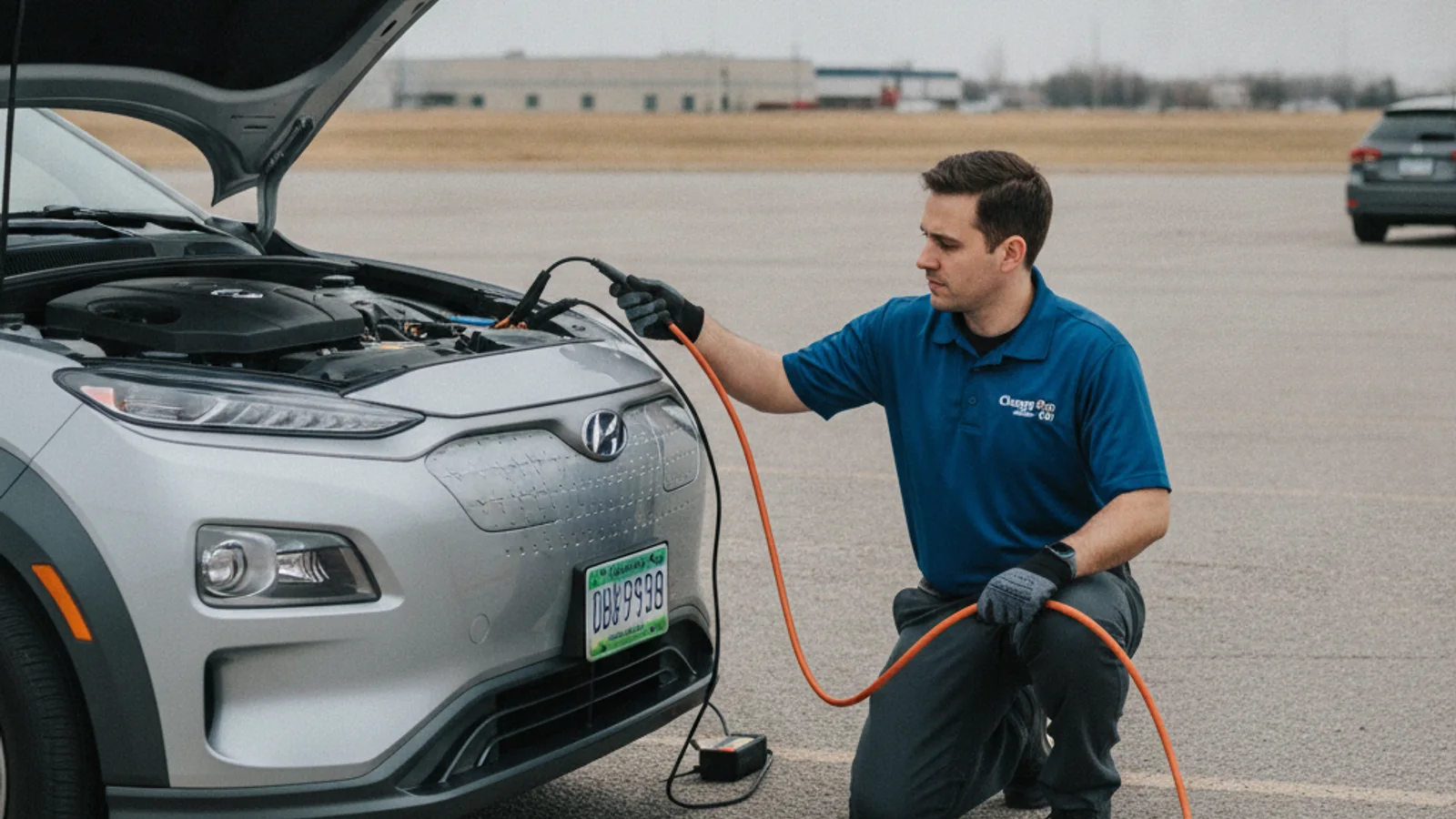
The electric Kona can run that 12V down harder than some other EVs. Sleep logic after a software update can leave modules awake longer than you think. Add an Illinois winter and an AGM battery that’s a few years old. The car can refuse to start with half a pack still showing.
This climate hits the 12V first
Chicagoland cold is the usual trigger, not heat. Chemical activity in a 12V AGM slows as the temperature drops. Available current falls. The Kona Electric still needs that current to close the high-voltage contactors. Those are the big switches that connect the main pack. No 12V means no Ready light, no drive, and no charge door.
Where the car slept matters. Chicago’s housing stock is old. 68.6% of units were built before 1980. Oak Park is 78.6%. Berwyn and Cicero sit near 90%. Those blocks mean more street parking and more unheated brick garages. More cars sit outside from dinner until the morning commute. A Kona Electric that spent the night well below freezing asks a tired 12V to do its hardest job at its weakest hour.
Newer suburbs change the garage, not the chemistry. Naperville’s pre-1980 share is only 11.7%. Gurnee is 9.5%. Plainfield is 6.7%. A heated garage helps. It doesn’t rescue a 12V that’s already aged out. Owners in Naperville, Wheaton, and Downers Grove still get no-starts after a string of short, cold trips.
Lake County follows the same split. Highland Park’s pre-1980 share is 60.6%. Libertyville is 34.7%. Waukegan is 54.0%. Cold nights treat those batteries the same way.
Make sure the Kona in front of you is the EV
Hyundai sold the Kona as gasoline, hybrid, and electric. A no-start means different things in each. This checklist is only the electric one. If you have a fuel door and a bay full of engine, you want a conventional jump and a regular shop.
US Kona Electric production starts with the 2018 model year. From 2019 on, Hyundai added a 12V Battery Save setting. That menu only exists if the screen still has power. If the cluster is black, skip the settings hunt. Go to the jump points.
Read the car before you call anyone
Stand at the driver’s door. Tap the fob. Try the interior lights. Then press Start/Stop with your foot on the brake.
No click, no glow, no cluster: treat it as a 12V fault. The charge port door may stay shut because the latch is electric. Hunting a public plug won’t help if the door won’t open. The computers are asleep.
Some life on the dash, plus low-range messages, means the pack is the problem. The 12V did its job. You need a boost, not a jump. The mobile EV charging operators we connect you with bring a 240V Level 2 source to the car. They typically add 10 to 20 miles of range in 15 to 30 minutes of charging. That number is charging time. It’s not an arrival window.
For the broader split between the little battery and the pack, see which EV battery type matters when you’re stranded.
What each failure looks like on the Kona Electric
| What you notice | Weak or dead 12V | Empty traction pack |
|---|---|---|
| Dash stays fully dark | Typical | Rare. You usually see alerts |
| Fob ignores the doors | Typical | Unlikely |
| Cabin lights stay off | Typical | Unlikely |
| Ready light never comes on | Yes | Yes |
| You rolled a few miles, then it quit | No | Yes |
| Range warnings came first | No | Yes |
| Charge door still opens | Often no | Usually yes |
If the cluster is dead, stop thinking about chargers. Restore 12V power first. If the cluster is alive and the range figure is the problem, skip the jump pack and book a boost.
Where the 12V actually sits
Hyundai put the Kona Electric’s 12V in the under-hood bay, on the driver’s side, toward the rear of the compartment. It’s a standard AGM, roughly the size of the battery in a compact gas car. That’s more reachable than a frunk tray or a hide under the cargo floor.
Look for a plastic tray and a hold-down strap or bracket. The positive post has a red cap. The negative is bare or under a black cover. The bay is tight, and you’re working next to other hardware.
The interior hood release needs 12V on many cars. If the battery’s fully dead, the latch may not fire. The owner’s manual shows an emergency hood release. On a lot of Konas it’s a pull near the driver-side fender, reached through the grille. Don’t pry the panel.
Jump the marked terminals
The Kona Electric has dedicated jump points under the hood. Use those. Don’t clamp onto a painted bolt and hope.
You need a portable jump pack made for cars, or cables from a gasoline vehicle. Don’t use a second EV as the donor. EVs aren’t designed to source that kind of current. You can throw faults on the car that’s trying to help.
Work in this order:
- Open the hood with the interior handle, or the emergency release if you have to.
- Pull the red cap off the positive jump terminal on the fuse box cover, driver’s side of the bay.
- Find a clean, unpainted metal ground on the chassis. A shock-tower bolt is a common pick. Skip the battery’s own negative post if you have a better ground.
- Connect the positive clamp to the Kona’s positive terminal, then to the pack or donor positive.
- Connect the negative clamp to the pack or donor negative, then to the Kona’s chassis ground.
- Let current flow for a couple of minutes before you try to start.
- Foot on the brake. Press Start/Stop. The Ready light should come up in a few seconds.
The winter walkthrough on how to jump start an electric car covers the same safety rules that apply across brands, including the Kona Electric.
Once it starts, get it to a Level 2 plug and leave it connected for at least an hour. While the car charges, the high-voltage pack trickle-feeds the 12V. If the same 12V dies again the next morning, the battery’s finished. A jump is a bridge. Replacement is the fix. EV 12V battery replacement signs walks through what that looks like on the shoulder or in a lot. If it fails again after a jump that worked, read what to do when an EV 12V dies again.
12V Battery Save, and the limits it has
On 2019 and newer Kona Electrics, Hyundai added a 12V Battery Save control. The path is usually Settings, then Vehicle, then Charge Settings, then 12V Battery Save. Labels shift a little by year and trim.
When the setting’s on, the car borrows a small amount of current from the traction pack to hold the 12V above a cutoff. Think of it as a get-home feature. It’s not a new battery.
Three limits matter in this climate:
If the 12V is already dead, the screen is dead, so the menu’s gone. You have to jump first.
If you keep turning Save on after every cold night, the 12V is aging out. Replace it instead of leaning on the traction pack.
After a jump on an old battery, turn Save on for the drive to a charger or a Hyundai shop. Then schedule the replacement. Don’t treat the setting as a winter-long workaround.
Sleep behavior can change after a software update. Modules that used to go quiet may stay awake. If the 12V started dying in the days after an update, tell the dealer and bring the car in.
Short winter trips starve the 12V slowly
The Kona Electric uses a DC-DC converter to keep the 12V topped from the traction pack while you drive. That refill needs time. A ten-minute hop from a Berwyn street to a Cicero lot, then another short hop home, may never give the converter a full cycle in January. The dash still looks fine. Two weeks later the car’s dark.
Owners who mainly crawl local streets in Chicago, Skokie, or Park Ridge see this more than people who run a longer highway commute. The fix isn’t a mystery charger. It’s an occasional longer drive, or a Level 2 session overnight, so the 12V gets a real top-off with the pack.
Schaumburg, Arlington Heights, Elk Grove Village, and Hoffman Estates add a different sit: the all-day office or warehouse lot. The car sleeps for nine hours in a January wind. You come out, tap the fob, and get nothing. The last range figure you remember was nowhere near empty.
Naperville, Aurora, and Joliet commuters get the mixed version. A garage at home, a cold lot at work, and a string of short after-school stops. The 12V fails at the last stop, often in a grocery or school pickup lane. That’s a bad place to run cables.
Evanston, Wilmette, and Glenview add older housing in Evanston, where 71.2% of units predate 1980. A Kona Electric that sat through a deep freeze will often need the 12V before it needs a pack boost.
Stay out of traffic if you can’t work safely
A jump needs space around the nose of the car. If you’re in a live travel lane, a tight city garage, or a stall with cars on both sides, don’t stretch cables through a walkway. Call for help and wait somewhere safe.
An operator we match you with can jump on site, or, if the pack is the problem, run a non-Tesla EV rescue. They quote before they start. They bill you directly. Charge Pro CHI doesn’t own trucks, doesn’t employ technicians, and doesn’t set prices.
Have a clear story ready. Dark dash versus a cluster full of warnings is the split that decides jump versus boost. Mention the model year if you know it. Mention whether the car sat for a weekend. Mention a recent software update if you had one.
If the jump doesn’t wake it
A correct jump that still leaves a dark Kona Electric usually means one of three things. The 12V won’t hold any charge. A fuse in the junction box is open. Or, less often, the battery management system won’t enable the high-voltage side.
Those cases need a Hyundai dealer or an EV shop, and often a flatbed. Tell the tow operator it’s an EV and that it may have no power for Park. Neutral and wheel dollies matter. Don’t drag it.
The same 12V-first pattern shows up on Hyundai’s other electrics. If the car in the driveway is an Ioniq 5, use the Ioniq 5 no-start checks instead of this Kona page.
When the pack is empty instead
Once the 12V is healthy and Ready still won’t hold, look at the range figure. If you already had low-range warnings, treat it as an empty pack. A mobile 240V boost is the on-site path. Operators bring a Level 2 source, a native NACS plug when the car has one, and CCS or J1772 adapters for everyone else. Most US Kona Electrics use CCS.
Fifteen to thirty minutes of charging is typically enough for 10 to 20 miles. That’s meant to reach a plug you already use at home, at work, or at a station you trust. It’s not a full fill.
Stay with the car if you can do it safely. Bring the fob. If you carry a charge-port key, have it in hand. Know whether the dash was dark or full of warnings before anyone arrives.
Frequently asked questions
How do you jump start a Hyundai Kona Electric?
Use a car-rated jump pack on the dedicated positive terminal under the driver-side fuse box cover. Ground to clean chassis metal, not a painted panel. Wait a couple of minutes, then press Start/Stop with your foot on the brake. Don’t jump it from another EV. After it starts, plug into Level 2 so the 12V can recharge from the pack.
Why does a Kona Electric refuse to start in this climate?
Cold cuts what an AGM 12V can deliver. The Kona Electric’s computers need that 12V to close the high-voltage contactors. Street parking and unheated garages in older Cook County housing leave the battery sitting at its worst temperature overnight. Short winter trips don’t always refill it. A pack that still shows 50% range can sit behind a 12V that’s already done.
What does 12V Battery Save do on a Kona Electric?
It siphons a little energy from the traction battery to keep the 12V above a minimum. You’ll find it under Settings, Vehicle, Charge Settings on most 2019-and-newer trims. It won’t run on a fully dead 12V because the screen is off. If you need it often, replace the battery.
If the Kona Electric is dark and you’re stuck in Chicagoland, call Charge Pro CHI at (858) 925-5546. We’ll match you with a local mobile rescue operator. They confirm the quote with you before they start.