When a Jaguar I-Pace won’t start, check the 12-volt battery first. The traction pack is usually still fine. The small battery just can’t wake the computers. Handles stay flush, the fob does nothing, and the dash stays black. You aren’t looking at a failed pack in most of these stalls. You’re looking at a 12V that quit overnight.
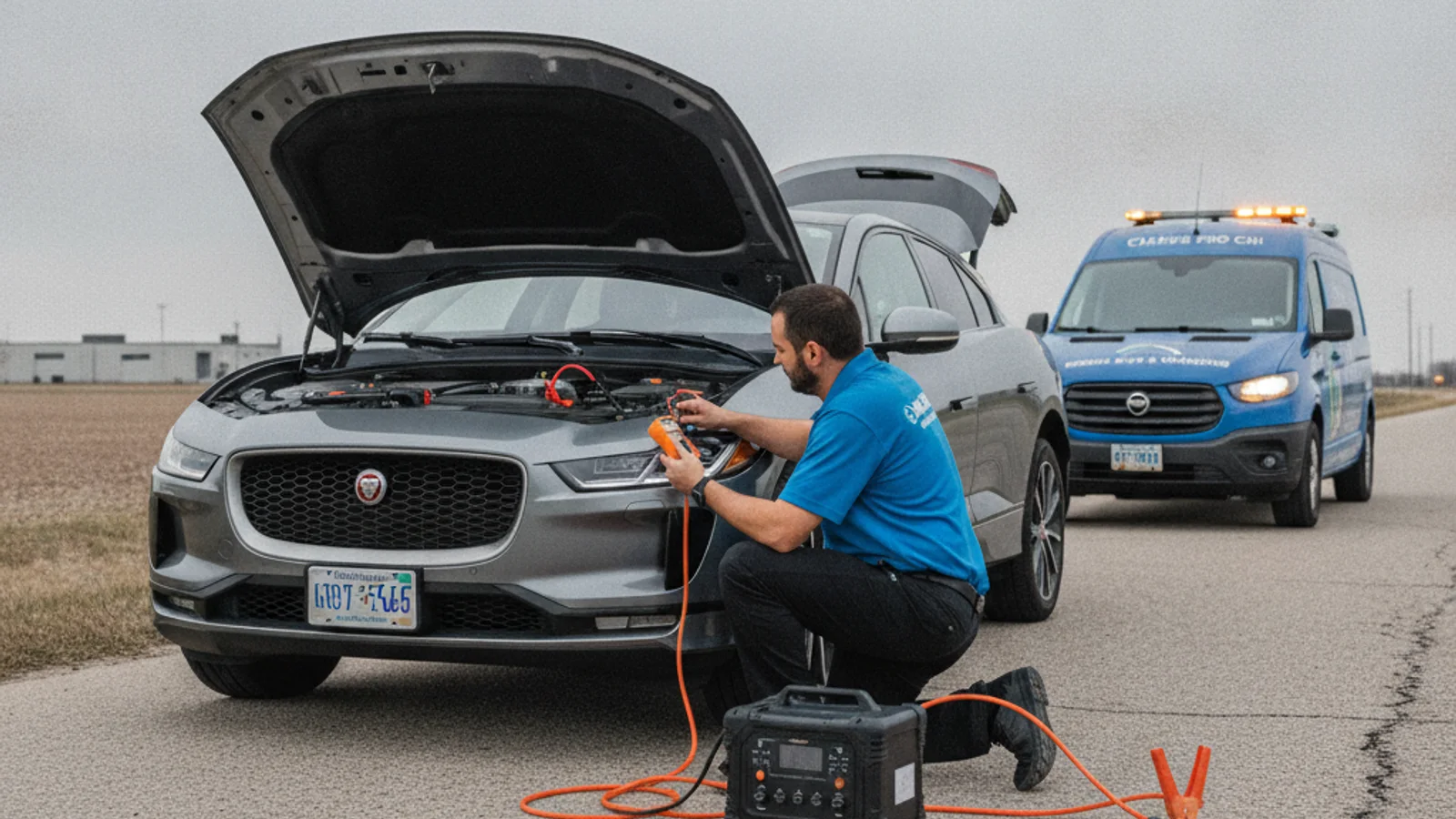
That pattern shows up after a Chicago night, a long sit in Oak Park, or a workday in Naperville. Cold doesn’t invent a new failure. It just makes a weak 12V obvious. A car can drive home with range on the display. It can still be a brick by morning.
The no-start that looks like a dead pack
People assume the big battery died because the car is fully dark. That’s the wrong first guess on an I-Pace. The high-voltage pack moves the wheels. The 12V runs the modules that are allowed to connect that pack. If the 12V is flat, those modules never boot. READY never comes. Range from last night doesn’t matter.
You’ll see a quiet car, not one full of warnings. No chime as you walk up, no handle presentation, no interior glow, no lock clunk.
A different failure looks busier. The dash lights, a message flashes, then the car shuts down again. Don’t keep jumping that one. That can be a high-voltage or DC-DC problem. It needs a dealer scan, not another pair of cables.
The same split shows up across EVs. What you see when an EV 12V dies is the same story in winter. Dark and silent means start with 12 volts. Warnings then a shutdown means stop and scan.
An empty pack usually warns you first. You watched the range fall, and the car may still unlock. A 12V no-start is the other way around. You parked a normal car, maybe with plenty of miles. The next walk-up is mute. If you just charged at home in Wheaton or Elmhurst, think 12V. A dark car after a full charge isn’t an empty pack.
Why an I-Pace can sit full and still refuse to wake
Think of the I-Pace as two systems that have to agree. The pack stores the miles. The 12V stores the permission to use them. Locks, screens, and control units live on that 12V side. A dead 12V is a locked door in front of a healthy pack.
That’s why a tow feels like the only move. The car won’t unlock or present handles. It won’t show a range number you can trust. None of that proves the pack is empty. It proves the low-voltage side is down.
Lead-acid 12V batteries also lose punch in the cold. That’s chemistry, not a local study and not a rate we made up. A tired battery fails the first hard Chicago overnight. Evanston and Skokie see the same thing after a long parked stretch. So do Lake County towns like Waukegan and Gurnee. The pack can still sit at a usable state of charge.
Signs that point at the 12V, not the pack:
- Flush door handles stay retracted when you approach
- The key fob won’t unlock the car
- Dash, touchscreens, and cabin lights stay dark
- No welcome chime and no lock sound
If you have a lit dash and a stored fault, you’ve left this path.
Pre-2021 I-Pace cars and the two-battery frunk
Early I-Pace years are the ones that go dark most often. Owners of 2018 to 2020 cars report the 12V running down while parked. Plenty have replaced it around three years, earlier than they expected. Jaguar revised the setup for the 2021 model year. A 2018 to 2020 car with the original 12V is the one to watch.
Those pre-2021 cars also hide two 12V batteries under the frunk panel. One weak unit can pull the whole low-voltage system down. A jump has to hit the correct positive post. The red cap is your first clue. Your model-year manual is the final one. Don’t copy a later car’s layout onto an earlier one.
A slow, glitchy wake isn’t a quirk to ignore. Lazy locks and a delayed READY are an early warning. So is a car that needs a second try. A load test settles whether the battery still holds. 12V replacement on site is the next conversation if it doesn’t.
Chicago housing is old. About 68.6 percent of Chicago homes were built before 1980. Oak Park is 78.6 percent. Cars in those neighborhoods spend a lot of nights in the cold. That ages a 12V. It still doesn’t mean the traction pack failed.
Unlock the cabin while the car has no power
You can’t grab a flush handle that never presents. Prying it is how you crack a door. Use the mechanical key in the fob instead.
Slide the fob release. Pull the metal key blade out of the fob body. On the driver’s door, push the front of the handle inward near the small button. The back edge should pivot outward. Pull the handle out as far as it will travel. The lock cylinder sits behind it. Insert the key blade and turn it clockwise. The door should unlock with zero power in the car.
If the key won’t turn, stop. Don’t add muscle. A frozen or damaged cylinder is a rescue job, not a parking-lot fight. The same lockout trap hits other EVs with powered handles. Tesla owners deal with it when the 12V dies and the car won’t unlatch. The I-Pace steps are its own. The idea matches a dead EV that won’t let you in.
Release the frunk when the 12V is what’s holding it
The I-Pace 12V lives in the frunk under a removable center panel. A dead 12V also keeps that frunk latched. The usual button won’t help you. You need the manual cable.
After the driver’s door is open, go to the right-side footwell. Find the black plug. Behind it is the frunk release cable. Pull that cable. The frunk should pop so you can reach the batteries.
Lift the center panel. Pre-2021 cars show two batteries. Positive posts have red caps. 2021 and newer cars were revised, so the layout can differ. Confirm the post against your own model-year manual. Do that before a clamp goes on.
Jump the I-Pace 12V the quiet way
Stay on the 12V posts. Don’t go near orange high-voltage cables, and don’t guess at unmarked terminals. Do this only after you’ve matched the post to your year:
- Clip the red clamp to the exposed positive post under the red cap
- Clip the black clamp to bare, unpainted chassis metal, not the battery negative
- Let the donor source feed the system for two to three minutes
- Then power the car and try to reach READY
A chassis ground keeps any spark away from the battery. That matters in a tight frunk. In winter the same process is slower to recover. Give it the two to three minutes. Don’t request READY on a starved module. Jump-starting an EV in the cold walks through why the ground point matters.
Once it hits READY, keep it awake. Shutting down in the same stall can drop a weak 12V again. Move it if you can. Get a load test if the battery is old. If a clean jump still leaves a black dash, stop. More current won’t invent a missing module. That’s a shop scan or an EV-safe tow, not a longer jump.
Read the stall before you call a wrecker
| What you see | Most likely cause | What to do next |
|---|---|---|
| Handles in, dash dark, no chime | Dead 12V | Manual key, then jump the frunk 12V |
| Wakes, warns, then shuts off | High-voltage or DC-DC fault | Don’t keep jumping. Get a dealer scan. |
| Starts, then dies again within days | 12V near the end of its life | Load test and replace the 12V |
| Still dark after a correct jump | Deeper electrical fault | Road diagnosis or an EV-safe tow |
| Dead in a lot with no donor car | No 12V source on hand | Call a mobile operator with a jump pack |
Most of those rows don’t start with a flatbed. A woke I-Pace can often drive to a charger or a shop. A no-power tow is a heavier, riskier job. Neutral and transport mode need power you may not have. That’s why towing a dead EV has extra costs. You don’t want those if a 12V jump would have done it.
When to stop DIY and call a local operator
Stop if the key won’t turn. Stop if the frunk cable won’t release. Stop if a correct jump doesn’t bring READY. Stop if you’re in a live lane or a packed garage. Stop if the weather makes the frunk unsafe.
A Schaumburg office deck is a poor place to improvise. So is a Glenview driveway or a downtown Chicago garage. So is a shoulder in Cook County traffic. The car can wait.
Don’t keep cycling cables on a car that wakes, warns, and dies. That pattern isn’t a weak battery you can keep jumping. The high-voltage side isn’t a donor pack for this job.
Charge Pro CHI is a referral line. We match stranded drivers with independent local operators. We don’t do the work. We don’t own the trucks. We don’t employ the technicians. We don’t set prices or arrival times. The operator quotes you before starting and bills you directly.
Those operators handle Jaguar and other non-Tesla EVs. They bring a 240V Level 2 source to the car. The I-Pace takes a CCS connection, and they carry the adapter for that. They can open a locked I-Pace and jump the right 12V post. They can load test the battery. They can add range if the pack is also low. A typical boost is 10 to 20 miles in 15 to 30 minutes of charging. That’s charging time, never an arrival time.
A similar luxury no-start follows the same 12V-first logic. See the Cadillac Lyriq that won’t start. For Jaguar and every other non-Tesla in this metro, use non-Tesla EV rescue.
Frequently asked questions
Why won’t my Jaguar I-Pace start?
The usual cause is a dead 12V battery, not a failed traction pack. The I-Pace needs that small battery to boot its computers. Without it, handles stay flush and the fob is mute. The dash stays black even with range left. Jump the 12V first. If a clean jump still does nothing, you need a dealer scan.
How do I get into an I-Pace when the handles stay flush?
Use the metal key blade hidden in the fob. Push the front of the driver’s handle inward so the back pivots out. Pull the handle out to expose the lock cylinder. Turn the key clockwise to unlock. That works with no power in the car. If the key binds, stop and call for help.
Where is the I-Pace 12V, and how do you jump it?
It sits in the frunk under a center panel. A dead 12V also keeps the frunk latched. After you unlock the cabin, find the black plug in the right-side footwell. Pull the manual frunk release cable behind it. Red clamp on the red-capped positive post. Black clamp on bare chassis metal. Wait two to three minutes, then try READY. Pre-2021 cars have two 12V batteries, so match the post to your year.
If the I-Pace is dark after a Chicago night, start with the 12V. Same move in an Oak Park driveway or a Naperville lot. Call Charge Pro CHI at (858) 925-5546 and we’ll match you with a local operator. They quote before they start.