Your Kia EV6 is plugged in, and charging never starts. That’s not the same problem as a pack at zero. The port, the stall, or the 12-volt battery usually blocks the handshake. Start with a port check. If the car still won’t take power, a 240-volt boost can add range. That range is often enough to reach a stall that works.
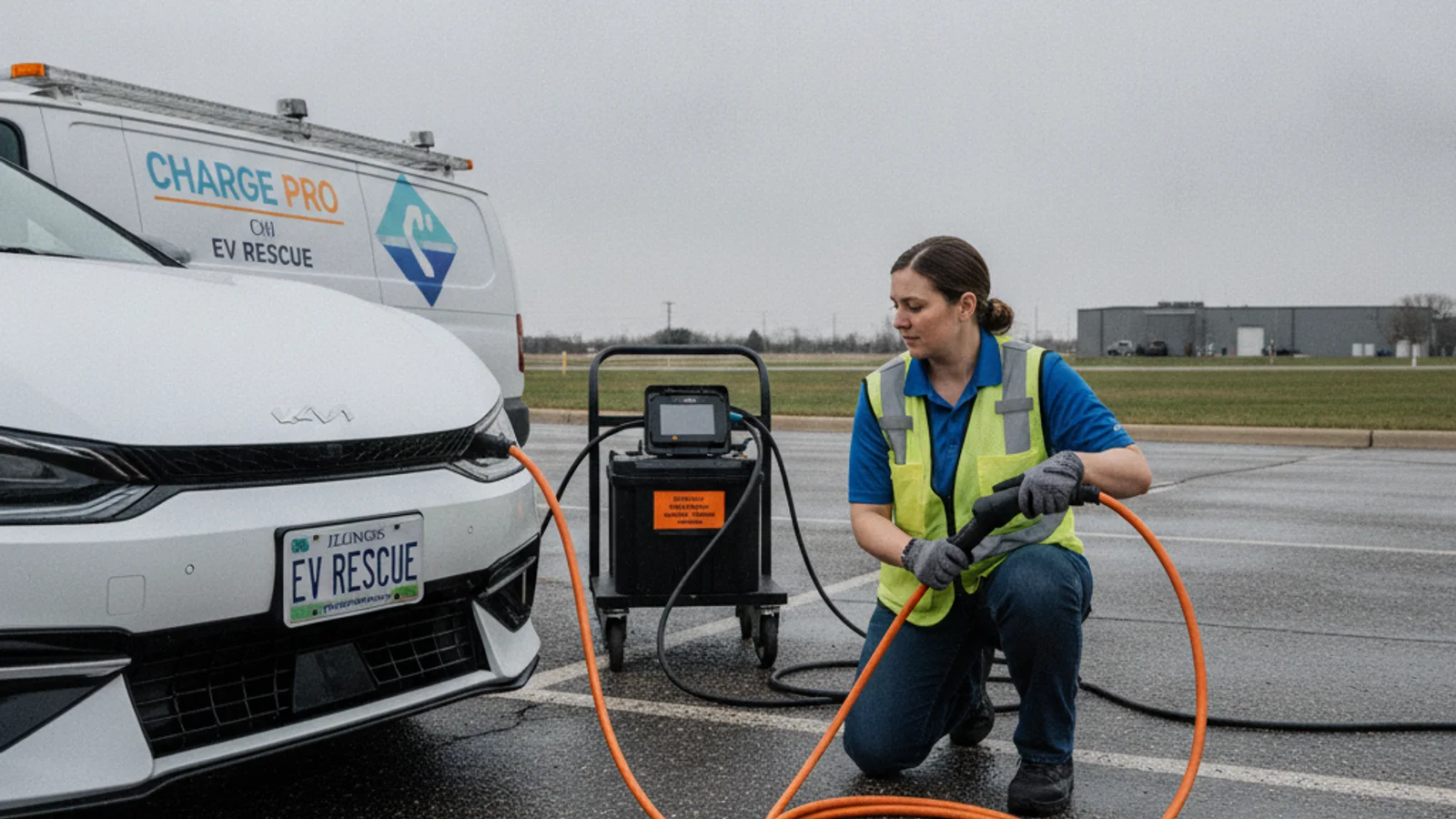
Empty pack versus a refused session
An empty EV6 needs energy. A refused session is a car that won’t talk to the cord. Those two failures feel the same when you’re sitting in a lot. They are not the same repair.
Look at the dash before you panic about the traction battery. If the state of charge is not at zero, look at the icon. If charging never appears, the handshake failed. If the pack is actually empty, you still may need a boost. You don’t need to diagnose a failed inlet first. Out of charge in Chicago: what to do when the pack is empty is the empty-pack path.
This page is for the other case. The cord is in. The car won’t start charging. Work the list below in order.
Start at the charge port
The EV6 won’t begin a session if the CCS handle is only half seated. Push until it latches. A plug that looks fine from two feet away can still miss the pins. Open the door fully. Wipe dirt, ice, and road film off the inlet. Look at the pins before you force another handle in.
Winter around Chicago, Evanston, and Skokie packs slush into that door. A frozen latch is a port problem, not a pack problem. Don’t yank the cable. Don’t pour hot water on the inlet. Work the door gently and dry the pins. How to unlatch an EV charging cable that’s stuck in the port covers a cable that won’t release.
If the car chirps and the dash never shows a charging icon, unplug and wait. Seat the handle again. Try a different cable at the same site if one is free. The EV6 takes a CCS plug. A NACS Tesla handle won’t fit without the right adapter. A loose combo handle is a common miss after a rushed stop. That happens on the Eisenhower, I-55, and the Kennedy.
Prove the stall before you blame the car
One public stall is a weak test. The screen can be dark. Payment can hang. A stall can light up and still send no current. Move to the next stall at that site before you decide the EV6 is at fault.
If two stalls fail and you still have range, try a different site. If the car charges there, the first hardware was the problem. If home and public both refuse, the car side of the handshake is next. Public charger says connected but isn’t charging: do this next splits those cases.
A busy lot in Schaumburg or a garage downtown is not a verdict on the car. It’s one piece of hardware on one night. Don’t keep restarting the same failed stall while the pack falls.
The garage version of the same fail
Plenty of EV6 owners first see this at home. You plug in after a Naperville or Wheaton commute. Morning comes, and the percent hasn’t moved.
Check the wall-box breaker. If it tripped, reset it once. If it trips again, leave it off. That’s house wiring. A roadside boost won’t repair a panel.
Chicago, Oak Park, Cicero, and Berwyn have a high share of homes built before 1980. Older garages and older panels trip more often than the newer stock in Naperville, Plainfield, or Huntley. The car can also wait on a schedule you forgot. Open the EV6 charge menu. Turn off delayed charging. Raise a charge limit you set for battery care. Plug in again and watch for the charging icon in the first minute.
Scheduled charging is useful on a weeknight. It’s also a quiet reason an overnight cord does nothing when you wanted an immediate session. Check the Kia app too, if it still wakes. A remote charge limit or a climate timer can look like a dead wall box.
Why a healthy pack still won’t charge
The traction battery moves the car. A separate 12-volt battery wakes the computers that talk to the charger. If that 12-volt is low, the EV6 can sit with a high pack reading and still refuse a plug.
Dim interior lights and a frozen screen are common. Door handles that don’t respond, or a port that never locks, point the same way. Cold nights in Waukegan, Gurnee, Crystal Lake, and McHenry make a weak 12-volt more obvious. What happens when an EV’s 12-volt battery dies in the cold is the same pattern on other EVs.
Don’t assume a gas-car jump pack is safe on unlabeled terminals. Use the EV6 manual for 12-volt access. If you’d rather not open covers in a dark lot, that’s a reason to call. Operators in this network jump or replace a dead 12-volt on site. They also bring a 240-volt Level 2 source and a CCS adapter for a non-Tesla EV6.
That onboard charge is typically 10 to 20 miles of range in 15 to 30 minutes of charging. That’s charging time, not a promise of when someone arrives. The operator quotes you before work starts and bills you directly.
What the warning lights actually mean
The EV6 often stores a charging fault when a session never starts. A battery symbol, a check EV system message, or a charging error on the cluster is a stop. It’s not a suggestion to keep replugging. Match the exact text in the owner’s manual.
A parts-store code reader might pull a stored trouble code. Treat that as a note for a Kia shop, not a reset button. Clearing a code without fixing the cause brings the light back at the next stall. If the warning stays after a port check, stop guessing. A second stall and a 12-volt look should already be done.
High-voltage diagnosis is dealer work. A mobile boost can’t recode a failed charge-control unit. It can still get you off a shoulder. That’s only if the car will accept power after the 12-volt is up.
A reboot is optional, and the manual wins
A stuck controller sometimes clears after a proper reset. That’s not the same as yanking cables the way you would on an old gas car. Find the EV6 procedure in the manual for your year. Park, set the brake, and power fully off first.
If you can’t find the 12-volt location, stop. Model-year layouts differ. Guessing at terminals in a Lower Wacker garage or a Joliet lot is how you create a second problem. A mobile operator can test that 12-volt without a roadside experiment.
When hunting another stall stops making sense
You seated the plug. You tried a second stall. You’re parked on a street and can’t reach a home wall box, or the home unit is dark. The pack is too low to cruise for another site. Now a boost is the practical next step.
Charge Pro CHI is a referral line. It matches stranded EV drivers with independent local mobile rescue operators. It doesn’t hold a shop license, own a fleet, or send its own technicians. The pros we connect you with are licensed and insured. They handle Tesla and every major EV brand, including Kia.
What’s an EV charging truck, and how mobile rescue actually works shows what the visit is. For the service itself, start with mobile EV charging and non-Tesla EV rescue.
This is the call after long-dwell parking in Orland Park or Tinley Park. It’s the call from an office lot in Schaumburg or Elk Grove Village. It’s also the call when a commute dies on the Kennedy, the Dan Ryan, I-90, or the Tri-State.
If the 12-volt is the blocker, the operator can address that first. If the high-voltage system is in a hard fault, a boost won’t replace a dealer visit. The goal is movement when the car can still take a Level 2 charge.
What to have ready
Stay with the car when it’s safe. Hazards on a shoulder. Don’t stand in a live lane on the Dan Ryan or the Jane Addams. In a lot in Glenview, Des Plaines, or Aurora, wait near the vehicle so the operator can reach the port.
If the Kia app still opens, note the last percent and any alert. Write down whether the port door opens and whether the handle latched. That helps the operator choose a 12-volt jump or a CCS boost.
Don’t keep restarting a failed stall. Don’t force a frozen door. Don’t let a passerby jump unlabeled EV posts from a gas truck.
After you’re rolling
Once the EV6 takes a charge, go to a working stall if you still need more range. Don’t treat a 10 to 20 mile boost as a full fill. It’s a way off the lot or the shoulder.
If a 12-volt jump brought the car back, plan a replacement. A 12-volt that needed a jump once often fails again in the next cold snap. That’s a shop item, not another night of hoping.
If public stalls keep failing this one car after a 12-volt repair, take it to Kia. Repeated handshake faults can be inlet, charge-door, or control-unit work. A referral boost is not that repair.
After the port check, make the call
If the EV6 still won’t start charging, call (858) 925-5546. Charge Pro CHI will connect you with a local operator. You hear the quote before any work starts. The operator bills you directly.