Tesla charging cost here tracks your bill, not a national average. Pack size and winter cabin heat both move what you spend. Whether you plug in at home or in public matters just as much. Confirm the per-kWh rate on your latest utility statement. Treat any blog estimate as a method, not a quote.
Winter cabin heat shows up as extra kWh
A Tesla heats the cabin from the high-voltage pack, and that energy isn’t free. A January commute burns more kWh than the same miles in June. You pay for that extra draw the next time you charge. Range also falls in the cold, so you plug in more often. That’s why winter shapes what owners spend across this metro. Cook, Lake, DuPage, Kane, Will, and McHenry counties all see that winter draw.
Seat heaters and preconditioning while plugged in pull less from the pack than blasting cabin heat on the road. Precondition on the wall when you can, then drive off with a warm cabin. That shifts some winter kWh onto the house meter. We couldn’t confirm a published winter rate adder on a local utility schedule. Your car’s energy screen is the check that actually matters. Compare a cold week with a mild week on the same route. Read how a Tesla charge holds up through a cold day.
Older housing decides if home charging is even on the table
Census ACS figures for 2019-2023 show how split this metro’s housing is. 68.6% of Chicago homes were built before 1980. Cicero is 90.2% pre-1980, and Berwyn is 90.0%. Oak Park is 78.6% pre-1980, Evanston is 71.2%, and Skokie is 72.0%. Evergreen Park is 87.7%, and Park Ridge is 67.1%. Those older cores are heavy on apartments, so a wall connector isn’t a given.
West and north suburbs look different on the same census tables. Naperville’s pre-1980 share is 11.7%, and Gurnee’s is 9.5%. Plainfield’s is 6.7%, Huntley’s is 3.8%, and Schaumburg’s is 15.9%. Carol Stream is 14.2%, Bolingbrook is 12.3%, and Orland Park is 11.8%. Tinley Park sits at 17.2%. A garage in those towns can often take a 240-volt circuit. A street park in Cicero often can’t take that circuit. Cook County inner-ring blocks aren’t Gurnee’s newer housing stock. That split is why two Tesla owners here can have different bills. Home charging when Cicero housing can’t take a charger covers that building-side limit.
Pull the number from the car, then from the bill
Don’t wait on a blog for a figure that’ll go stale. Note the kWh added on the Tesla charging screen. Multiply that by the supply rate printed on your bill. The product is what that session cost you. A Model S or X holds more energy than a Model 3 or Y. A low state of charge draws more kWh than a small top-off. Some energy is lost as heat between the wall and the pack. The house meter can read a bit higher than the car.
If your bill lists peak and off-peak prices, timing matters. The same kWh costs more in the expensive window. Those windows are set by your utility, not by Charge Pro CHI. We looked for a verifiable Chicagoland per-kWh figure to publish. None turned up that we could cite with confidence. Cook, DuPage, Kane, Lake, Will, and McHenry each have utility service of their own. Read the rate schedule on your statement for the current number.
Public DC fast charging versus a home Level 2 plug
Superchargers and other DC fast sites sell speed. The app shows a rate per kWh before you start. That listed rate is usually above what a home meter bills. Idle charges and membership prices appear in the same app. We won’t quote them here, because they change. Open the Tesla app and read the listed rate before you plug in.
A Supercharger stop after a long Chicago day is a different bill than an overnight charge on a Wheaton home meter. Speed is the product you’re buying in public. Time on the house meter is the product you’re buying at home. Don’t assume last month’s public rate still holds.
Home Level 2 on your own meter is the other end. You control the schedule on that home circuit. A standard wall outlet is slower than Level 2. It can leave you short before a long day. What a Level 1 charger is, and when it isn’t enough covers that limit. For session length, see how long it takes to charge a Tesla in Chicagoland.
North Shore driveways and inner-ring blocks
Highland Park, Northbrook, Glenview, and Wilmette sit on the North Shore. Their housing mix isn’t identical from town to town. Wilmette still has 74.3% pre-1980 stock, while Glenview is 40.3%. Highland Park is 60.6%, and Northbrook is 39.1%. A Tesla in a Northbrook garage isn’t the same charging life. A Chicago side street is a different overnight setup.
Waukegan’s pre-1980 share is 54.0%, and Oak Lawn is 58.4%. Aurora is 33.1%, Elgin is 41.5%, and Joliet is 39.0%. Where you park overnight shapes how much public energy you buy. Public sites exist across these towns, and home access is still uneven.
A mobile boost is a quoted session, not a published rate
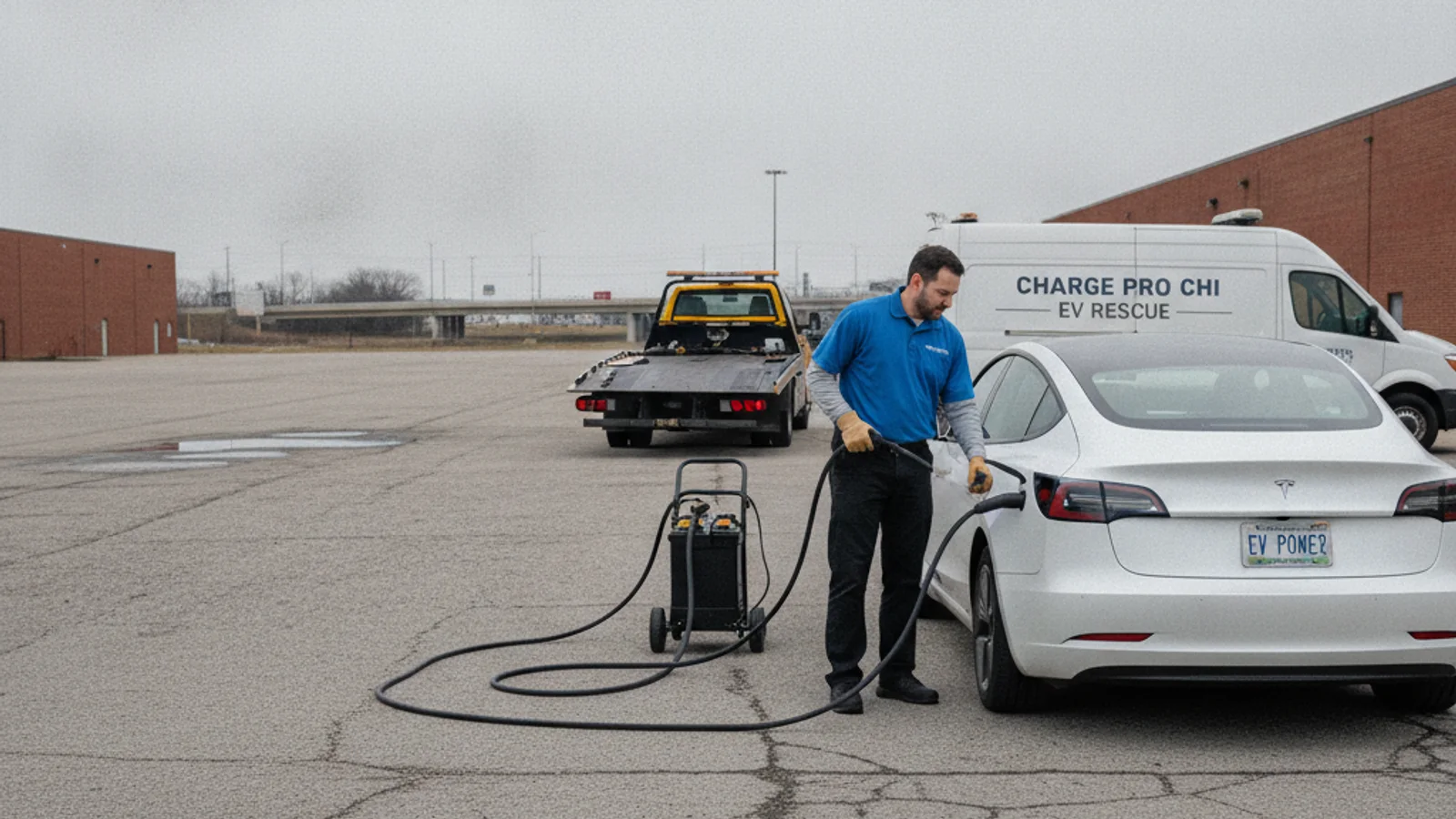
If the pack hits empty away from a plug, a local operator can help. They bring a 240-volt Level 2 source to the car. Tesla gets a native NACS plug, and CCS or J1772 adapters cover other EVs. A boost typically adds 10 to 20 miles in 15 to 30 minutes of charging. That’s charging time, never an arrival time.
Distance, time of day, and how much range you need all move the quote. The operator quotes you before starting and bills you directly. Charge Pro CHI is a referral line and doesn’t set prices or own trucks. What a mobile EV charging quote covers spells out that call. For the boost itself, start at mobile EV charging.
Questions owners ask before they plug in
How much does it cost to charge a Tesla at home here?
There’s no single figure we can publish for a home charge. Multiply kWh added by the supply rate on your bill. Pack size and winter heat change how many kWh you need. Confirm the rate with the utility that serves your city.
Does a Supercharger cost more than charging at home?
Per kWh, DC fast charging is usually priced above a home Level 2 session. Read the rate in the Tesla app and on your bill. We couldn’t confirm a current published comparison for this metro.
What if my building can’t take a home charger?
You’ll buy more public energy on those weeks. That usually costs more per kWh than a home meter. If you stall with an empty pack, call (858) 925-5546. A local operator quotes the boost before they start.