Stops at 41% one day and 68% the next aren’t a setting. EV charging stopped at a random percentage because the pack or the stall cut out. A limit you chose always lands on the same number. A public stop that leaves you short still needs a mobile Level 2 boost.
Check the limit before you chase a fault
Open the car’s app or the center screen first. Look there for a daily charge limit. Most EVs let you cap charging in the 70 to 90 percent range. That cap is for pack health on ordinary days. You save a full charge for a longer trip. If every session ends on that same number, the car isn’t failing. It’s following the number you set.
Random stops don’t match that number. They land somewhere new each time. That’s when you look at temperature, the stall, or the 12V. Tesla owners usually find the cap on a slider. Other brands bury it in EV settings. If the stop matches the number you picked, you’re done.
The BMS guards a temperature, not a percent
Every EV uses a battery management system, or BMS. It slows charging when the pack is too hot or too cold. It can pause the session if temperature keeps moving the wrong way. Charging itself adds heat after a long drive. A pack that already ran warm hits the pause sooner on a DC fast stall.
You don’t see that threshold as a tidy percentage. So the stop looks random from the seat. A car that rested overnight in Glenview starts cooler than one finishing a hot Chicago afternoon. Same car and charger type, different stopping point.
Winter does the inverse across this metro. A pack that’s sat in Waukegan or Gurnee may be too cold for a fast rate. The BMS holds back until the pack warms. That can look like a random early stop too. Chicagoland asks the pack to handle both seasons. Heat-only advice misses half the year here.
Give the pack a few minutes after you park. A short rest before a DC plug beats another reset in the app. Shade or a garage helps when the car’s been sitting in sun. A cold pack may need a little drive first. You’re not fighting a percent. You’re waiting on temperature.
A short public session is the one that strands you
You feel a cut-short charge most when you needed that stall to finish. ACS 2019-2023 figures put pre-1980 housing in Chicago at 68.6%. Cicero and Berwyn sit at 90.2% and 90.0%. Oak Park is 78.6%, and Evanston is 71.2%. Newer west-suburb stock looks different. Naperville is 11.7% pre-1980, and Schaumburg is 15.9%. Plainfield comes in at 6.7%.
Those numbers don’t prove anything about a given driveway. They do explain why a public session carries more weight in older Cook County streets. If a wall box isn’t part of the house, that stall is how you leave. A pause at 43% isn’t a curiosity then. It’s a range problem for the rest of the day. Home charging in Cicero is one local version of that bind.
If only the fast stall fails, blame the cabinet first
Home Level 2 that completes is a clue. Public DC fast stalls that die early are another. Fast stalls share cabinets. They derate when the gear is hot, or when the next stall is pulling hard. The car may show charging, then sit at a frozen percent. That’s a station problem, not a charge limit you forgot.
A charger that says connected but isn’t charging is a nearby version of this. A slower Level 2 session is a useful test. If Level 2 finishes and DC doesn’t, the stall was the weak link. Charging levels when you’re stranded walks through what each level delivers. Don’t keep retrying a dead DC stall until the pack is too low to move.
Try the stall beside you if it’s free. Check the station screen for an error before you assume the car failed. Then leave for a Level 2 plug if DC keeps dropping. Hunting a second fast stall while you’re already short can turn a nuisance into a strand.
Cool weather, shade, and it still quits
Rule out heat and cold before you assume a repair. If it still stops on a mild morning, look at the 12V. The 12V keeps the charging computer alive through a session. A weak one can drop mid-charge and freeze the percent. The dash can make that look like a random stop. What you see when an EV 12V dies covers those signs.
Locks that act up belong on that list. So does a car that won’t wake. A true BMS fault or a failing onboard charger is less common. It still belongs there when weather and the stall both look fine. That’s the point where a shop visit makes sense. A boost still gets you off the lot if you’re already short.
Work the list in this order
Don’t start with a tow. Skip the shop until the simple checks are done. Confirm the charge limit in the app. Then give the pack a rest after a hard drive. Fifteen to twenty minutes is a common wait before a DC session. Park in shade or a garage when you can. Try a Level 2 stall if the fast one keeps dying. Watch for 12V warnings, weird locks, or a car that won’t wake cleanly.
If the session still won’t finish, treat it as a range problem now. You can sort the fault later. The number you already have is the number you can spend.
When the percent you got isn’t enough to leave
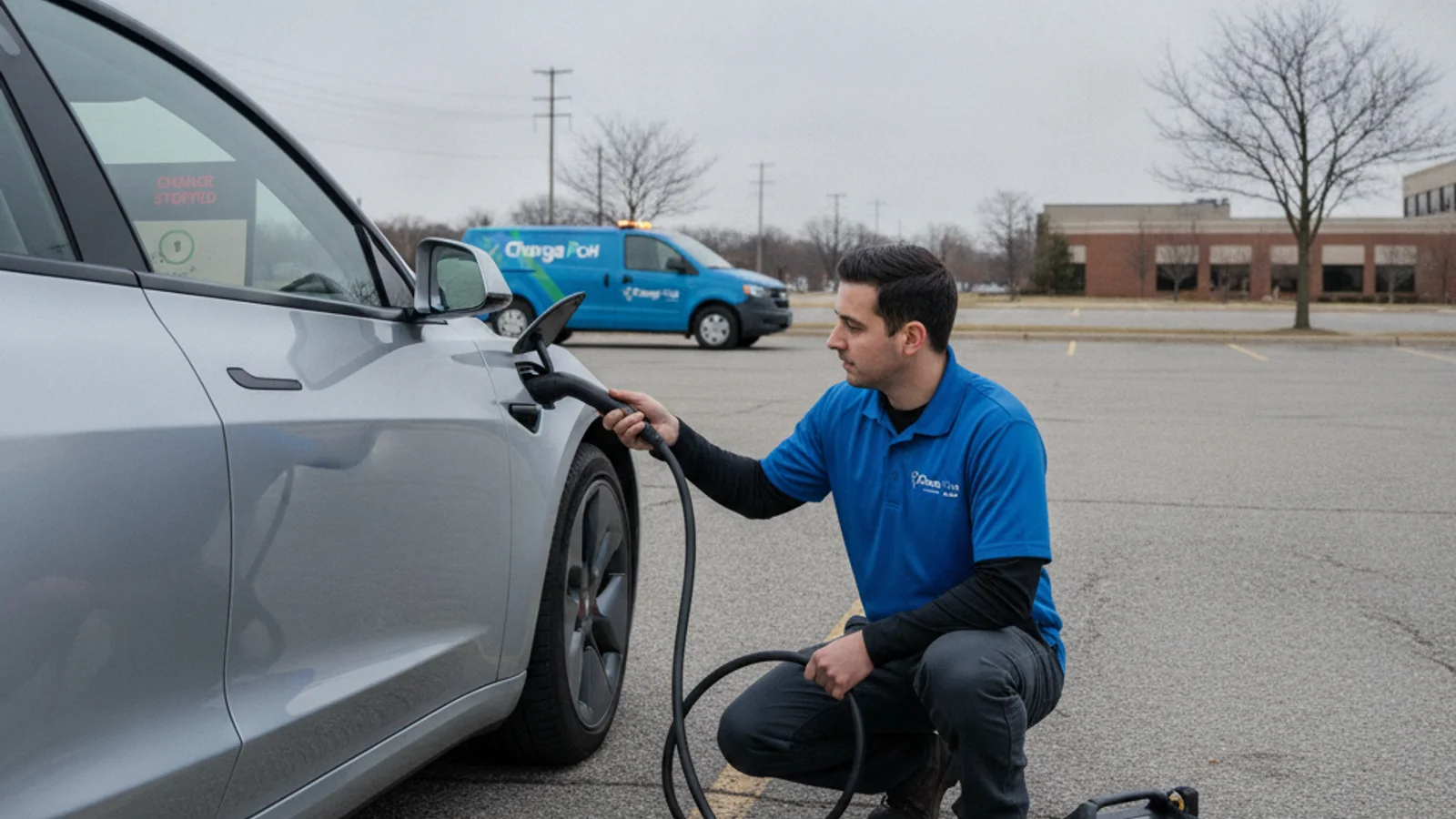
A stopped public charge can leave you under the miles you planned. Charge Pro CHI is a referral line. It matches stranded EV drivers with independent local mobile rescue operators. The brand doesn’t own trucks, and it doesn’t employ technicians. The pros we connect you with bring a 240V Level 2 source to the car. Teslas get a native NACS plug. Other EVs use a CCS or J1772 adapter.
A typical on-site charge adds 10 to 20 miles of range. That takes 15 to 30 minutes of charging. That’s charging time, not a clock on arrival. The operator quotes you before any work starts. They bill you directly.
If you’re still rolling but low, what to do before you stall helps you stretch a partial charge. If you’re already stuck, mobile EV charging is the match you want. The boost isn’t a repair. It buys range to finish at a working charger, or to get home.
Call Charge Pro CHI at (858) 925-5546 to get matched with a local operator.
Frequently asked questions
Why does my EV stop charging at a different percentage every time?
The BMS is usually pausing on pack temperature, not on a percent you picked. Driving heat, a summer soak, or a cold sit all move that threshold. Because the trigger isn’t a fixed number, the stop looks random. A busy DC stall can also cut the session at whatever percent you’d reached.
Is it bad for the pack if charging stops early from heat or cold?
No, the BMS is protecting the pack. Forcing a full charge through a hot or frozen battery is the harder path. Letting it rest, then finishing later, is the safer one.
Does a random stop mean Charge Pro CHI can repair the car?
No, Charge Pro CHI doesn’t repair a BMS, an onboard charger, or a thermal system. The pros we connect you with can deliver a Level 2 boost on site. If a cut-short session left you without enough range, that’s the help they bring. A shop still has to chase a true hardware fault.