You plugged in before bed. The cable looked seated. This morning the percentage hasn’t moved. In Chicagoland that happens a lot. It’s worse when the car sat on a cold street all night.
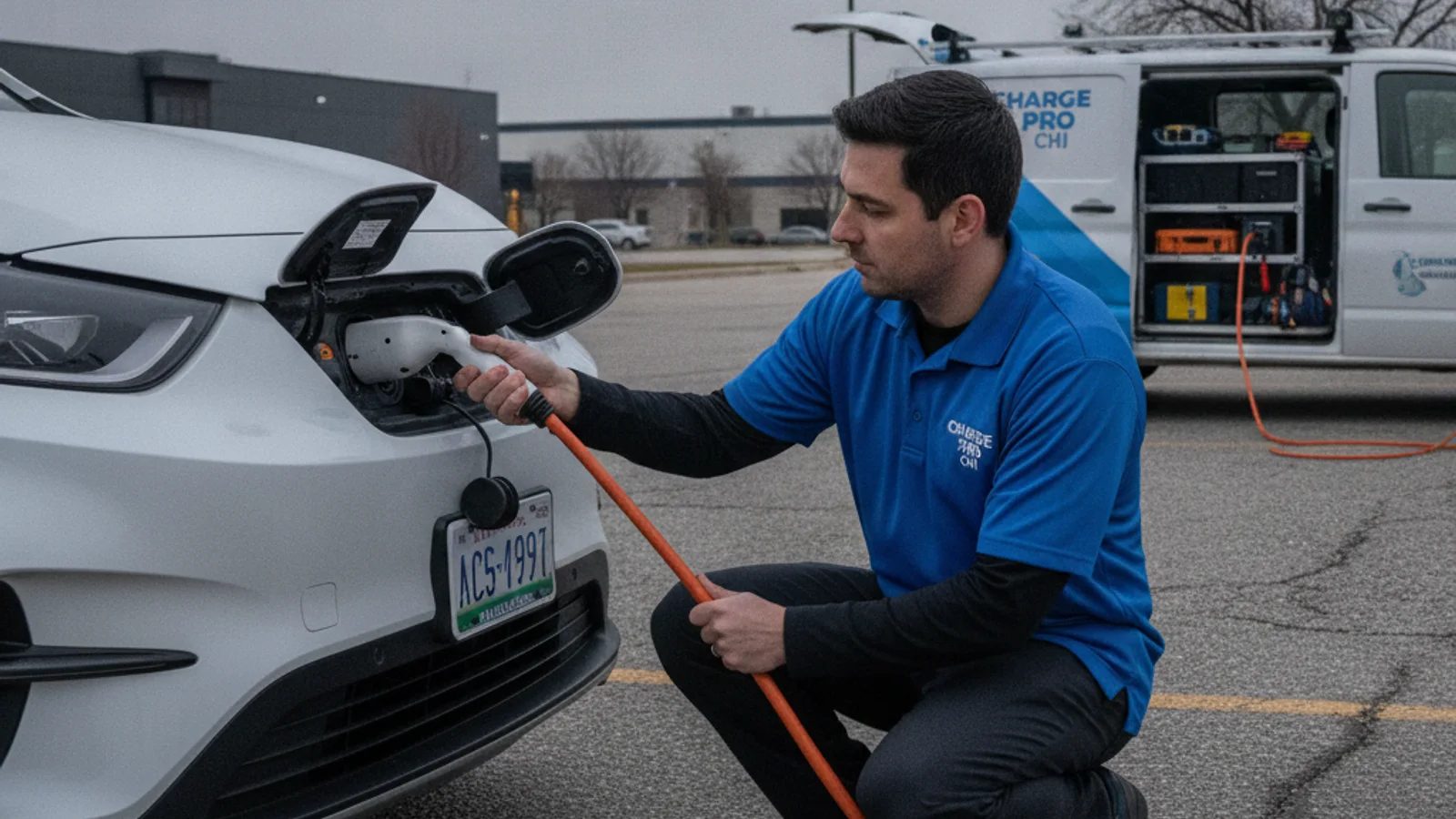
A failed overnight charge is rarely a dead pack. It’s usually a forgotten schedule, a sleep state, or a weak 12V. Street parking and winter cold stack those three together here.
Why overnight charging fails more in this climate
A mild night in a garage is one thing. A January curb in Chicago is another. The pack has to stay warm enough to accept current. The 12V has to stay awake enough to run the charging computer. Slush sits in the port and the latch ices. None of that means the charger vanished. It means the session has more ways to never start.
Scheduled charging is the first thing to check. Almost every EV lets you set a departure time or an off-peak window. The car waits on purpose. You thought it would fill while you slept. It was waiting for a window that opens after you’ve already left. That setting is easy to turn on once and forget. An app update can restore a default you didn’t pick. Open the app or the center screen. Look for scheduled charging, charge on departure, or off-peak charging. Do that before you blame the hardware.
Street parking is not a garage circuit
A driveway wall box is one story. A porch outlet, a shared lot pedestal, or a curbside public post is another. Chicago, Cicero, Berwyn, and Oak Park still lean on street spots. Most homes in Cicero and Berwyn were built before 1980. Chicago is about two-thirds pre-1980. Oak Park is closer to four in five. A dedicated garage circuit isn’t a given on those blocks. You plug in wherever you can.
Naperville, Gurnee, and Plainfield have much newer housing. A garage Level 2 is more typical. The overnight miss there is usually a schedule or a 12V. In Cicero the house itself may never take a hardwired charger. Home charging when Cicero housing can’t is the local version of that problem.
A cable on the street also backs out. Wind and ice can leave the plug looking seated. A bumped bumper does the same. Reseat it until you hear or feel the click. If the door is frozen shut, don’t yank it. A stuck winter charge port needs a thaw, not force.
Wilmette, Evanston, and Highland Park sit closer to the lake. Freeze-thaw on the curb chews on latches and seals.
The car went to sleep before the window opened
Plug in at 7 p.m. Set the car to wait until 1 a.m. Then the vehicle drops into a low-power sleep. Some cars don’t wake cleanly enough to start on time. You walk out at 7 a.m. to the same percentage you had at dinner.
Open a door, unlock the fob, or start climate from the app. If charging begins a few minutes later, sleep was the problem. In a Chicagoland winter that sleep state runs deeper. Cabin heat and pack warming both load the 12V. A tired 12V makes a clean wake even less likely. Evanston winter battery care covers those 12V habits.
A 120-volt porch trickle can look like a failure too. On a hard freeze the car may spend the night warming the pack. That isn’t a dead charger. It’s a Level 1 session losing the fight to the cold. Unplug and replug. Then confirm the car is in a real charge session, not just connected.
Quick reference: what you see and what to check
| What you see | Likely cause | First check |
|---|---|---|
| Same percentage, cable still seated | Scheduled window starts later than you think | App or dash: departure time or off-peak window |
| Unplug and replug, then it starts | Sleep state before the window opened | Open a door or start climate from the app |
| Session died partway through the night | Charge limit already hit, or a real cut | Confirm the charge limit before you hunt a fault |
| Charger light is on, car screen is blank | Loose plug or a communication miss | Reseat the cable until the port clicks |
| Breaker or GFCI tripped at the panel | Circuit lost power, not a pack failure | Reset once. If it trips again, stop and call an electrician |
When the schedule was open and nothing still happened
Rule out the settings first. Then look at hardware that actually fails in this climate.
Start with a loose cable. Home cords pull out when they’re short and under tension. Street cables take hits from passing traffic and ice. Push it in until it latches.
Check the breaker next. If the circuit died at 2 a.m., the charger has no power. The plug can still sit in the port. Reset the breaker once. Repeated trips mean a licensed electrician, not another flip of the switch. Older panels in pre-1980 Chicago, Oak Park, and Berwyn homes trip more often. Why a wall box keeps tripping the breaker walks through that path.
Look at the wall unit’s status light. Most home charging boxes change color or blink when the unit itself has failed. A red light is the charger, not the car.
Check the 12V next. The charging computer runs on the 12-volt battery, not the big pack. If the 12V is failing, a session can start, then drop. What you see when an EV 12V dies lists the signs. In this climate those signs show up first on cold mornings.
If you have to leave and the pack is still low
Morning. Low range. No time to chase settings. Don’t guess your way onto the Kennedy on what’s left. The Eisenhower and I-90 are the same trap. Stretch the pack only if you know it covers the next real charge. What to do before you stall is the checklist for that.
If you need range now, mobile EV charging is the call. Charge Pro CHI is a referral line. It matches stranded drivers with independent local operators. Those operators bring a 240-volt Level 2 source to the car. Native NACS on Teslas. CCS or J1772 adapters for everyone else. Typical on-site charging adds 10 to 20 miles. That’s in 15 to 30 minutes of charging time. That is charging time, not a promise of when someone arrives. The operator quotes you before starting and bills you directly.
Frequently asked questions
Why did the car say it was charging while the percent never moved?
The display often shows charging while it waits for a scheduled window. A charge limit that’s already met looks the same. Check the schedule and the limit in the app first.
Does sitting plugged in without drawing power hurt the pack?
No. An idle plug isn’t a stress on the high-voltage battery. The software is choosing not to pull power yet. That’s a schedule, a sleep state, or a limit already met.
What if I have to leave and last night’s charge never happened?
Don’t roll out on a guess. Call Charge Pro CHI at (858) 925-5546. We’ll connect you with a local operator. That operator can bring a Level 2 boost to wherever you’re parked.