Each brand prints its own EV maintenance schedule by brand. Tesla, Rivian, Ford, Hyundai, and Chevy don’t share one calendar. The lists still miss the stalls that happen here. A weak 12-volt battery leaves the car dark. Winter range drop empties the pack on a Cook County hop.
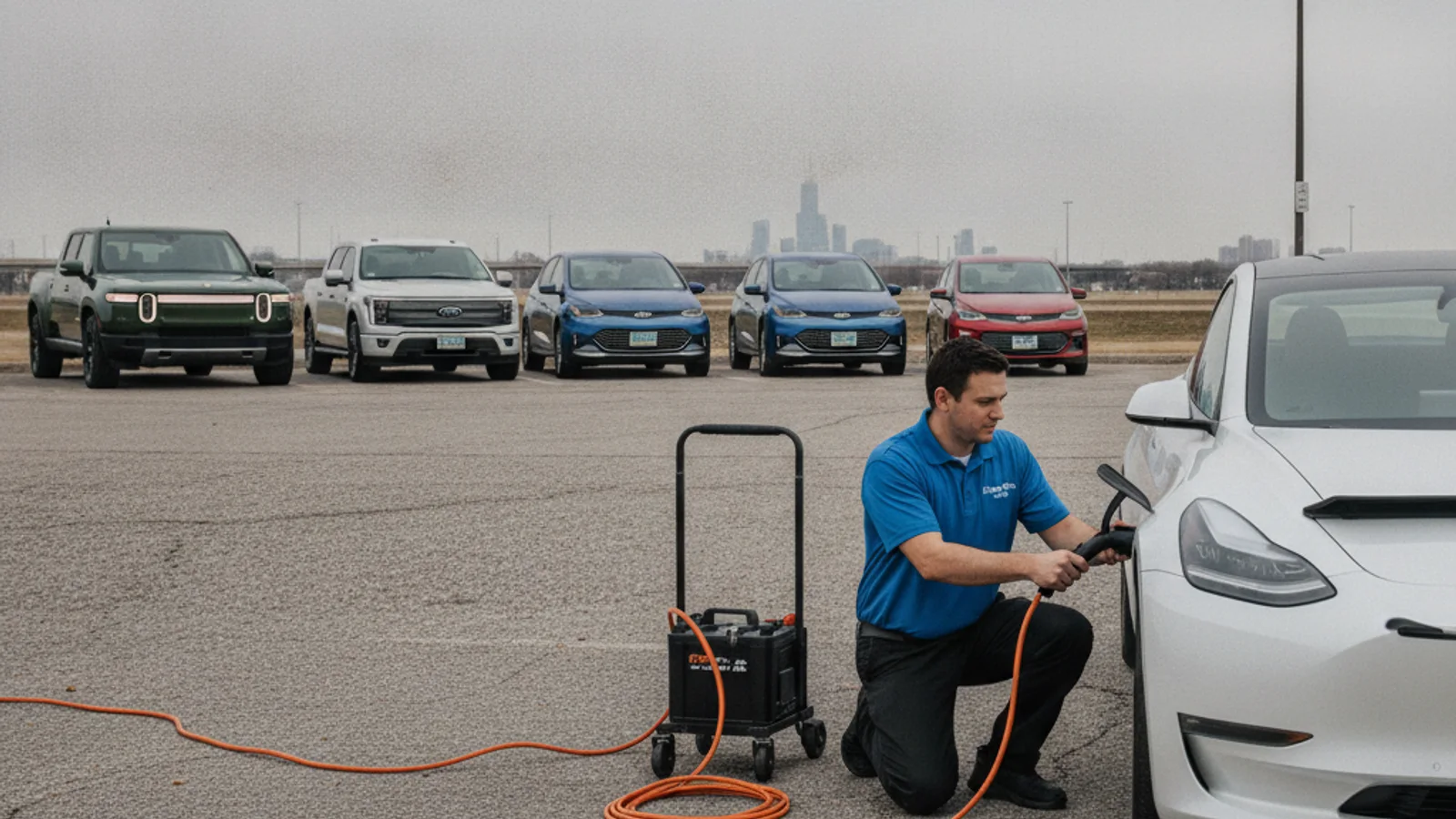
A Model Y on an Oak Park street ages differently than a Lightning in Plainfield. Chicago’s ACS housing data still shows 68.6% of units built before 1980. Cicero sits at 90.2%. Berwyn sits at 90.0%. Huntley sits at 3.8%. The badge on the hatch doesn’t change those blocks. Your service PDF doesn’t either.
What every brand’s book leaves out
Shop intervals cover tires, filters, and fluids. They almost never bold a 12-volt test. That small battery wakes locks, screens, and high-voltage contactors. If it dies, a full traction pack won’t help. The car just sits.
They also skip winter range. Cabin heat and short trips through Evanston or Skokie eat miles. A summer schedule never models that drain. A 10,000-mile inspection won’t refill an empty pack in a Berwyn lot.
Every EV still needs a few shared chores. Start with our guide to EV maintenance for owners here. Then match the badge-specific miles below.
Tires, brakes, cabin air, and the 12-volt
Tires are the item every maker repeats. EVs are heavy, and torque hits at once. Check pressure each month. Rotate on the printed interval, often every 6,000 to 8,000 miles. Uneven tread steals range before it steals a sidewall.
Brake pads last longer because regen does the slowing. Brake fluid still takes on moisture. Published lists often want a check or flush every two to three years. Pads that rarely work can glaze or rust. Have them inspected when you rotate tires.
Cabin filters clog and strain the HVAC. HVAC is winter range. Replace the filter on the brand’s miles or years.
The 12-volt is the roadside gap. After year three, test it yearly. Don’t wait for a no-start in a Northbrook garage. Don’t wait in a Cicero alley either.
Tesla intervals that actually show up
Tesla dropped the old yearly stamp. The car nags from the screen. You still have a real list.
Tesla’s list by item
Rotate tires every 6,250 miles. Do it sooner if any two tires differ by 2/32 inch of tread. That’s tighter than many other badges. Weight and power chew the inner edges on a Model 3 or Y.
Have brake fluid tested every two years. Replace it if the shop finds contamination. Thick pads don’t make the fluid optional.
Swap the cabin filter every two years. Newer Model S and Model X can use a HEPA pack. That HEPA and carbon set waits three years.
The A/C desiccant bag is easy to skip. Tesla sets it at three to six years, by model. Model 3 and Y sit at four years. A 2012 to 2020 Model S sits at three. Confirm your year in the owner’s screen before you book.
Tesla will run a multi-point check when you’re already in. There’s no mandatory annual stamp. Watch the tires. Watch the 12-volt. See our Tesla 12-volt guide for the layout by model.
A healthy Tesla still sits dead if the 12-volt won’t close the contactors. That’s the stall operators get after a cold night. It’s not a missed desiccant bag.
Ford still wants you on a 10,000-mile clock. Tesla wants you to watch the screen. Neither clock is a January 12-volt test. Set your own reminder. The app won’t call you before a no-start.
Ford Mach-E and F-150 Lightning
Ford kept a mileage rhythm that feels like a gas car. The item count is just shorter.
Ford’s inspection loop
Every 10,000 miles, or at least once a year, Ford wants a multi-point inspection. That pass covers tire rotation and a brake look. Pads, rotors, hoses, and the parking brake are on it. So are cooling hoses, half-shaft boots, steering, suspension, and ball joints.
Cabin filter replacement lands at 20,000 miles. That’s longer than Tesla or Rivian. If airflow feels weak in an Aurora or Elgin garage, don’t stretch it.
The F-150 Lightning, on all-wheel-drive builds, has rear eAxle fluid at 150,000 miles. High-voltage battery coolant is the long job. First replacement is at 100,000 miles, then every 50,000 after that.
Ford’s book won’t warn you about winter 12-volt failure. A Lightning used as a work truck in Joliet or Romeoville can still sit dark. If the truck won’t wake, start there. Our notes on a Lightning that won’t start walk the order.
Rivian R1T and R1S
Rivian’s trucks and SUVs add hardware a compact EV doesn’t carry. The schedule follows that kit.
Rivian’s extra hardware
Rotate tires every 7,000 miles. Check alignment every 14,000 miles, or when wear looks uneven. Heavy quad-motor trucks eat inner tread on commutes out of Gurnee or Libertyville.
Drive unit fluid is the line other brands often skip. Rivian wants it at 140,000 miles. It lubricates the gears in the motor assemblies. The interval is long. Missing it still matters.
Inspect air suspension for leaks or damage every 28,000 miles. Replace the air compressor filter at 56,000 miles. Cabin filter is yearly, or every 14,000 miles. Brake fluid is every three years.
None of that list is a 12-volt jump on a frozen morning. If an R1T or R1S won’t start, check the 12-volt first.
Hyundai Ioniq 5 and Chevy Bolt
Hyundai and Chevrolet keep short inspection loops. They catch wear. They still leave the 12-volt as your problem.
Ioniq 5 miles
Tires rotate every 8,000 miles. At 16,000 miles, inspect brakes, steering, and suspension. Cabin filter is 24,000 miles. Battery coolant gets an inspect at 40,000 miles. First coolant replacement is 120,000 miles, then every 40,000 after that. Brake fluid flush is every two years.
Bolt EV and EUV miles
Every 7,500 miles, rotate tires and run a multi-point inspection. Cabin filter is 22,500 miles. Brake fluid is every five years. At five years or 150,000 miles, drain and fill the coolant loops. Chevy splits those loops across the battery, the power electronics, and the cabin heater.
Chevy’s three coolant loops matter in this climate because the cabin heater loop works hard. That’s still a shop flush at five years or 150,000 miles. It’s not a roadside boost. If the Bolt won’t start, think 12-volt first.
Both brands want you in a bay on a clock. Neither clock is a winter range plan. A commute from Oak Lawn into the city can still land you low. A parked Bolt in Evergreen Park after a long dwell can too.
How this metro breaks the PDF
Housing age changes how you charge, and how the 12-volt lives. Oak Park’s pre-1980 share is 78.6%. Evanston’s is 71.2%. Skokie’s is 72.0%. Evergreen Park’s is 87.7%. Chicago Heights sits at 74.3%. Park Ridge sits at 67.1%. Older housing shares are high on those blocks. Overnight setups differ from a 1990s subdivision. Short cold trips never fully warm the pack. The 12-volt still cycles every lock and every wake.
Newer tracts tell another story. Naperville’s pre-1980 share is 11.7%. Plainfield’s is 6.7%. Gurnee’s is 9.5%. Bolingbrook’s is 12.3%. Algonquin’s is 10.1%. New Lenox sits at 7.9%. Orland Park sits at 11.8%. More of that housing is post-1980. Overnight parking patterns differ from Cicero or Oak Park. The schedule still doesn’t cover an empty pack after a weekend trip. It doesn’t cover a 12-volt that sat through a hard freeze.
On the North Shore, Wilmette’s pre-1980 share is 74.3%. Glenview’s is 40.3%. Northbrook’s is 39.1%. Same general commute toward the city. Three different housing ages. The Tesla tire interval doesn’t change. The overnight cold load on the 12-volt can.
South Cook splits the same way. Oak Lawn sits at 58.4% pre-1980. Tinley Park sits at 17.2%. Orland Park sits at 11.8%. A Bolt on a 7,500-mile rotation is still a Bolt. The overnight cold load isn’t identical.
West of the city, Elmhurst is 56.6% pre-1980. Naperville is 11.7%. Wheaton is 35.2%. Downers Grove is 41.3%. Ford’s 10,000-mile pass doesn’t mention any of them.
Lake County isn’t one garage story. Highland Park’s pre-1980 share is 60.6%. Waukegan’s is 54.0%. Libertyville’s is 34.7%. Gurnee’s is 9.5%. Same county, four different winters for the 12-volt.
DuPage cities like Wheaton, Downers Grove, and Elmhurst mix older cores with newer subdivisions. Aurora and Elgin mix housing ages on longer Kane County trips. McHenry’s Crystal Lake and Huntley skew newer. Will County’s Joliet still has 39.0% pre-1980 stock. Schaumburg’s share is only 15.9%, but a long workday parked still drains a 12-volt. Carol Stream sits at 14.2%. The brand PDF doesn’t split any of that.
Cold is the multiplier. Heaters pull from the pack. A low charge plus a weak 12-volt will strand a car that had service last fall. It still won’t unlock. Evanston winter battery care is the climate half of this. The brand schedule is the shop half.
Confirm the line in your own book
These miles are the published intervals owners usually see. Year, pack size, and trim can move a line. If your screen and your PDF disagree, follow the newer one. We didn’t find a Cook County rule that replaces the manufacturer’s list. We couldn’t confirm a DuPage County rule either. We couldn’t confirm an Illinois statute that forces these shop visits. The city doesn’t set brake-fluid years. The brand does. Confirm the current spec in the owner’s manual before you pay for a shop visit.
When the schedule can’t help you
Skipped tire rotations cut range and chew inner shoulders. Skipped brake fluid shows up years later as a soft pedal. Skipped coolant on a Bolt or Ioniq 5 is a shop problem. It’s not tonight’s stall.
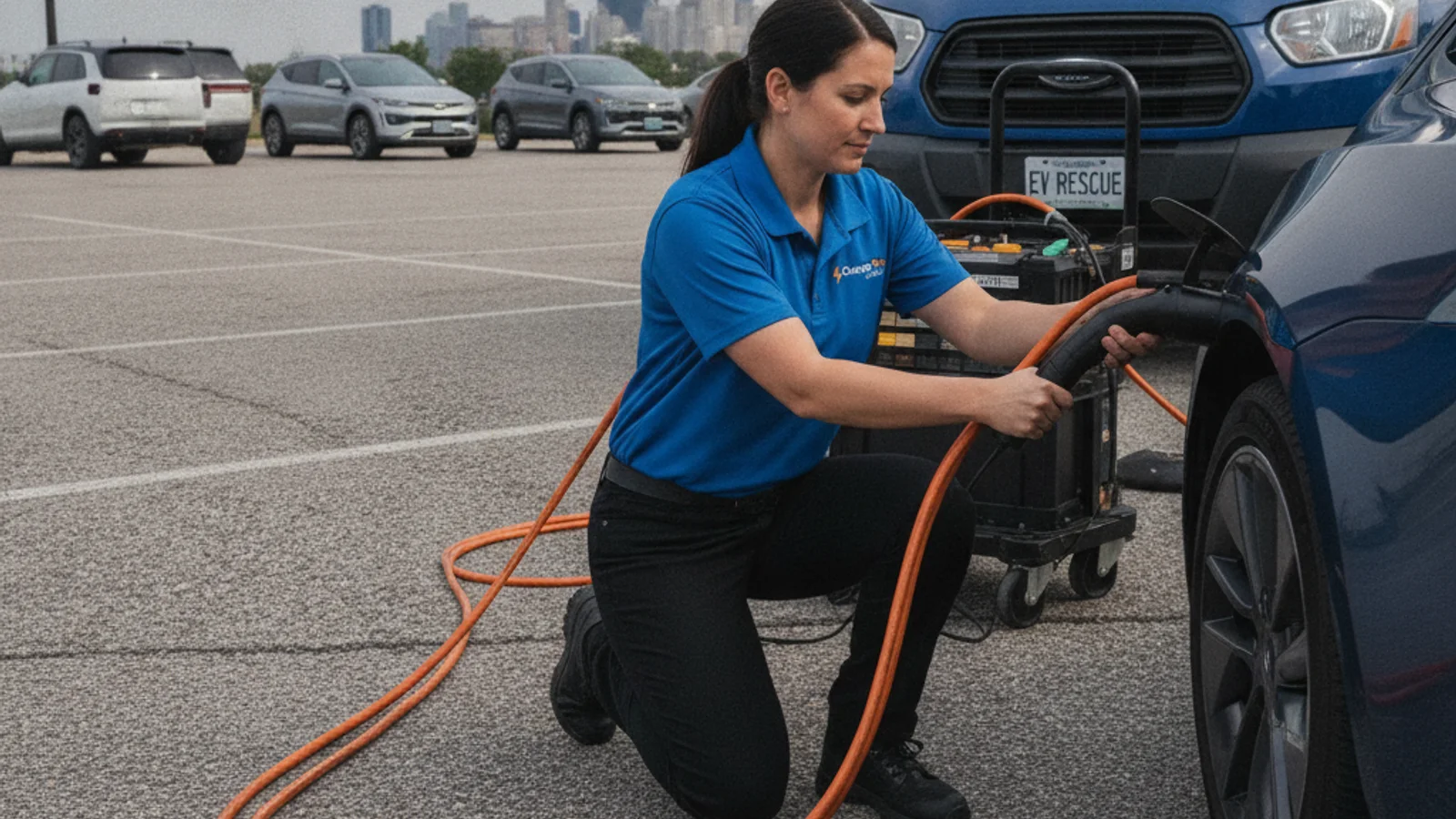
The stall that needs a truck is usually simpler. The 12-volt won’t wake the car. Or the traction pack is empty, and you can’t roll to a plug. Charge Pro CHI doesn’t do the fluid and filter work in this guide. We’re a referral line. We match you with independent local operators. Those operators bring a 240-volt Level 2 source to the car. They use a native NACS plug, or a CCS or J1772 adapter for non-Tesla EVs. They typically add 10 to 20 miles of range in 15 to 30 minutes of charging. That’s charging time, never an arrival time. They can also jump or replace a dead 12-volt on site. They handle Tesla and every major EV brand. The operator quotes you before starting, and bills you directly.
If you’re already stuck, EV roadside assistance is the path. A missed 8,000-mile sticker isn’t. Open the Chicagoland EV charging hub for the city map.
If the dash is dark, or the pack is empty, you’re past the checklist. Call (858) 925-5546. We’ll connect you with a local operator who quotes before any work starts.