A Hyundai Ioniq 5 charging time in this climate is two clocks. A Long Range pack on Level 2 still takes roughly 6 to 7 hours. A Standard Range pack is closer to 5 to 6. Hyundai lists 10 to 80 percent at around 18 minutes on a capable DC charger. That figure assumes a warm pack. Cabin heat and a cold battery are what change it here. That holds across Cook, Lake, DuPage, Kane, Will, and McHenry counties.
Home charging stays on a familiar clock
Most Ioniq 5 owners here plug in overnight and leave it. You come home. You connect the cable. You unplug in the morning. That rhythm works in Chicago and it works in Naperville. A Level 2 wall box delivers a fixed output. The car’s 800-volt architecture doesn’t speed that box up.
Start from a higher state of charge and the session is shorter. Start from empty and you’re in that 5 to 7 hour window. Overnight covers a normal commute without extra planning. That’s the boring, useful answer for daily driving.
Level 1 is a regular 120-volt household outlet. It’ll add charge. It’s not a daily plan. A full fill from empty can run past a day. Keep it as a backup when the wall box is down.
What the 800-volt pack actually buys you
Most mainstream EVs use a 400-volt battery system. The Ioniq 5 is built on 800 volts. Higher voltage lets the car take more power at a compatible DC station. The cables and the pack stay within temperature limits while that power flows. That’s the reason the fast-charge specs stand out.
It doesn’t help at home. A wall box can’t feed the car the way a high-power DC stall can. So home time looks like other EVs with a similar pack. The advantage only shows at a station that can actually match the car. In winter, even that wait starts with cell temperature, not voltage.
Pack size still sets the Level 2 clock. See the Ioniq 5 battery size guide for both packs in this climate.
Cabin heat and a cold pack on a local day
Winter here puts two loads on the same battery. Heating the cabin spends range on the drive. Warming the cells so they’ll accept a fast charge spends energy at the stall. You notice the first as miles that vanished. You notice the second as a DC session that won’t ramp.
Preconditioning before a planned fast-charge stop helps when the car still has charge to spare. You can’t precondition a pack that’s already empty. That’s the stall after a long dwell in a Schaumburg office lot. It’s the same problem on a cold street in Evanston. The car isn’t broken. The cells are cold, and there’s no spare energy left to warm them.
Leave cabin heat on and some incoming energy never becomes range. Turn it down if you can sit it out. If you can’t, budget a longer stop. Nobody can give you a single extra-minute figure for every January morning. Watch the live kilowatts on the screen instead.
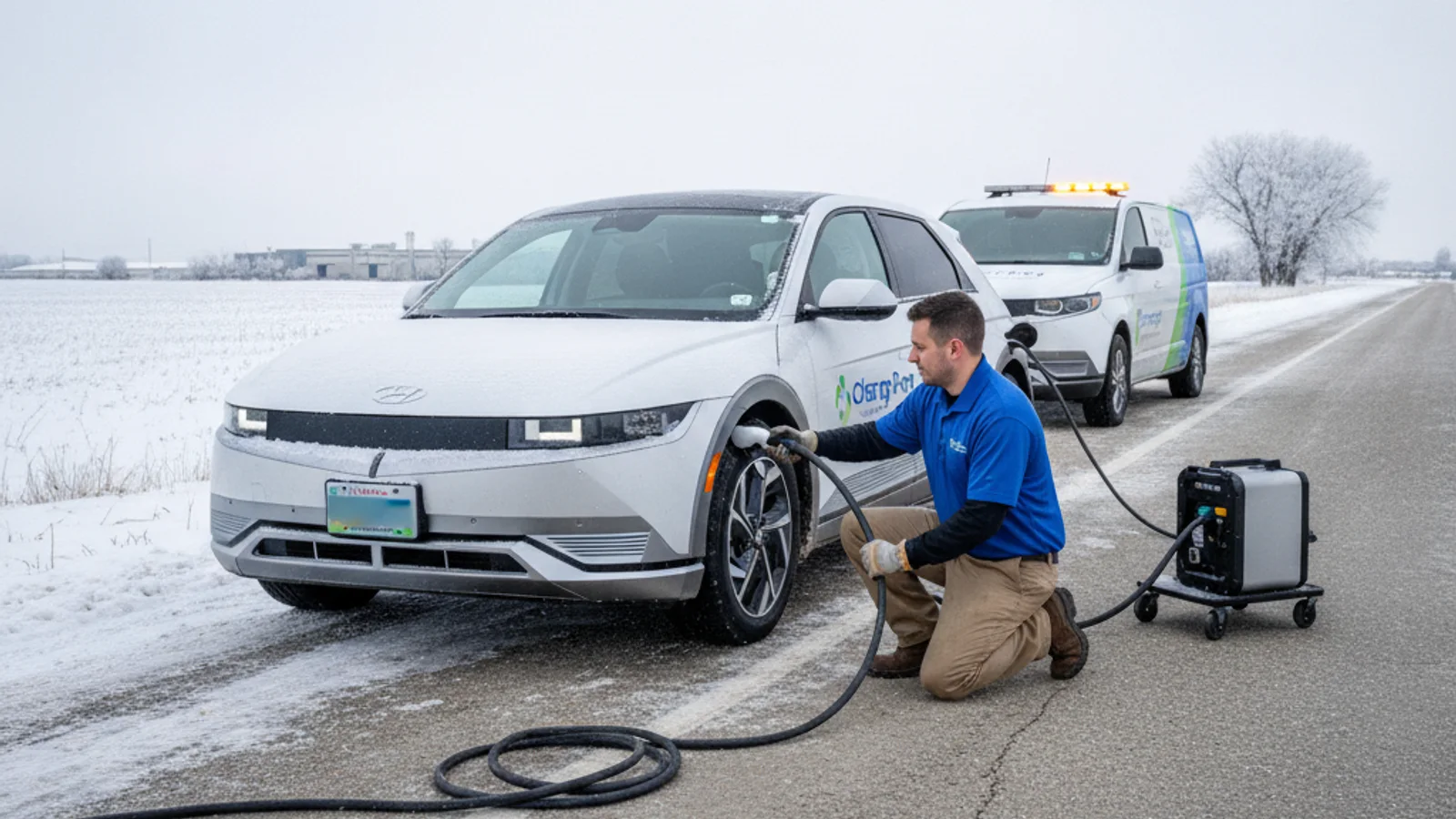
A mobile operator doesn’t skip this physics. The pros we connect you with bring a 240-volt Level 2 source to the car. CCS or J1772 adapters cover a non-Tesla like the Ioniq 5. Typical charging time is 15 to 30 minutes. That usually adds about 10 to 20 miles of range. That’s charging time, never an arrival time. In the cold, cabin heat still spends some of what the truck just added.
Older housing and the overnight plug
Level 2 needs a dedicated 240-volt circuit. That’s a home project, not a car setting. Talk with a licensed electrician about the panel before you assume there’s room.
Housing age is the local split. In Chicago, 68.6% of housing predates 1980. Oak Park is 78.6%. Cicero is 90.2%. Berwyn is 90.0%. Evanston is 71.2%. Skokie is 72.0%. Older houses often mean a longer electrical conversation. That’s not a verdict on any one block. It’s why a wall box is separate from buying the car.
Newer suburbs tell a different story. Naperville is 11.7% pre-1980. Gurnee is 9.5%. Plainfield is 6.7%. Huntley is 3.8%. Bolingbrook is 12.3%. Orland Park is 11.8%. Newer construction doesn’t mean a charger is already in the garage. It often means the panel talk is simpler.
If the house can’t take a wall box yet, the car can still move. A Level 2 boost on the street still gets the car moving. Use that when the garage circuit isn’t ready. Don’t treat a public DC stall as your nightly fill. The last 20 percent is the slow part on almost every EV. Overnight Level 2 is how you finish.
What stretches a DC stop once the pack is cold
Battery temperature is the first brake. A cold pack accepts power slowly until it warms. Hyundai’s 18-minute figure assumes a mild starting temperature. It also assumes the charger is delivering its full rated power. A January session after the car sat outside will run longer. How much longer depends on the pack, the stall, and the soak time.
Station output is the second brake. A charger listed as high-power doesn’t always deliver high power. Shared cabinets, older hardware, and a busy stall all cap a session. The car can only take what the station actually sends.
Starting state of charge is the third. Plug in at 60 percent and the number climbs. You still add less total range. Plug in near empty and the car wants to ramp. It can only do that if the cells are warm enough.
Connector type is the fourth. The Ioniq 5 uses a CCS port. Adapters exist for NACS-standard chargers. Adapter support and speed vary by model year. Confirm what your year supports before you count on a specific stall.
The charge curve isn’t a winter problem. It’s how these packs work. Power peaks in the middle of the session. It tapers as you approach full. That’s why most highway stops target 80 percent. The 80 to 100 stretch can cost as much clock as the climb to 80.
When the cable never starts a session
A cable that never starts a session is a different problem. A frozen or stuck charge port is a known Ioniq 5 issue in cold weather. See the stuck Ioniq 5 charge port guide if the cable won’t release.
If the car won’t accept a charge, check the 12-volt battery next. The high-voltage pack can still have range while the 12-volt is dead. Walk through the Ioniq 5 no-start checks before you assume the pack is empty.
Empty pack, cold street, no wall to use
If you’re out of range, this is a different call. Charge Pro CHI is a referral line. We match stranded EV drivers with independent local operators. We don’t perform the work. We don’t own trucks. We don’t set prices. The operator quotes you before starting and bills you directly.
That network covers Chicagoland, including Chicago and the collar counties. Operators handle Tesla and every major EV brand, including the Ioniq 5. If you need a charge brought to the car, call (858) 925-5546. We’ll connect you with a local operator.
For what a truck actually carries, see how a mobile EV charging truck works.
Frequently asked questions
How long does a Hyundai Ioniq 5 take on a home charger in winter?
On Level 2, a full charge is still roughly 5 to 6 hours for Standard Range. Long Range is roughly 6 to 7 hours. Cabin heat doesn’t change how fast the wall box feeds the car. A cold garage can add a little time while the pack warms. Level 1 from a regular outlet can still run past a day.
Why is DC charging slower here than the 18-minute spec?
Hyundai’s figure assumes a warm pack and a charger at full rated power. A cold pack after a night outside accepts energy slowly. Cabin heat while you wait uses some of what you just added. Real stations also often deliver less than their listed output.
Does the 800-volt system help on a home charger?
No. The 800-volt architecture only speeds a compatible DC fast charger. A 240-volt home charger delivers a fixed output. Winter doesn’t change that split. It only makes the DC side wait on pack temperature.